Cash vs Financing Solar in San Diego: What Each Really Costs
Cash vs Financing Solar in San Diego: What Each Really Costs
Paying cash is the lowest-cost way to own a solar system, because you never pay interest. Financing, leasing and prepaying a lease change how much you put down, who owns the panels and who carries the risk, and the right pick depends on your SDG&E bill, your roof and how long you plan to stay. For a San Diego homeowner the choice also has a second layer since the federal homeowner credit ended. Whatever you pick, the system design (panels, battery and how you use the power) decides most of your savings.
We have installed solar for San Diego County homeowners since 1996, and the same question comes up in nearly every consultation. Here is how the options compare.
TL;DR
- Cash is the cheapest route in total dollars. NREL’s research finds that, with no financing costs, a cash purchase is likely the lowest total-cost way to buy a PV system.
- Loans let you own the system and spread payments. The CFPB reports typical terms of 8 to 25 years, and fees can raise what you really pay.
- Leases and PPAs put a company on the title, with payments that often escalate every year. Check the escalator and the sale terms before you sign.
- The federal 30% homeowner credit (25D) does not apply to expenditures made after December 31, 2025, so compare quotes on price, not on a credit you cannot claim.
- In SDG&E territory, a battery matters as much as the payment method, because exports earn low midday credits under net billing.
Table of Contents
- The four ways to pay for solar
- Paying cash: lowest cost, biggest check
- Solar loans: own it without writing one big check
- Leases and PPAs: someone else owns the roof equipment
- What happened to the federal tax credit
- Why SDG&E rates change the math
- A worked example: how the choice plays out
- What happens when you sell
- Perspective
- Get a number you can compare
- FAQ
- Sources
The four ways to pay for solar
A home solar system comes down to four arrangements. The CFPB’s 2024 Issue Spotlight puts the average residential installation at about $25,000, and in 2023 cash made up 19% of the at-home residential market, loans 58% and third-party ownership 23%.
| Cash | Loan | Lease | PPA | |
|---|---|---|---|---|
| Who owns the panels | You | You | The company | The company |
| Upfront cost | Full price | Often little or none | Typically none | Typically none |
| What you pay over time | Nothing further | Principal plus interest and any fees | Fixed monthly payment, often escalating | Per-kWh rate, fixed or escalating |
| Repairs and upkeep | You | You | Usually the owner | Usually the owner |
| Typical term | None | 8 to 25 years | 15 to 20 years | 6 to 25 years |
The terms in the last row come from the CFPB’s report. A prepaid lease, which we offer, sits between cash and a standard lease: you pay for the lease term up front instead of monthly. We cover it below.
Paying cash: lowest cost, biggest check
The argument for cash is arithmetic. NREL’s study calls it likely the lowest total-cost means of buying a PV system, because you pay no financing costs. The CESA homeowner’s guide agrees that a direct purchase is typically the least expensive option in total dollars.
The same NREL study lists the trade-offs: you lay out the whole price at once, and you take on future maintenance and inverter replacement. The cash is also money you could have used elsewhere.
For a San Diego roof, the published price of our residential solar systems runs from $24,500 to $70,000, depending on roof, energy use and goals. Adding a battery is $12,000 to $16,000 for battery storage. Each system is designed by our in-house engineering team around your roof and your usage, so the price reflects your house rather than a template.
Cash tends to suit you if:
- You have the money available without draining your emergency fund.
- You plan to stay in the house for many years.
- You want no loan paperwork, no lien on the property and no sale complications later.
What cash buys you after the install
Owning means the system is yours. Panels carry manufacturer warranties, and ours go up to 25 years. The CESA guide notes panel warranties of 20 to 25 years against 5 to 10 years for inverters. That gap is why a service relationship matters. Our repair and maintenance team publishes its pricing: diagnostic visits are $150 to $250, inverter replacements are $1,500 to $3,500 and individual panel replacements are $300 to $800.
Solar loans: own it without writing one big check
A loan gives you ownership right away and spreads the cost. According to the CFPB, solar loans typically run 8 to 25 years with APRs of 1% to 7%, and those APRs often leave out fees that can inflate the principal. A low advertised rate with a large fee can cost more than a higher rate without one.
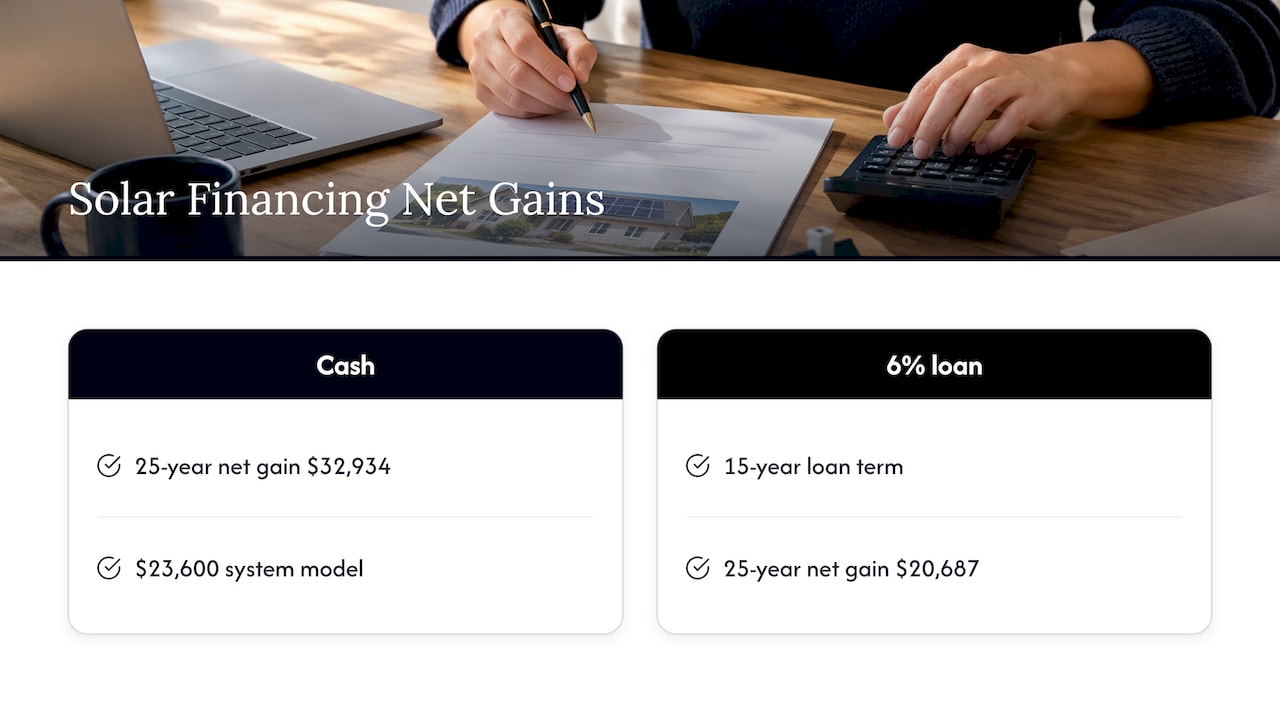
A simple way to compare offers is to add up everything you will pay over the loan, then subtract it from the savings you expect. A model of a $23,600 system by SolarRoost shows how wide the spread can be: with cash the net gain over 25 years is $32,934, while a 6%, 15-year loan nets $20,687. The figures rest on that model’s assumptions, but the pattern is the point: the longer the term and the higher the fees, the more of your savings go to the lender.
If you are weighing a loan, the general questions are the same as for any home project. This overview of home-improvement financing covers how payments, approvals and contract terms work, and the same logic applies to solar.
Leases and PPAs: someone else owns the roof equipment
With a lease or PPA you usually pay little or nothing down and the third-party owner handles maintenance, monitoring and insurance, according to CESA. The trade-off is that the owner, not you, keeps the tax benefits, as NYSERDA’s guide explains.
The escalator is where the cost hides
The CPUC’s California Solar Consumer Protection Guide says lease and PPA payments typically rise 1% to 3% a year, and that the increases compound. Its example: a 12¢/kWh PPA with a 3% escalator reaches 18.2¢/kWh by year 15, against 13.8¢ at 1%. Ask for the total cost over the whole contract, not the first-year payment.
Prepaid leases
Our prepaid lease program is built to cut upfront costs by 30% to 40%. Because you pay for the term at the start, there is no monthly payment to escalate. We handle the permitting, SDG&E interconnection and HOA approvals, and get the written timeline to you before you commit.
What happened to the federal tax credit
This is the biggest change from what older articles say. According to the IRS, the 25D residential clean energy credit is not allowed for expenditures made after December 31, 2025, and an expenditure counts as made when installation is completed. So a system finished in 2026 or later does not earn the homeowner credit. Any unused credit from a 2025 system can carry forward.
What this means when you compare quotes:
- A cash or loan quote should be judged on its price alone, with no credit subtracted.
- If a lease or PPA quote claims a lower price because the owner takes a credit, ask which credit, how much of it is in the price and what happens to the price if that credit is not available. Get the answer in writing.
- Our California solar incentives guide and the expiring incentives guide track what remains at the state level.
Why SDG&E rates change the math
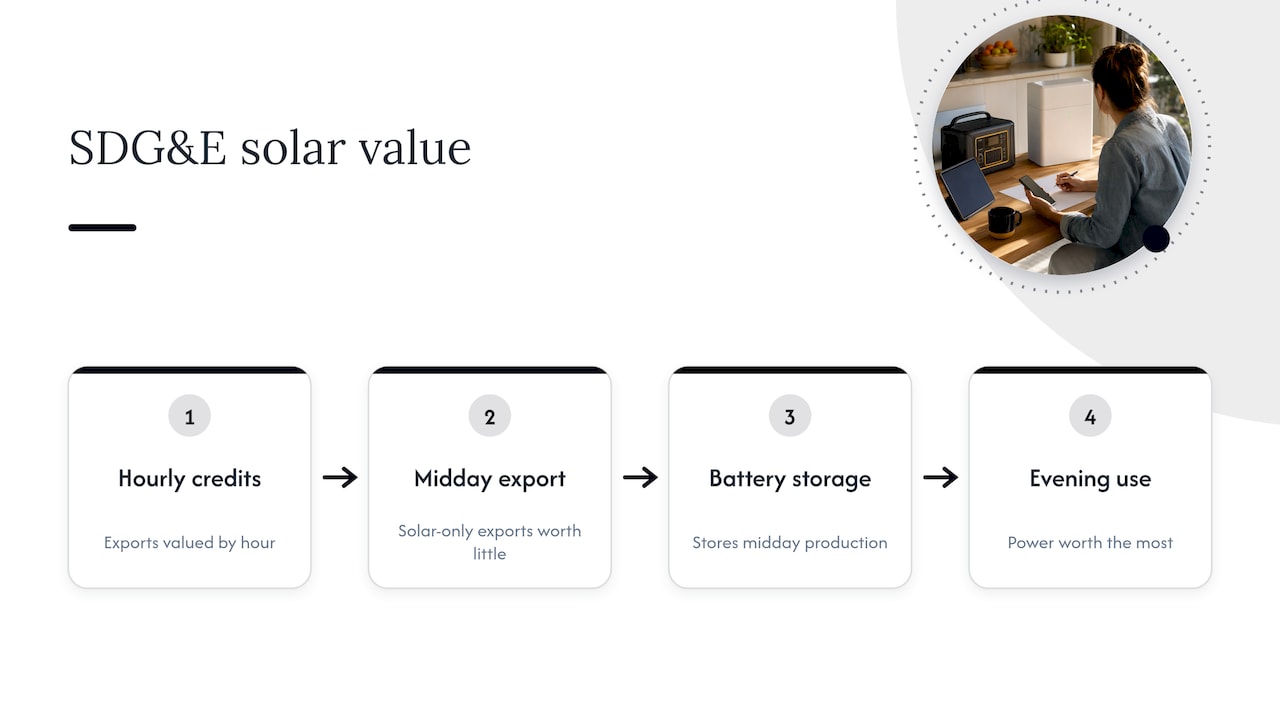
Since April 15, 2023, new rooftop customers of SDG&E are on the Net Billing Tariff, also called the Solar Billing Plan, which credits exports at hourly values, as US Net Metering summarizes. Midday exports from a solar-only system are worth little, and evening power is worth the most. For a household paying $200 or more a month, that has a plain consequence: using your own solar power in the evening is worth more than sending it to the grid.
This is why we specialize in NEM 3.0 solar-plus-battery design. A battery stores midday production for the evening peak and gives you backup during outages. If you drive an EV, charging at home from your own power fits the same logic. The payment method then matters in a specific way: a system with a battery costs more upfront, and the choice between cash, a loan or a prepaid lease decides how you cover that bigger first number.
We state payback as our own experience of typical San Diego projects: most homeowners see full payback in 5 to 7 years, with electric bill reductions of 80% to 92%. Your own bills and roof set your number, which is why we start with your usage.
A worked example: how the choice plays out
Take a homeowner with a $250 monthly SDG&E bill, who gets a quote near the CFPB’s $25,000 average.
- Cash. The full amount is paid at install. After that, the only costs are maintenance and an eventual inverter replacement. No interest is ever added.
- Loan. Payments begin shortly after install. Over a longer term, the total paid is higher than the price, so ask for the full repayment figure and any fee included in the principal.
- Lease or PPA. The first-year payment is usually below your old bill, but a 3% escalator compounds for the whole contract.
- Prepaid lease. You pay for the term up front at a lower cost than purchase, with no monthly payment.
Line up the totals from each quote against your last twelve months of SDG&E bills. That is a better test than the headline monthly payment.
What happens when you sell
It is a common worry, and the answers differ by option.
- Owned system, cash or loan: The panels sell with the house. With a loan, the payoff usually comes from the sale proceeds, and the lender’s lien filing may need to be cleared before closing, according to the Illinois Shines Homeowner Handbook.
- Lease or PPA: The CPUC guide says you either pay the remainder of the contract value or transfer it to the buyer, and that a buyout can cost thousands of dollars.
Owning the system outright keeps a sale simple, which is part of why cash and prepaid arrangements appeal to people who may move.
Perspective
We have been installing solar in San Diego since 1996, and we have watched incentives, rate rules and financing products change several times. What has not changed is that the cheapest monthly payment is rarely the best deal.
Our view is that you should decide in this order. First, size and design the system for your roof and your SDG&E usage, with a battery where it makes sense under net billing. Second, get the all-in price. Third, choose how to pay for it.
We build every system with our own crews, with no subcontractors, so the person who designs your system is accountable for how it is installed and serviced. That matters more when you own the equipment, because you want one company that will still answer the phone in year 15. It also holds when you add a new roof: solar and roofing from one crew means one warranty and no finger-pointing.
If you have the cash, owning outright is the cleanest path. If you want to keep cash free, our prepaid lease program is designed to cut upfront costs by 30% to 40%. Either way, we put the price and a written project timeline in front of you before you commit.
Curtis Williamson
Get a number you can compare
If you have had quotes before and not moved forward, bring them. Free consultations from San Diego Solar start with your bills, your roof and your goals, and end with transparent pricing and a written timeline. Whether you choose cash or our prepaid lease, we handle permitting, SDG&E interconnection and HOA approvals, and systems can be installed in as little as one day. See our residential solar page to start.
FAQ
Is it better to pay cash or finance solar?
Cash costs the least overall because there is no interest or fee. NREL also notes that even those with cash may prefer to keep it invested elsewhere. If paying cash would leave you thin, a prepaid lease or a lower-upfront option is worth pricing.
Can I still get the 30% federal tax credit for solar?
Not as a homeowner buying in 2026 or later. The IRS says the 25D credit does not apply to expenditures made after December 31, 2025. If you installed in 2025, unused credit can carry forward, and a tax professional can confirm your case.
Is it hard to sell a house with a solar loan?
It is manageable. The panels convey with the house, and the loan is typically paid off from the sale proceeds, per the Illinois Shines handbook. Your lender and title company will confirm whether a lien filing must be cleared before closing.
Does solar still make sense in San Diego without net metering?
Yes, when the system is designed for self-consumption. Under net billing, exports earn hourly credits, so pairing panels with a battery lets you use your own power in the evening. We size each system around your usage to do this.
Sources
- CFPB, Issue Spotlight: Solar Financing
- NREL, Residential Solar Photovoltaics: Comparison of Financing
- CESA, Homeowner’s Guide to Solar Financing
- CPUC, California Solar Consumer Protection Guide 2021
- CPUC, Solar Consumer Protection Guide 2021 (English edition)
- NYSERDA, Homeowner’s Guide to Solar Leases, Loans, and PPAs
- IRS, FAQs on OBBB changes to 25D and related credits
- Illinois Shines, Homeowner Handbook on selling your home
- US Net Metering, California net billing
- SolarRoost, Solar Loan vs Cash
- Home-improvement financing options overview