Decode Confusing Solar Proposals Before You Sign
Decode Confusing Solar Proposals Before You Sign
Two numbers on any solar proposal tell you almost everything you need to know: the Year 1 production estimate in kWh/year and the itemized scope of work. If either one is missing, vague, or buried in a glossy PDF full of stock photos, stop and ask for it before you compare pricing at all. Everything else, financing terms, equipment brands, even the total price, only makes sense once you know how much power the system will actually produce and exactly who is responsible for what.
Here’s what to do in the next 24 to 48 hours if a proposal (or three) is sitting in your inbox and none of them look alike:
- Pull your last 12 months of utility bills so you have a real usage baseline to check any production claim against.
- Ask each installer for the Year 1 kWh estimate and the specific modeling tool used to generate it, whether that’s PVsyst, HelioScope, or PVWatts.
- Request an itemized cost breakdown rather than a single bottom-line number.
Before doing anything else, check these five values on every proposal you receive:
- Year 1 production estimate (kWh/year)
- System size in kW DC
- Total cost before any incentives
- Cost per watt ($/W)
- Scope of work responsibilities, spelled out by task
If a proposal can’t answer all five clearly, it’s not ready to compare. Send it back with questions before you waste time weighing it against anything else.
Key Takeaways
The single most reliable way to decode a confusing solar proposal is to anchor every comparison to Year 1 production in kWh, a fully itemized scope of work, and a normalized cost per watt.
| Point | Details |
|---|---|
| Anchor on Year 1 kWh | Compare the modeled first-year production against your actual last 12 months of utility usage. |
| Demand an itemized SOW | Permitting, interconnection, roof work, and cleanup should each name a responsible party in writing. |
| Normalize with three calculations | Compute $/W, production ratio (kWh ÷ kW), and cost per first-year kWh on every quote. |
| Get three comparable quotes | Use the same 12-item checklist with each installer to force an apples-to-apples comparison. |
| Verify credentials before signing | Confirm NABCEP certification, state license, references, and an installed portfolio. |
| San Diego Solar offers a free review | Its in-house team will decode existing proposals or build a site-specific one with a production guarantee and workmanship warranty. |
Table of Contents
- How to Decode Confusing Solar Proposals Section by Section
- How to Compare the Numbers That Actually Matter
- Costs, Incentives, and Financing: What to Expect
- Scope of Work and Contract Terms to Watch For
- Reading Equipment Lists and Warranty Fine Print
- Why Year 1 Production Is the Metric Worth Fighting For
- Common Red Flags and Exact Questions to Ask Installers
- The One-Page Checklist for Comparable Proposals
- How We Evaluate a Solar Proposal Before Recommending Anything
- Let San Diego Solar Review Your Proposals for You
- Frequently Asked Questions
- Sources
How to Decode Confusing Solar Proposals Section by Section
A solar proposal isn’t one document. It’s usually eight or nine distinct sections stitched together, and most of the confusion homeowners feel comes from not knowing which section holds the number they actually need. Once you know what each part is supposed to say, the whole packet stops feeling like a sales brochure and starts reading like a spec sheet.
- Executive summary: A one-page overview of the recommended system, expected savings, and total investment. Useful for a quick glance, but never the section to base a decision on.
- Equipment list: Manufacturer names, model numbers, panel wattage, inverter type, and (if applicable) battery model. This is where you confirm whether the proposal names real hardware like Tesla Powerwall or Enphase IQ, or just says “premium battery system.”
- System design and layout: A roof diagram showing panel placement, orientation, and tilt. Look for per-roof-plane detail, not a single box labeled “24 panels.”
- Year 1 production estimate and assumptions: The projected kWh for the first year, along with the modeling inputs (shading, tilt, azimuth, degradation) behind it.
- Itemized cost breakdown: Equipment, labor, permitting, and any adders, broken out rather than lumped into one price.
- Warranties: Product, performance, and workmanship warranty terms, each stated separately.
- Scope of work: Who handles permitting, interconnection with your utility, roof penetrations, and cleanup.
- Timeline and milestones: Expected dates for permitting approval, installation, inspection, and utility sign-off.
- Financing terms and signature page: Payment structure, deposit amount, and the legal terms you’re agreeing to.
When you’re comparing multiple bids, four line items matter more than the rest: system size in kW DC, Year 1 kWh, cost before incentives, and the modeling tool behind the production number. Companies that build proposals around modeling software such as PVsyst or HelioScope, the same tools San Diego Solar uses to generate itemized, site-specific proposals, are giving you something you can actually verify. A proposal built on regional averages instead of your specific roof is guesswork dressed up as engineering.
How to Compare the Numbers That Actually Matter
Every solar proposal eventually gets reduced to a single question: how much energy will this system make, and what will it cost to get there? The trick is normalizing the numbers so a 14-panel system from one company can be compared honestly against a 22-panel system from another.
Start with production. Your Year 1 production estimate is the most reliable figure for judging whether a system will meet your needs, and it should be checked against your actual usage from the past 12 months, not against a national average. Pair that number with system size in kW DC to get what’s called the production ratio, or specific yield: divide Year 1 kWh by system size in kW. A 6 kW system producing 9,600 kWh in Year 1 has a production ratio of about 1,600 kWh/kW. In most of Southern California, a ratio between 1,400 and 1,700 kWh/kW is realistic for a well-sited system with minimal shading. Anything meaningfully above that range on a proposal deserves a follow-up question, not blind trust.
Here’s the calculation sequence to run on every quote you receive:
- Confirm the system size is stated in DC watts, not AC, since mixing the two skews every comparison that follows.
- Calculate cost per watt: total system price divided by system size in watts. A $24,000 system at 6,000 watts comes out to $4.00/W.
- Calculate the production ratio: Year 1 kWh divided by system size in kW.
- Calculate cost per first-year kWh: total price divided by Year 1 kWh. This tells you what you’re paying for every unit of energy the system is projected to produce in its first year.
Two proposals with the same $/W can still be very different deals if their production ratios don’t match. A cheaper $/W paired with a suspiciously high production ratio usually means the Year 1 number is inflated, not that you found a bargain.
Pro Tip: Always ask which software generated the production number. If an installer can’t name PVsyst, HelioScope, or PVWatts, or won’t share the underlying report, that number is likely a rough estimate dressed up as a guarantee.
Costs, Incentives, and Financing: What to Expect
Every proposal should show a gross cost before incentives, then a net cost after the federal solar tax credit is applied. The gross number matters even if you plan to claim the credit, because it’s the figure that reveals dealer fees, markups, and financing costs before any subsidy softens the blow. If a proposal only shows you the “after incentive” price, ask for the number before it.
Financing structure changes what you should be asking for:
- Cash purchase: Confirm the itemized price matches the equipment and labor listed, with no unexplained adders.
- Solar loan: Ask for the APR, loan term, and any dealer fee baked into the principal, since a “0% loan” often has a dealer fee rolled into the equipment cost instead.
- Lease or power purchase agreement (PPA): Ask for the annual rate escalator, contract length, and what happens if you sell your home before the term ends.
Two quotes with an identical $180 monthly payment can represent very different total costs once you factor in loan term length, dealer fees, and escalator clauses on a lease. A 25-year loan at a higher dealer fee can cost thousands more over its life than a 15-year loan with a smaller monthly bump, even if the sticker payment looks the same today. That’s exactly why comparing solar quotes has to go beyond the monthly number.
Salespeople sometimes lead with the payment because it’s the easiest figure to make attractive. Push back by asking for both the cash price and the total amount financed, including all fees, before you agree to anything. Industry guidance on transaction disclosures exists precisely because price and cost-per-watt transparency protect buyers from exactly this kind of framing.
Scope of Work and Contract Terms to Watch For
The scope of work is the least glamorous part of a proposal and the one most likely to cost you money later if it’s vague. It should spell out, in writing, who handles permitting, who manages utility interconnection, who’s responsible for electrical panel upgrades if your service needs one, who handles roof penetrations and flashing, who does site cleanup, and who schedules inspections.
- Permitting and city/county approval, including who submits and tracks the application.
- Utility interconnection paperwork with SDG&E or your local provider.
- Any electrical panel upgrade required to support the new system.
- Roof attachment method, flashing, and waterproofing responsibility.
- Site cleanup and debris removal after installation.
- Final inspection scheduling and who’s present for it.
Beyond the SOW itself, a handful of contract clauses deserve a close read: the payment schedule and deposit amount, dispute resolution or arbitration language, any production guarantee and what remedy it actually provides if the system underperforms, the workmanship warranty length, whether warranties transfer if you sell the home, and termination or cancellation penalties.
The scope of work is the contract’s most critical section. Vague or missing SOW language is one of the leading causes of change orders and inflated final costs, because it leaves room for the installer to define “included” however benefits them once work has started.
Watch for red-flag language too: scopes that say “standard installation” without defining what that includes, pricing that’s only valid “if signed today,” and financing paperwork that references a dealer fee without stating the amount. Also confirm the legal entity named on the contract matches the company whose reviews and license you actually checked. A scope of work that reads clearly on page one and gets fuzzy by page four is telling you something.
Reading Equipment Lists and Warranty Fine Print
An equipment list that just says “high-efficiency panels” and “smart inverter” isn’t a spec sheet, it’s marketing copy. A proposal worth comparing names the manufacturer, model number, panel wattage, inverter type and model, mounting method, and the monitoring platform you’ll use to track production once the system is live.
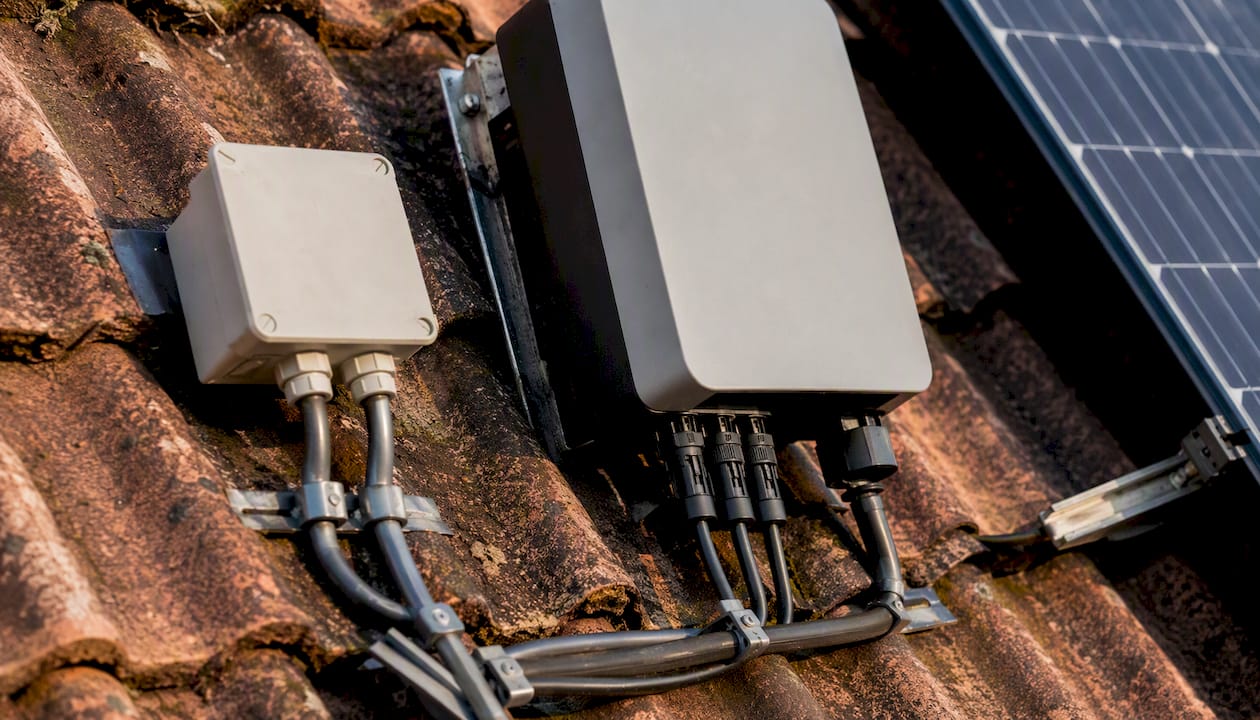
Warranties deserve the same scrutiny. Four fields matter: product warranty length (covers manufacturing defects), workmanship warranty from the installer (covers installation errors, leaks, and mounting issues), any production or performance guarantee, and whether warranties transfer to a new owner if you sell your house.
| Warranty type | Minimum to expect | What it actually covers |
|---|---|---|
| Panel product warranty | 12 to 25 years | Manufacturing defects in the panel itself |
| Inverter warranty | 10 to 25 years, depending on type | Inverter failure or performance degradation |
| Workmanship warranty | 10 to 25 years | Leaks, mounting failures, wiring errors from installation |
| Production guarantee | Stated remedy, not just a promise | Compensation if actual output falls below modeled estimate |
If a battery is part of the proposal, don’t stop at nameplate capacity. Compare usable kWh (the portion of the battery you can actually draw from), continuous output in kW (whether it can power your air conditioner and refrigerator at the same time during an outage), and the warranty’s guaranteed usable capacity at the end of its term. Battery storage should always be compared on usable kWh, not the marketing number printed on the box. Whether the proposal specs a Tesla Powerwall, an Enphase IQ battery, or something else, ask the installer to translate nameplate capacity into usable kWh and confirm continuous output matches what you actually need to back up.
Why Year 1 Production Is the Metric Worth Fighting For
Every glossy proposal wants to sell you on 25-year savings projections or a percent offset claim. Ignore both. A 25-year number depends on utility rate increases nobody can predict, and a percent offset can be manipulated just by changing the usage baseline it’s measured against. Year 1 production in kWh is the only number grounded in a specific, verifiable model of your roof, your location, and your equipment right now.
Here’s the request template to send any installer whose Year 1 number seems generous: ask for the full production model export, whether that’s a PVsyst report, a HelioScope layout export, or the PVWatts assumptions sheet if that’s what they used. Specifically request the solar access percentage, tilt and azimuth for each roof plane, the soiling loss assumption, and the degradation rate applied over time. A credible report answers all of that. A company that can’t produce it probably built the estimate off a rule of thumb instead of your actual roof.
A production model built on real site data typically includes these components:
- Per-roof-plane output, not a single combined number for the whole system.
- Monthly production breakdown showing seasonal variation.
- A shade report referencing Solar Access, Time of Frost (or shading percentage), and Total Solar Resource Fraction.
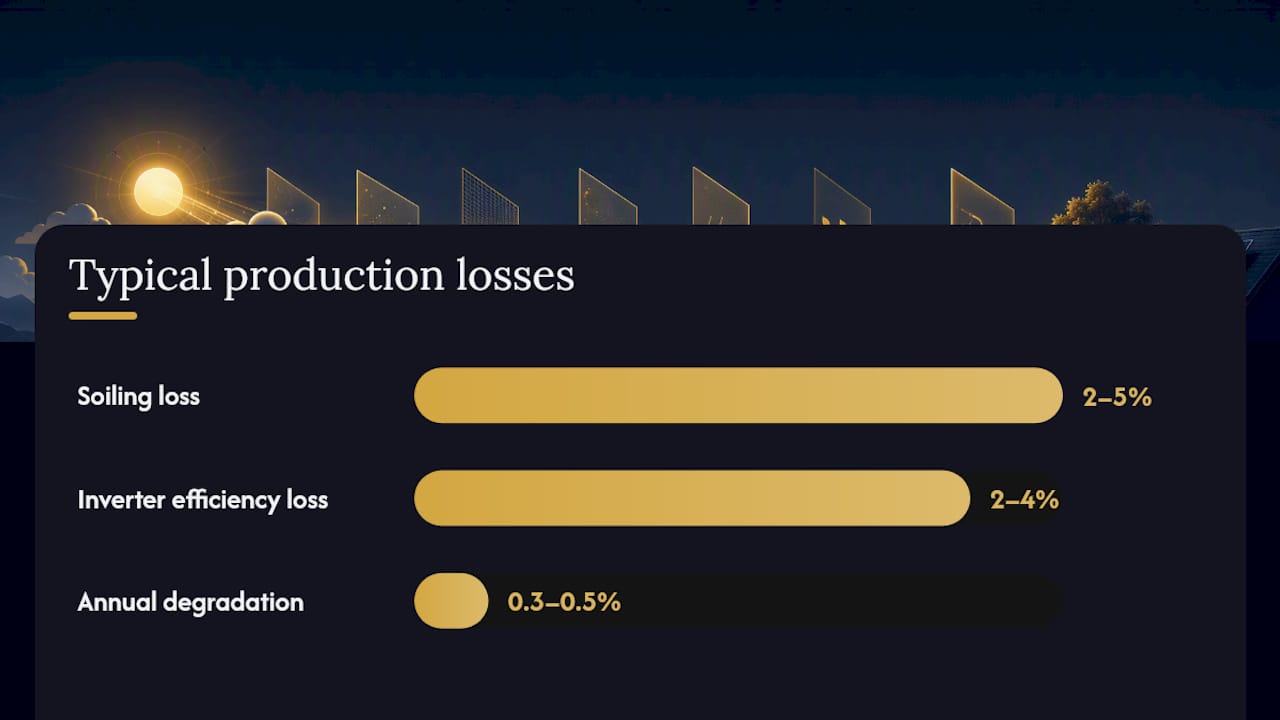
- A stated panel degradation rate, usually between 0.3% and 0.5% per year.
| Assumption | Typical range in a credible report | Why it matters |
|---|---|---|
| Soiling loss | 2% to 5% annually | Dust and debris reduce output between cleanings |
| Shading loss | Varies by site, stated per roof plane | Trees, chimneys, and neighboring structures cut production |
| Annual degradation | 0.3% to 0.5% per year | Panels lose a small amount of output each year over their lifespan |
| Inverter efficiency loss | 2% to 4% | Energy lost converting DC to usable AC power |
NREL’s technical guidance on PV modeling backs up why these assumptions matter more than the final kWh figure itself. Two systems with identical panel counts can post very different Year 1 numbers depending on which shading and soiling assumptions the installer plugged in. Once you have the report, run one more check: compare the modeled Year 1 kWh against your last 12 months of actual utility usage to confirm the system is sized to your real consumption, not a generic household average.
Common Red Flags and Exact Questions to Ask Installers
Certain warning signs show up again and again in confusing proposals, and most of them are easy to spot once you know to look:
- Equipment listed by category only (“400W panels”) with no manufacturer or model number.
- A production estimate with no supporting report, model, or assumptions attached.
- A scope of work that isn’t written down anywhere in the contract.
- Pricing that expires “today only” or requires an on-the-spot signature.
- No workmanship warranty mentioned separately from the panel manufacturer’s warranty.
- A monthly loan payment presented without the cash price or total financed amount.
If you’re on a call with a sales rep, these questions cut through most of the noise fast:
- “What’s the Year 1 production estimate in kWh, and what tool generated it?”
- “Can you send me the full production report, not just the summary number?”
- “What’s the itemized cost for equipment versus labor versus permitting?”
- “What’s the cost per watt before any incentives are applied?”
- “Is there a production guarantee, and what happens if the system underperforms it?”
- “Who’s responsible for permitting and utility interconnection, in writing?”
- “What’s the workmanship warranty length, and does it transfer if I sell the house?”
- “What’s your typical timeline from signing to permission-to-operate?”
- “Are you using in-house crews or subcontractors for the installation?”
- “What’s the cash price if I don’t finance?”
A confident, well-run company answers all ten without hesitation. If you get vague answers, or a rep who redirects to the monthly payment every time you ask about total cost, that’s a signal worth escalating to a written request or simply moving on to another installer.
The One-Page Checklist for Comparable Proposals
Forcing every installer into the same format is the fastest way to make three confusing proposals actually comparable. Request these twelve items from each company before you make a decision:
- Last 12 months of your actual kWh usage (you provide this).
- Year 1 production estimate in kWh.
- System size in kW DC.
- Modeling tool and report used (PVsyst, HelioScope, or PVWatts).
- Itemized cost breakdown, not a single total.
- Cost per watt ($/W), before incentives.
- Panel and inverter manufacturer, model, and wattage.
- Warranty terms: product, workmanship, and performance.
- Written scope of work with named responsibilities.
- Project timeline with permitting and interconnection milestones.
- Full financing terms: APR, term, fees, and total financed amount.
- Installer credentials, including NABCEP certification and state license number.
A short email works fine as a request template: “Before I compare this proposal against others, can you send the Year 1 production report, an itemized cost breakdown, the written scope of work, and your NABCEP and state license numbers?” Any legitimate installer will have this material ready to go.
Once you have three completed checklists side by side, run the same three calculations on each: divide cost by watts for $/W, divide Year 1 kWh by system size for production ratio, and divide total price by Year 1 kWh for cost per first-year kWh. Line the three results up next to each other and the best value usually becomes obvious fast, regardless of which proposal had the flashiest cover page.
How We Evaluate a Solar Proposal Before Recommending Anything
The proposals that hold up under scrutiny share a pattern: they’re itemized rather than bundled, the production estimate comes with a real model behind it, the warranties are stated in specific years rather than vague marketing language, and the scope of work reads like a contract, not a brochure. Companies that use in-house crews instead of rotating subcontractors also tend to produce cleaner proposals, mostly because the same team that designs the system is accountable for installing it correctly.
Consider two proposals for the same roof: one quotes $19,500 with a system described only as “premium panels, smart inverter,” and the other quotes $23,000 with named equipment, a HelioScope-generated production report, a 25-year workmanship warranty, and a written SOW covering permitting and interconnection. The cheaper bid looks better until you can’t verify a single claim in it. The $3,500 gap often buys you a documented production model, accountable warranty terms, and a company that will still be around if something goes wrong in year eight. Low bids frequently conceal compressed warranties or lower-tier equipment that only becomes obvious after installation, when there’s nothing left to compare it against.
That’s the lens worth applying to every proposal: not “which number is lowest,” but “which company gave me enough to verify their claims.” In-house crews matter here because accountability doesn’t survive being passed between three subcontracted teams. A trustworthy installer makes their proposal easy to verify, not just easy to sign.
Let San Diego Solar Review Your Proposals for You
San Diego Solar is the alternative to spending a weekend cross-referencing spec sheets and financing fine print: bring us the proposals you already have, and our in-house engineering team will decode them line by line, free of charge.
We’ve been designing systems for San Diego County roofs since 1996, with zero subcontractors on any job in 30 years, so when we review a competing proposal we know exactly which numbers hold up and which ones don’t. If you request a proposal from us instead, you’ll get a site-specific HelioScope or PVsyst production report, not a regional estimate, along with an itemized cost breakdown, a written scope of work, and workmanship warranties that spell out exactly what’s covered. If battery backup is part of the plan, we install and stand behind Tesla Powerwall and Enphase IQ systems and can walk you through usable kWh versus nameplate capacity so you know exactly what you’re buying.
If you’re ready to see what a fully itemized, site-specific proposal actually looks like, schedule a free consultation with San Diego Solar and bring your existing quotes along. We’ll tell you straight where they hold up and where they don’t.
Frequently Asked Questions
What’s the fastest way to decode confusing solar proposals when I have three offers that all look different?
Ignore the layout differences and pull four numbers from each: Year 1 kWh, system size in kW DC, total cost before incentives, and cost per watt. Once those four are lined up side by side, the proposals become comparable regardless of how each company formatted its PDF.
Why does Year 1 production matter more than the 25-year savings estimate?
A 25-year projection depends on future utility rate increases nobody can accurately forecast, while Year 1 production is based on a specific model of your roof, orientation, and shading right now. It’s the only number in the proposal you can actually verify against your own utility bills.
What is a normal cost per watt for a residential solar system?
Cost per watt varies by region, equipment tier, and whether battery storage is included, so there’s no single number that applies everywhere. The more useful move is comparing $/W across your own three quotes rather than benchmarking against a national figure that may not reflect your local market or roof complexity.
Should I choose the installer with the lowest quote?
Not automatically. A lower bid with vague equipment descriptions, no production report, and a thin workmanship warranty often costs more in the long run through underperformance or early equipment failure. Compare what’s actually included before comparing price alone.
What should I ask about battery storage in a solar proposal?
Ask for usable kWh rather than nameplate capacity, continuous output in kW, and the warranty’s guaranteed usable capacity at the end of its term. Those three figures tell you whether a battery like a Tesla Powerwall or Enphase IQ system will actually meet your backup needs.
How many solar quotes should I get before deciding?
Most guidance recommends at least three comparable proposals, each built to the same checklist, so you can run the $/W and production ratio calculations across all of them and spot outliers in either direction.
This article provides general educational information about solar proposals and is not a substitute for personalized advice from a licensed contractor or financial professional. Confirm current incentive eligibility and contract terms directly with your installer before signing.
Sources
If you want to go deeper on any single piece of this process, these resources are worth bookmarking:
- How to read your solar proposal
- How to Compare Solar Quotes in 2026: Complete Buyer’s Guide | Solar Price List
- Quotechecker
If a proposal still doesn’t add up after running it through all of the above, San Diego Solar is a direct line to a team that’s been decoding these documents for three decades.