15–25% More Self Consumption: East West Solar for Homeowners
15–25% More Self Consumption: East West Solar for Homeowners
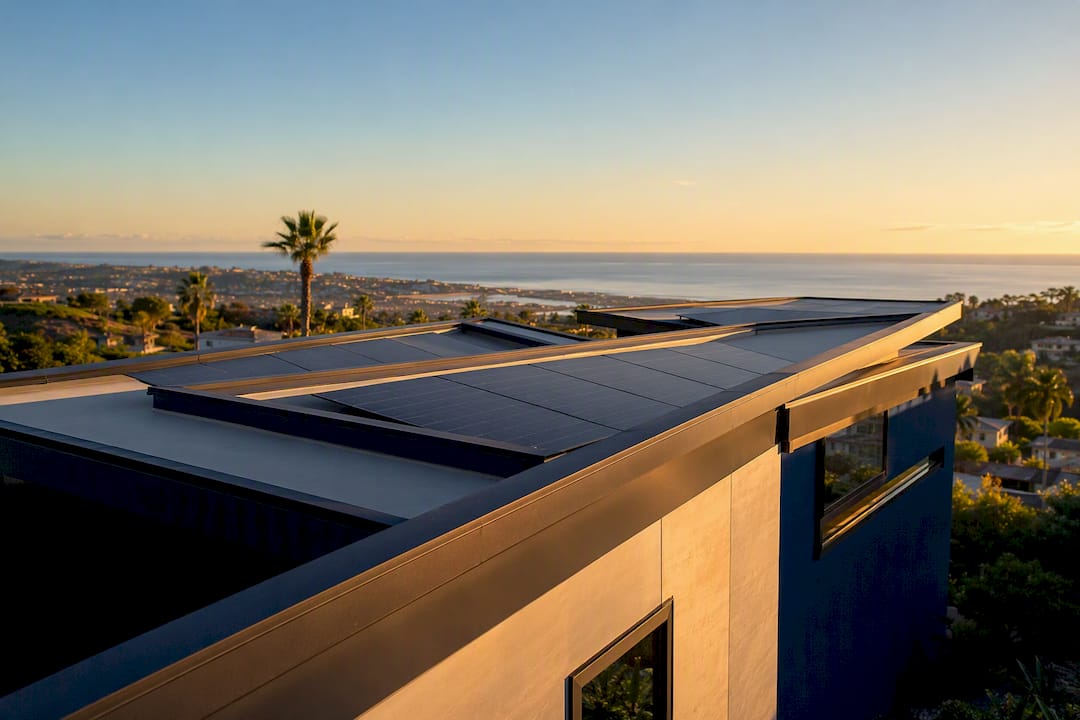
East-west solar layouts win when your roof space is limited, your utility pays little for exported power, or you don’t have a large battery to soak up a midday production spike. Facing panels split east and west typically costs you 10 to 35% in annual kilowatt-hours compared to true south, but it can raise self-consumption by 15 to 25% and fit more panels on tight or flat roofs. The right call depends on two things: how much roof you actually have, and what your utility pays for excess power.
TL;DR:
- East-west arrays can increase self-consumption by 15 to 25% and fit more panels on limited or flat roofs, despite 10 to 35% lower annual output compared to south-facing systems.
- The production of east-west systems starts earlier in the morning and ends later in the evening, but peaks are 20 to 30% lower at midday, affecting inverter sizing and storage cycling.
- They perform better in areas with low export rates, small batteries, or roofs that lack a true south face, especially for households with evening energy use.
- Roof tilt, shading, and local regulations can limit how many panels fit in east-west arrangements, with low-tilt flat roof setups offering a significant density advantage.
- Utility rate structures, especially time-of-use billing, heavily influence whether east-west or south-facing layouts are more cost-effective, making site-specific modeling essential.
Table of Contents
- What Is East-West Solar and How Does It Change Daily Production?
- How Much Energy Do You Lose Compared to a South-Facing Array?
- When Does East-West Actually Win?
- Design Rules That Determine How Many Panels You Can Fit
- How Do Tariffs and Battery Size Affect Your Payback?
- What Installation Issues Come Up With East-West Layouts?
- What San Diego Solar Sees on Real Roofs
- What Should You Do Next?
- The Orientation Debate Misses the Real Question
- Get a System Designed Around Your Roof and Your Rate Plan
- Sources
What Is East-West Solar and How Does It Change Daily Production?
East-west solar splits an array into two halves, one row facing roughly 90 degrees east, the other 90 degrees west, instead of pointing every panel due south. The east half wakes up early and catches morning sun; the west half picks up the slack in the afternoon and evening. A true south array does the opposite: it builds to one sharp peak around solar noon, then falls off just as fast.
That difference matters more than it sounds. Instead of one tall midday hump, an east-west installation produces a flatter, wider curve stretched across more hours of the day.
- Production often starts one to two hours earlier in the morning and extends one to two hours later in the evening compared to a south-facing system.
- Midday peak output can run 20 to 30% lower than an equivalent south array, depending on tilt and layout.
- Inverters see less clipping because the system never hits one extreme spike, which lets you run a smaller inverter relative to array size in some designs.
- Batteries cycle more evenly since the home draws directly from solar production for more of the day instead of waiting on stored energy after a short generation window.
The practical effect is straightforward: east-west arrays commonly increase self-consumption by 15 to 25% because more of what you generate lines up with when you actually use electricity.
How Much Energy Do You Lose Compared to a South-Facing Array?
South-facing solar wins on raw annual output almost everywhere in the continental U.S. The U.S. Department of Energy puts the gap at 10 to 35% more annual kilowatt-hours for south-facing systems versus an identically sized east-west array, with the exact number depending on your latitude, roof tilt, and local weather patterns.
The numbers behind the trade-off: A field study from the Renewable Energy Learning Center measured south-facing modules producing roughly 30 to 35% more energy annually than east or west-facing modules at the same site. But the same study found east and west modules actually out-produced south during the May through July stretch, when the sun tracks a wider arc across the sky.
That seasonal flip is worth sitting with. At higher latitudes, winter sun sits low and mostly south, so a south-facing roof captures far more light during the shortest days of the year. In summer, the sun rises well north of east and sets well north of west, which gives east and west panels a longer window of direct exposure they don’t get in December. Snow adds another variable: a steeply pitched south array sheds snow faster than a low-tilt east-west layout, and that gap in shedding speed can widen the real-world production difference beyond what a simple modeling tool predicts.
When Does East-West Actually Win?
Run through this checklist before assuming south is automatically the better layout for your home.
- Check your import-to-export ratio. If you pay roughly three times more for imported power than you get credited for exported power, east-west usually wins even without a battery, because it shifts generation away from low-value midday hours.
- Look at your battery size. Small or no battery favors east-west, since the flatter curve does the self-consumption work a battery would otherwise need to do. A large battery (10kWh or more) can absorb a south-facing midday surge and shift it to evening anyway, which erodes east-west’s advantage.
- Measure your usable roof area. Flat roofs, dormered roofs, or roofs with meaningful east and west faces but no clean south exposure often make east-west the only realistic way to hit your energy target.
- Match it to your household’s schedule. Homes with evening-heavy loads, EV charging after work, or occupants home in the early morning and late afternoon see the biggest self-consumption gains from east-west.
Pro Tip: Don’t decide on orientation before you decide on your tariff. If your utility bills on time-of-use rates or a net-billing structure like NEM 3.0, run both orientation scenarios against your actual rate schedule. The “best” layout on paper can lose money in practice once you plug in real peak pricing.
Design Rules That Determine How Many Panels You Can Fit
Orientation decisions get made on paper, but they get won or lost on the roof. Tilt and spacing rules for east-west differ enough from south-facing conventions that they change how many panels actually fit.
On flat roofs, east-west arrays are typically mounted low, in the 10 to 15 degree tilt range, paired back-to-back in an A-frame configuration. That low angle lets rows sit much closer together than a south-facing row tilted at 20 to 30 degrees, since there’s minimal self-shading between an east-facing panel and the west-facing panel behind it. On pitched roofs, tilt usually locks to whatever angle the roof already has, which limits your flexibility but simplifies mounting.
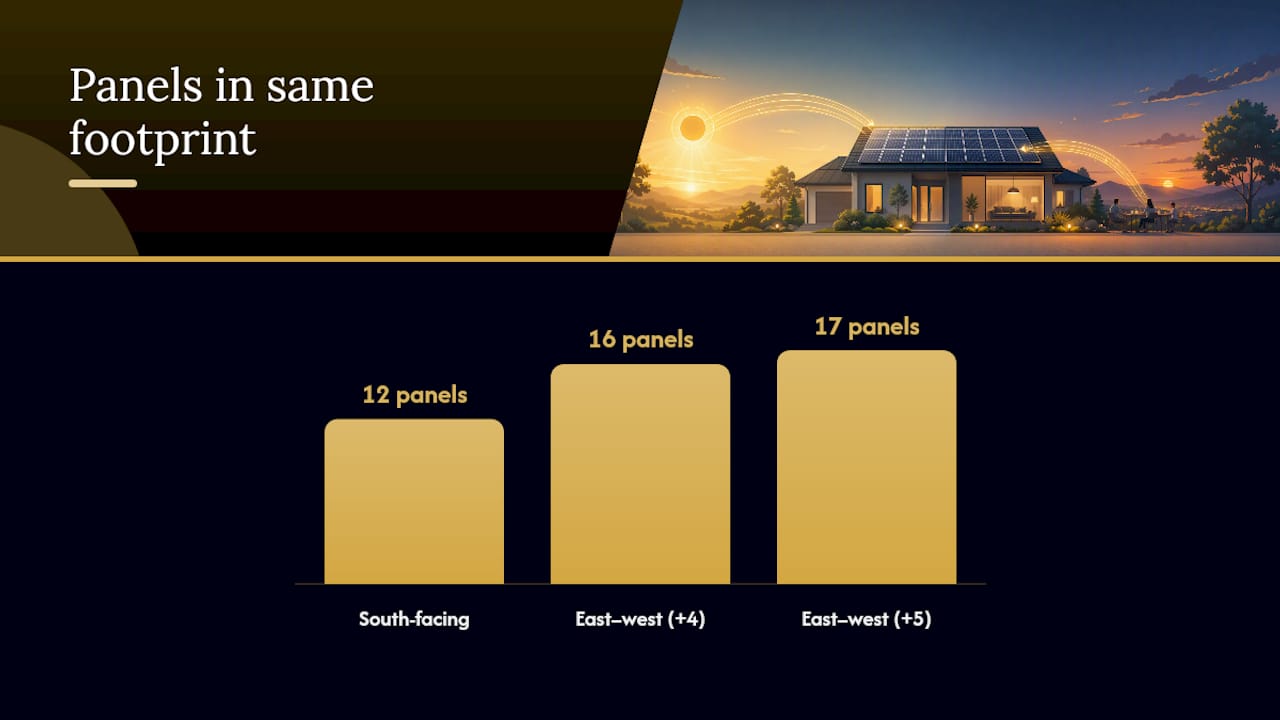
The density payoff is real. Installer data from SurgePV shows low-tilt east-west pairs on flat roofs can fit 25 to 40% more modules than south-tilted rows covering the same footprint, and some multi-row modeling puts total required surface area for east-west layouts can be substantially less than an equivalent south-facing design.
Here’s where that math gets practical: on a small roof that only fits 12 south-facing panels because of row spacing, an east-west A-frame layout might let you add 4 to 5 more panels in the same space. Those extra panels can close much of the annual kWh gap that orientation alone would otherwise create.
- Bifacial panels are worth a look for east-west layouts, since the low tilt and open backside on A-frame mounts can capture reflected light off a light-colored roof membrane.
- Ask your installer for a site-specific density comparison, not a generic rule of thumb, before assuming either layout wins on your roof.
How Do Tariffs and Battery Size Affect Your Payback?
Orientation is a production decision. Payback is a pricing decision, and the two don’t always point the same direction.
Under time-of-use billing, the value of a kilowatt-hour swings by when you generate it, not just how much you generate. East-west layouts can reduce midday grid exports by around 30% under certain tariff structures, which matters when your utility pays a fraction of the retail rate for anything exported at midday. Understanding your utility’s time-of-use rate structure before choosing orientation isn’t optional homework, it’s the whole game.
- Import/export math: If your export credit rate is low relative to your import rate, shifting production toward morning and evening (when you’re actually drawing power) beats generating more total power at midday and selling most of it back cheap.
- Battery threshold effect: Add enough battery capacity and a south-facing system’s midday surplus gets stored and used later anyway, closing the gap that made east-west attractive in the first place.
- Installed cost trade-off: More panels for an east-west layout add upfront cost, but a smaller inverter and less need for a large battery can offset some of that difference.
Two quick scenarios show the split. A homeowner on a steep TOU schedule with no battery and heavy evening use often sees faster payback with east-west, since less power gets exported at rock-bottom midday rates. A homeowner with a large battery and flat-rate billing usually does better with south-facing, since the battery handles the timing problem that east-west would otherwise solve. Reviewing how NEM 3.0 changes export credit value is the fastest way to see which scenario matches your bill, and comparing net metering against net-billing structures helps clarify why the credit rate matters as much as the production number.
What Installation Issues Come Up With East-West Layouts?
Getting the orientation right on paper doesn’t guarantee a clean install. A few things trip up east-west projects specifically.
- Shading and stringing: East and west sub-arrays need separate strings or module-level optimizers, since mixing panels that peak at different times of day on the same string drags the whole string’s output down to its weakest performer.
- Wind uplift: Low-tilt flat-roof arrays catch wind differently than steep south-facing rows, so installers need to weigh ballasted mounts against penetrating mounts based on your roof’s wind exposure and structural capacity, a question worth raising during a roof load-bearing assessment.
- Snow shedding: Tilted east-west arrays on pitched roofs tend to lose more production to slow snow shedding than low-tilt flat-mounted layouts, since the panel angle affects how fast accumulated snow slides off.
- Permitting and HOA review: Ask early whether your jurisdiction or HOA has visibility restrictions on east or west-facing rooftop equipment, since some approval processes treat split orientations differently than a single south-facing array.
Anyone considering a flat roof installation should get these questions answered in the proposal stage, not after the crew shows up.
What San Diego Solar Sees on Real Roofs
Three decades of installing systems across San Diego County means seeing every roof shape imaginable, and orientation debates rarely settle the way spreadsheets predict. San Diego Solar pulled the first commercial solar permit in the City of San Diego at the OB People’s Food Co-Op, and that installation, like most since, came down to matching the array to the roof in front of the crew, not to a textbook ideal.
Common scenarios San Diego Solar’s engineering team runs into:
- A single-story home with a north-south ridge line that leaves only east and west roof faces usable, making east-west the practical default rather than a preference.
- A homeowner with a small usable roof area who needs every added panel an east-west A-frame layout can provide to hit their offset target.
- A household on a TOU rate structure with evening cooking, laundry, and EV charging, where west-facing production lines up better with actual usage than a midday-heavy south array would.
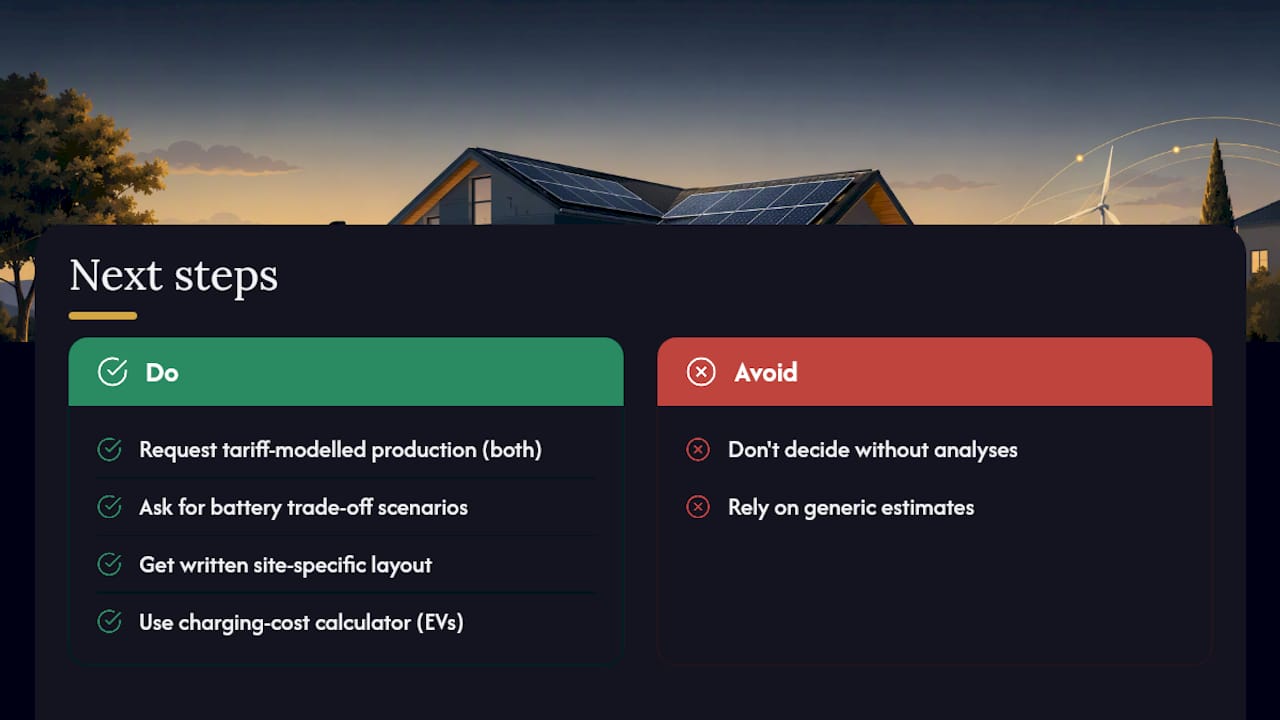
Ask any installer for a written, site-specific production model before signing anything, not a generic estimate pulled from an online calculator. Request the tariff-adjusted numbers, not just raw annual kWh, since that’s the number that actually determines your bill.
What Should You Do Next?
South-facing still wins on raw annual production almost everywhere. East-west wins when your roof forces the issue, your export credits are weak, or your battery is small enough that timing matters more than total output.
Before you commit to either layout, request three things from whoever designs your system: a tariff-modeled production estimate for both orientations, a battery trade-off scenario showing how storage size shifts the recommendation, and a written, site-specific layout rather than a generic estimate. Homeowners running EV charging loads can also check a charging cost calculator to see how much evening charging demand shifts the value of west-facing production.
Get those three answers, and the orientation debate stops being theoretical.
The Orientation Debate Misses the Real Question
Most articles on this topic treat orientation like a physics problem: point panels at the sun, get the most electrons. That framing is backwards for anyone paying a power bill. The right question isn’t which layout produces more kilowatt-hours annually, it’s which layout produces power when you’re willing to pay for it.
Conventional advice defaults to south-facing because that’s what maximizes raw generation, and generation is the easiest number to model. But raw generation stopped being the only number that matters the moment utilities moved to time-of-use pricing and thinner export credits. A system that generates 20% less annually but times that generation to your usage can outperform a bigger south-facing system on your actual bill.
Here’s what I’d prioritize first if I were sizing a system today: pull your last 12 months of hourly usage data before you think about panel angle at all. Orientation should follow your load profile and your tariff, not the other way around. Homeowners who skip that step end up with a technically efficient system that still leaves money on the table every billing cycle.
— Curtis Williamson
Get a System Designed Around Your Roof and Your Rate Plan
San Diego Solar is the alternative to guessing at orientation from a rooftop calculator: every system gets custom engineered by an in-house team that models your actual roof, your household’s usage patterns, and your SDG&E rate structure before a single panel gets placed. No subcontractors, no generic templates, just 30 years of designing systems for the exact roof shapes and tariff structures homeowners across San Diego County deal with every day.

Whether your roof pushes you toward an east-west layout or a traditional south-facing design, San Diego Solar’s engineering team runs the tariff-modeled numbers before you commit to anything, backed by manufacturer warranties up to 25 years and a company that’s outlasted every boom and bust the solar industry has thrown at it since 1996. If you’re weighing orientation, battery size, or roof constraints, start with a free residential solar consultation and get a written, site-specific layout before making any decision on panel placement.
Sources
- East–west oriented photovoltaic power systems: model, benefits and technical evaluation (E3S 2025)
- Solar photovoltaic energy production comparison of east, west, south-facing and tracked arrays (Renewable Energy Learning Center study)