Energy San Diego: Solar + Battery Guide for Homeowners
Energy San Diego: Solar + Battery Guide for Homeowners

San Diego homeowners should pair rooftop solar with battery storage and hire a local installer who handles permits and SDG&E interconnection from day one. Under NEM 3.0, exported daytime solar earns time-dependent avoided cost calculator rates that are a fraction of the retail rate paid by customers, reducing export value compared to previous NEM versions. Batteries change that math by shifting stored solar into SDG&E’s 4 p.m.–9 p.m. on-peak window, where it offsets the highest-cost grid power instead of exporting at a fraction of retail. Your first call should get you a site visit, a preliminary system size, a rebate check, and a written project timeline before you sign anything.
Table of Contents
- What services and equipment does a San Diego solar installer offer?
- What should you ask an installer, and what are the red flags?
- Which neighborhoods does San Diego Solar serve across the county?
- How does the solar + battery installation process work in San Diego?
- How does San Diego Solar compare to other local installers?
- What local San Diego incentives exist beyond the federal tax credit?
- How long do solar panels and batteries last in San Diego’s climate?
- Key Takeaways
- The part most homeowners get wrong about NEM 3.0
- What San Diego Solar’s free consultation actually covers
- Authoritative resources for San Diego homeowners
What services and equipment does a San Diego solar installer offer?
A full-service residential installer covers rooftop solar panels, home battery storage, EV charging integration, and combined solar-plus-roofing packages. The three battery systems most commonly installed in San Diego are the Tesla Powerwall, Enphase IQ Battery, and Franklin WH. Each pairs directly with a solar array and discharges automatically during peak hours. For homeowners with an aging roof, a solar roofing package handles both the reroof and the solar install under one permit and one warranty, which eliminates the scheduling gap that creates costly change orders.
What should you ask an installer, and what are the red flags?
Ask whether the crew is in-house or subcontracted, how many San Diego County permits the company has pulled, and whether they file SDG&E interconnection through DIIS themselves. A good installer gives you a written project timeline before you commit and carries manufacturer warranties up to 25 years. Red flags: a quote with no permit line item, a salesperson who cannot explain NEM 3.0 export credits, pressure to sign before the site assessment is complete, and any mention of subcontracting the electrical work. Permits protect your roof warranty and your homeowner’s insurance; an installer who skips them is a liability, not a deal.
Pro Tip: Ask specifically how many SDG&E interconnection applications the company filed last year and what their average time to Permission to Operate (PTO) was. A contractor who tracks that number works the process; one who doesn’t know it probably doesn’t.
Which neighborhoods does San Diego Solar serve across the county?
San Diego Solar covers every community in San Diego County, from coastal cities like Oceanside, Carlsbad, Encinitas, Del Mar, and Point Loma to inland areas including Escondido, Poway, Scripps Ranch, El Cajon, and Santee, plus south county communities like Chula Vista. Rancho Santa Fe, La Jolla, and backcountry unincorporated areas are all within the service footprint.
How does the solar + battery installation process work in San Diego?
- Free site assessment. An engineer visits, measures your roof, pulls your SDG&E usage history, and sizes the system.
- System design and proposal. You receive a custom design, equipment spec, financing options, and a written timeline.
- Permitting. Qualifying systems under 15 kW go through SolarAPP+ for same-day automated approval at City of San Diego DSD. Larger or more complex projects follow standard plan check, which typically runs 7–15 business days.
- Installation. Most residential systems install in a single day with an in-house crew.
- Inspection. City or county inspector signs off on the permitted work.
- SDG&E interconnection. The contractor submits through DIIS; SDG&E completes technical review and issues Permission to Operate.
County jurisdictions outside the City of San Diego use their own permit offices, so timeline varies by municipality.
How does San Diego Solar compare to other local installers?
| Factor | San Diego Solar | Large national installers | Smaller local shops |
|---|---|---|---|
| Years in San Diego | Since 1996 (30 years) | Varies; many entered post-2020 | Often under 10 years |
| Crew model | 100% in-house, zero subcontractors | Frequently subcontracted | Usually in-house but smaller capacity |
| Permit and interconnection handling | Full service, including DIIS | Varies by market | Varies |
| Battery options | Tesla Powerwall, Enphase IQ, Franklin WH | Typically one or two brands | Limited selection |
| Financing | Cash, loan, prepaid lease (30% savings) | Loan and lease common | Usually cash or loan |
| Warranty backing | Manufacturer up to 25 years, company-backed | Manufacturer warranty; company longevity risk | Company longevity risk |
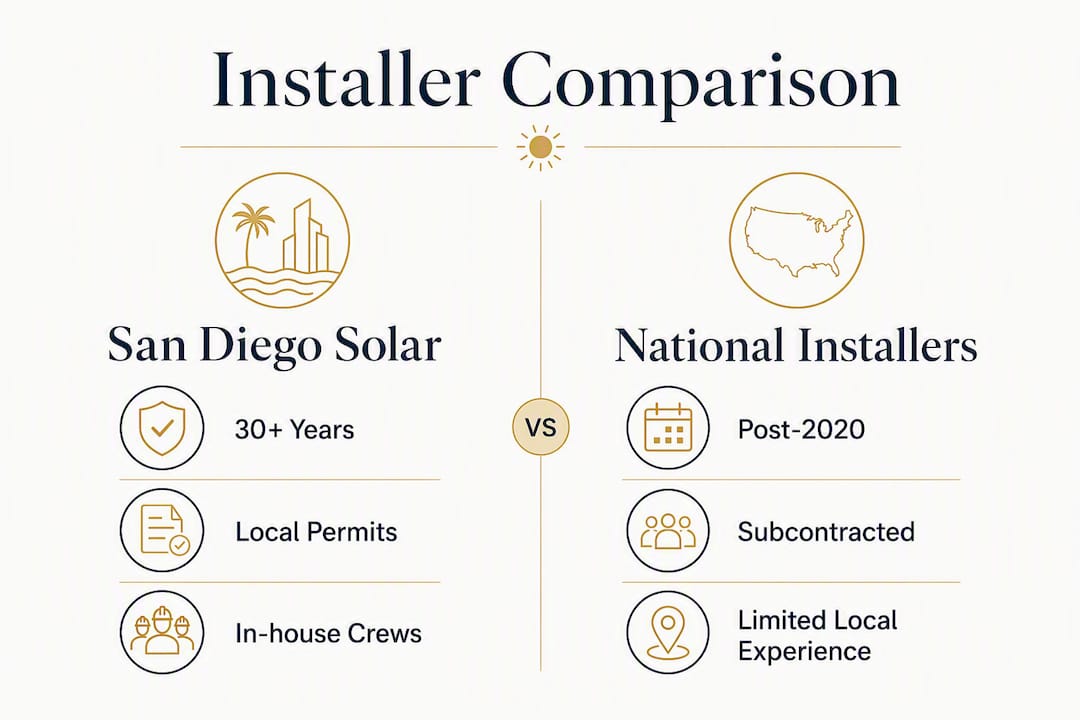
The practical difference between a 30-year local company and a post-2020 entrant shows up when you need a warranty claim honored or a system serviced five years from now.
What local San Diego incentives exist beyond the federal tax credit?
The federal Residential Clean Energy Credit covered 30% of solar, battery, and installation costs for homeowner-owned systems through December 31, 2025. Systems installed after that date no longer qualify under Section 25D. Third-party-owned systems such as prepaid leases may still qualify under Section 48E through 2027, which is one reason the prepaid lease structure remains financially attractive in 2026.
Beyond federal credits, San Diego homeowners should check:
- DAC-SASH: Up to $3 per watt for income-qualified homeowners in disadvantaged communities, active through 2030.
- SGIP RSSE: Battery rebates for income-qualified households; currently waitlist only as of 2026.
- California property tax exclusion: Solar additions do not trigger reassessment, currently scheduled through December 31, 2026.
- San Diego Solar Equity Program (SDSEP): Monetary assistance for income-qualifying homeowners in the City of San Diego. Confirm current availability directly with the City.
- San Diego Community Power: Offers Solar & Storage 101 resources and can clarify how your billing changes after interconnection.
SDG&E’s Solar Billing Plan also includes a non-nettable Base Services Charge that all solar customers pay regardless of generation. Factor that into your savings projection.
How long do solar panels and batteries last in San Diego’s climate?
San Diego’s mild, low-humidity climate is genuinely good for solar hardware. Panels typically carry 25-year performance warranties and routinely produce at or above rated output well into that window. The main maintenance task is cleaning: marine layer deposits salt residue on coastal panels, and inland dust accumulates faster than most homeowners expect. Annual professional panel cleaning keeps output near nameplate and preserves warranty compliance.
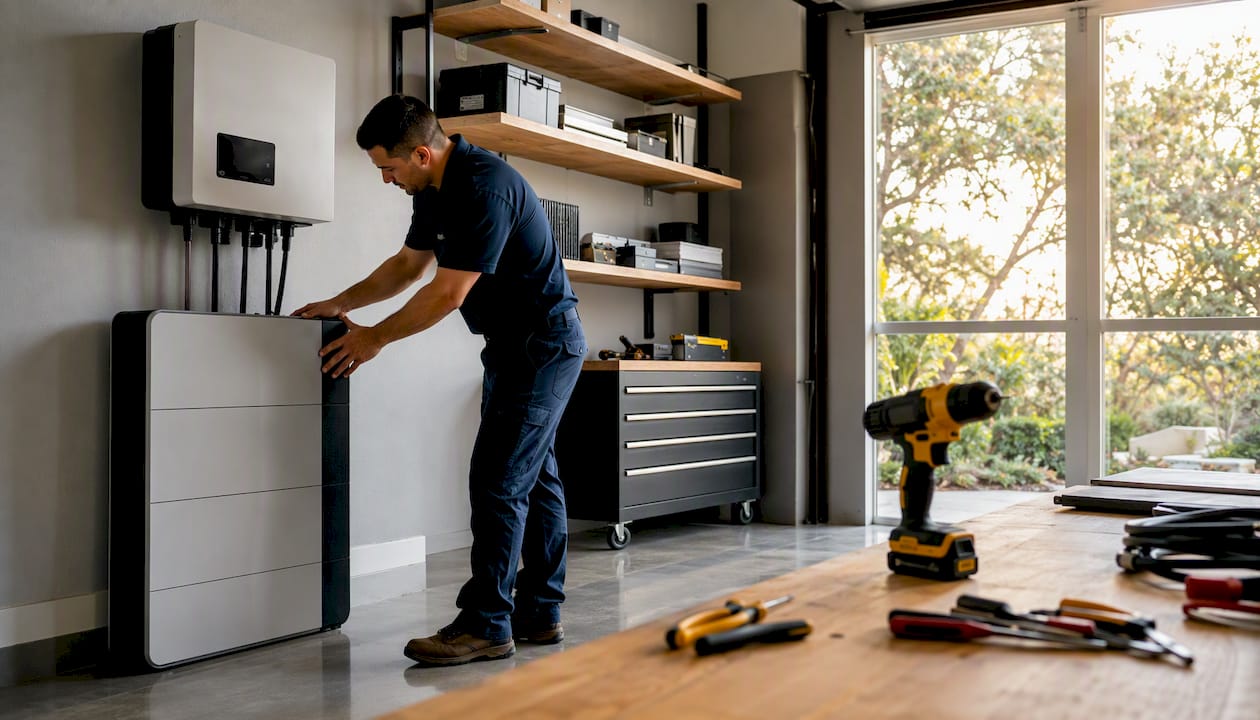
Batteries like the Tesla Powerwall and Enphase IQ carry 10-year warranties with guaranteed minimum capacity retention. In San Diego’s moderate temperatures, thermal degradation is slower than in desert climates, which tends to extend useful life beyond the warranty period. Inverters typically need replacement around the 10–15 year mark and are the most common maintenance item in the second decade of a system’s life.
Key Takeaways
Under NEM 3.0, battery storage is no longer optional for San Diego homeowners who want fast payback. Pairing solar with a battery and working with a permit-experienced local installer is the most direct path to significant bill reduction and a five- to seven-year payback.
| Point | Details |
|---|---|
| NEM 3.0 export value | Exported solar earns avoided cost calculator rates, which are a fraction of retail; self-consumption with a battery avoids full retail rates instead. |
| Permitting timeline | SolarAPP+ delivers same-day approval for qualifying systems under 15 kW; standard plan check runs 7–15 business days. |
| Federal tax credit status | Section 25D expired December 31, 2025 for homeowner-owned systems; prepaid leases may qualify under Section 48E through 2027. |
| What to ask installers | Confirm in-house crews, DIIS interconnection experience, permit handling, and 25-year warranty backing. |
| San Diego Solar | Serving San Diego County since 1996 with in-house crews, full permit and SDG&E interconnection service, and Tesla Powerwall, Enphase IQ, and Franklin WH battery options. |
The part most homeowners get wrong about NEM 3.0
The shift to NEM 3.0 is widely described as bad news for solar. It is not bad news. It is a different set of rules that rewards a different system design. Under NEM 2.0, you could oversize a solar array, dump excess power onto the grid all day, and bank retail-rate credits. That model is gone. What replaced it actually suits San Diego homeowners better than most people realize: a right-sized solar array paired with a battery, consuming most of what you generate and discharging stored power during the 4–9 p.m. peak window, can still cut your SDG&E bill by a substantial margin.
The mistake most homeowners make is treating the battery as an optional add-on. Under the current billing structure, the battery is the mechanism that makes the economics work. An installer who quotes you solar-only in 2026 without a serious conversation about battery sizing is either not paying attention to the tariff or is steering you toward a simpler sale. Push back on that.
The other thing worth knowing: SDG&E’s interconnection queue moves faster when your contractor submits through DIIS with a complete application the first time. Incomplete submissions go to the back of the line. That is a controllable variable, and it is one of the clearest ways to tell whether an installer actually knows the local process.
What San Diego Solar’s free consultation actually covers
San Diego Solar has been installing residential solar in San Diego County since 1996, pulling permits, managing SDG&E interconnection through DIIS, and handling HOA approvals with 100% in-house crews. No subcontractors, ever.
A free consultation with San Diego Solar includes:
- On-site roof and shading assessment
- Custom system sizing based on your actual SDG&E usage
- Battery options and sizing for your backup and peak-shifting goals
- Rebate and incentive estimate (including Section 48E eligibility for prepaid lease)
- Permit roadmap and written project timeline before you commit
Ready to see what solar + battery looks like for your home? Get a free quote and walk away with a permit-ready plan and a clear timeline, no pressure.
Authoritative resources for San Diego homeowners
| Resource | What it covers |
|---|---|
| SDG&E Solar Billing Plan | TOU peak windows, Base Services Charge details, and export credit structure under NEM 3.0 |
| SDG&E NEM Documents | Official interconnection forms, DIIS portal access, and single-line diagram requirements |
| SDG&E Considering Solar | Overview of solar types, permitting steps, and PTO process from the utility’s perspective |
| SurgePV San Diego Permit Guide | SolarAPP+ eligibility, plan-check timelines, and SDG&E interconnection sequence |
| IRS Residential Clean Energy Credit | Current federal tax credit rules, eligible equipment, and filing requirements |
| San Diego Community Power Solar & Storage 101 | CCA-level explanation of solar and battery benefits, financing options, and billing after interconnection |
| California Solar Incentives 2026 (SurgePV) | Full breakdown of NEM 3.0 export rates, SGIP RSSE, DAC-SASH, and property tax exclusion status |