San Diego: Enphase Battery Cost, $350/kWh Rebate and 3 Real Examples
San Diego: Enphase Battery Cost, $350/kWh Rebate and 3 Real Examples
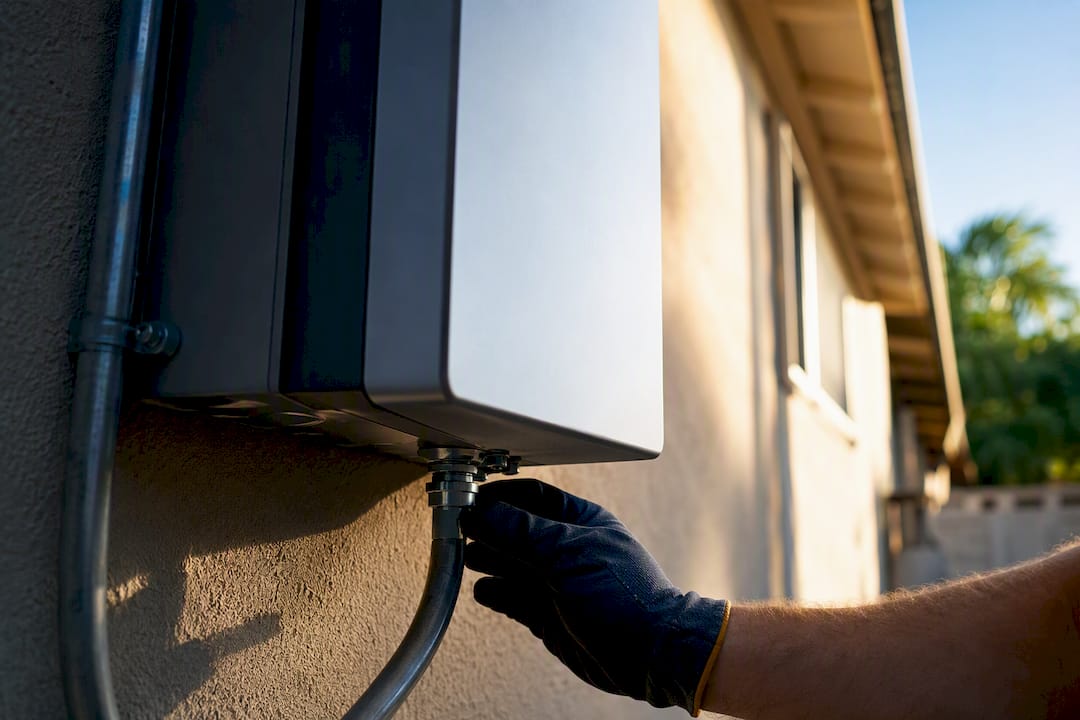
A single Enphase IQ Battery 5P installed in San Diego typically runs in the mid-five-figure range before incentives, with larger 10 kWh systems costing proportionally more. San Diego Community Power’s rebate can cut several thousand dollars off that upfront number depending on system size, and performance payments add more over time. Panel upgrades, roof condition, and backup scope can increase your specific quote.
TL;DR:
- Electrical panel condition and age can require upgrades costing $2,000 to $4,500, significantly affecting overall installation costs.
- The typical net price for a single 5 kWh Enphase battery ranges from $10,750 to $15,000 after the San Diego Community Power rebate.
- Larger systems with 10 to 13 kWh, paired with new solar, usually cost between $16,500 and $26,000 before incentives, depending on backup scope.
- Quotes often vary due to differences in panel upgrade needs, backup goals, roof complexity, and whether the installer handles rebate submissions.
- Properly itemized bids should include separate costs for equipment, labor, permits, interconnection, and any panel upgrades to ensure accurate comparisons.
Table of Contents
- What Drives Your Enphase Battery Installation Cost
- Why Do Enphase Battery Quotes Vary So Much?
- San Diego Community Power Battery Rebates, Explained
- What Does an Enphase Battery Actually Cost in San Diego? Three Examples
- How to Get an Apples-to-Apples Enphase Battery Quote
- Is an Enphase Battery Worth the Cost for a Typical San Diego Home?
- A Local Installer’s Take on Enphase Battery Pricing
- Get a Local, Itemized Enphase Battery Quote
- Sources
What Drives Your Enphase Battery Installation Cost
Enphase battery pricing breaks into four buckets, and any installer worth hiring will itemize all four on your proposal instead of handing you a single lump number.
Equipment costs cover the battery units themselves plus the Enphase Ensemble system that manages backup switching. A single IQ Battery 5P (5 kWh usable) installed typically prices between $12,000 and $18,000 once you factor in the microinverters, combiner boxes, and the IQ System Controller. Stack two batteries for roughly 10 kWh usable capacity and you’re generally looking at $18,000 to $28,000 installed, which tracks closely with EnergySage’s San Diego County average of about $1,074 per kWh and its example of roughly $13,958 for a 13 kWh system before incentives.
Labor, permitting, and interconnection fees are where a lot of homeowners get surprised. Installers commonly add several thousand dollars for crew time, SDG&E interconnection paperwork, and city permitting on top of hardware. A rough split looks like this:
- Equipment (batteries, Ensemble, mounting): the bulk of the quote, usually 65 to 75% of the total.
- Labor and commissioning: crew installation, system startup, and testing.
- Permitting and interconnection: city permit fees plus SDG&E paperwork and inspection scheduling.
- Electrical upgrades (if needed): main panel work, subpanels, or meter changes, billed separately from the battery itself.
That last category is the one that turns a clean estimate into a moving target, which is exactly what the next section covers.
Why Do Enphase Battery Quotes Vary So Much?
Two homes with identical batteries can get wildly different quotes, and it almost never comes down to the installer padding the price. It comes down to what your electrical panel, your roof, and your backup goals actually require.
- Panel age and amperage. Homes with service under 150A frequently need a panel or meter upgrade before a battery can be added, and that work typically runs $2,000 to $4,500 in San Diego.
- Backup scope. A partial backup covering a few circuits costs far less than whole-home backup, which usually means adding a second or third battery to carry HVAC and major appliances through an outage.
- Roof and mounting complexity. Older homes sometimes need conduit rerouting or additional structural work that adds labor hours.
- Where you bought the hardware. Installers generally won’t commission a battery you sourced yourself. They need to verify serial numbers and enroll the system in rebate portals, and a San Diego homeowner recently learned the hard way that a “too good to be true” third-party battery deal misrepresented the actual usable capacity.
Pro Tip: Ask your installer for a photo-based or virtual pre-inspection of your electrical panel before you get a final quote. It takes ten minutes and can save you from a mid-project change order that adds thousands.
San Diego Community Power Battery Rebates, Explained
This is where the math actually gets interesting, because the rebate structure directly changes what “affordable” means for an Enphase system in San Diego.
San Diego Community Power’s Solar Battery Savings program pays up to $350 per usable kWh for a new solar-plus-battery installation, or $250 per usable kWh if you’re adding a battery to solar you already own. Market-rate customers get those figures; CARE and FERA-enrolled households qualify for different, typically higher, incentive levels under the same program. On top of that upfront check, the program pays a performance incentive of $0.10 per kWh every time your battery discharges during weekday dispatch events, generally between 4 and 9 p.m., which is exactly when SDG&E’s peak rates bite hardest under NEM 3.0.
The program’s qualified-product list names several Enphase configurations by usable kWh, including the 4.5 kWh and 9.5 kWh variants and multi-unit setups like the 5P and 10C. A homeowner installing a 9.5 kWh usable system as part of a new solar-plus-battery project could see an upfront rebate near $3,325 (9.5 kWh times $350), paid by check.
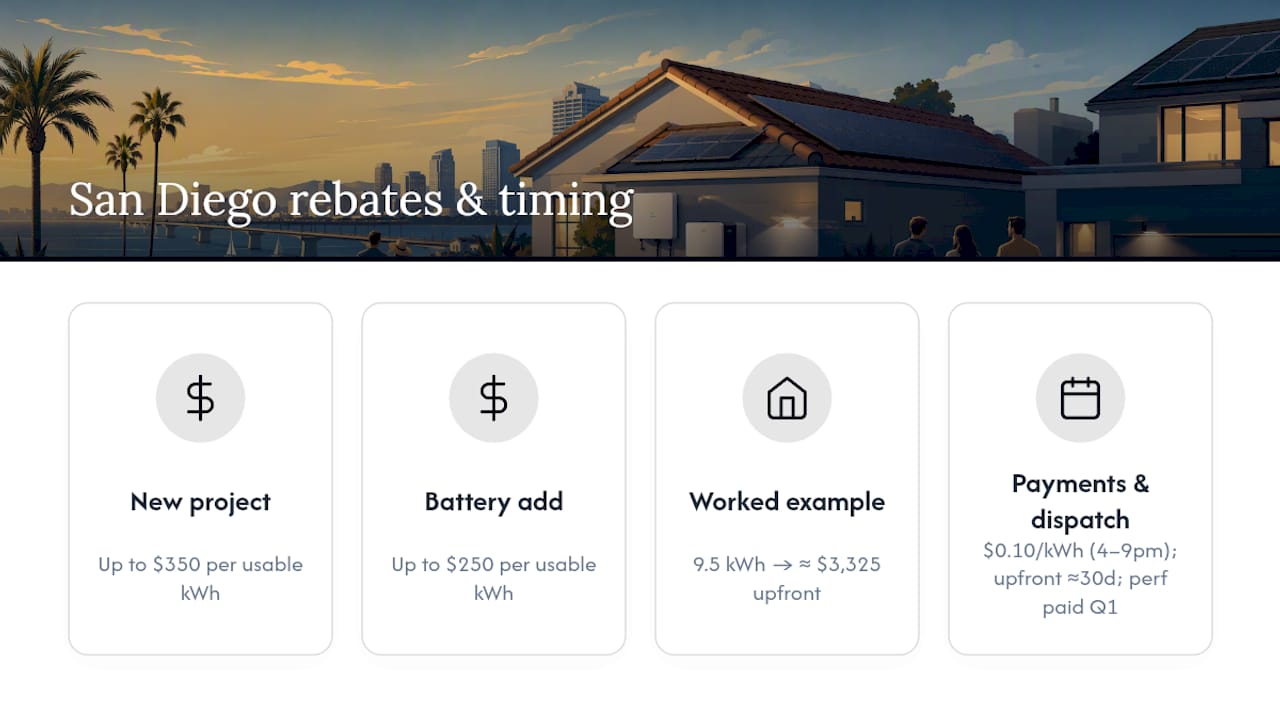
Timing matters too. According to the program FAQ, the upfront rebate check arrives roughly 30 days after your contractor submits verification and the battery is confirmed capable of sending power to your home and the grid. Performance incentives get paid annually, in the first quarter following the year they were earned, not month by month.
What Does an Enphase Battery Actually Cost in San Diego? Three Examples
Numbers land better with context, so here’s how the gross-to-net math plays out across three common San Diego scenarios. Every net figure assumes the contractor handles rebate submission, which is standard practice with an established local installer.
- Small add-on, existing solar: A single 5 kWh usable Enphase battery added to a home that already has solar runs roughly $12,000 to $15,000 installed. At the $250/kWh existing-solar rebate rate, that’s about $1,250 back, landing net cost near $10,750 to $13,750.
- 10 kWh bill-shifting system, new solar-plus-battery: Two batteries totaling 10 kWh usable, installed alongside new solar, run roughly $20,000 to $26,000. The $350/kWh new-install rebate returns about $3,500 upfront, plus an estimated first-year performance incentive in the low hundreds of dollars depending on how often the system discharges during dispatch windows. Net cost lands near $16,500 to $22,500 before performance payments.
- Whole-home backup: Three or more batteries scaled to cover HVAC and major appliances, often paired with a panel upgrade, can push gross installed cost to $35,000 or more. Rebates still apply per usable kWh, but the panel upgrade itself isn’t rebate-eligible, so net savings shrink as a percentage of the total.
These ranges assume no unusual roof work and a straightforward interconnection. Homes needing a panel upgrade should add that $2,000 to $4,500 on top of any scenario above.
How to Get an Apples-to-Apples Enphase Battery Quote
Comparing quotes only works if every bid itemizes the same things. Before you sign anything, make sure each proposal breaks out costs the same way.
- Require separate line items for equipment, labor, permitting, interconnection, and any panel or service upgrade.
- Ask who submits the San Diego Community Power rebate paperwork and when you can expect the upfront check.
- Confirm the performance incentive enrollment is included, not billed as an add-on service.
- Request serial number verification in writing, especially if any component pricing looks unusually low.
- Get a written timeline covering site visit, permitting, installation day, SDG&E inspection, and final commissioning.
Most straightforward San Diego installations run four to eight weeks from signed contract to final commissioning, longer if a panel upgrade or HOA approval is involved.
Is an Enphase Battery Worth the Cost for a Typical San Diego Home?
Under NEM 3.0, SDG&E’s export rates dropped enough that shifting your own solar into evening peak hours often saves more than selling it back. If your bills spike between 4 and 9 p.m., a battery attacks that directly, and the performance incentive rewards you for discharging in exactly that window. A rough payback check: divide net cost by (annual bill savings plus performance incentive). If that number is within a decade, the math works. If resiliency during outages matters more than pure savings, that shifts the decision toward backup capacity rather than sizing purely for financial payback.
A Local Installer’s Take on Enphase Battery Pricing
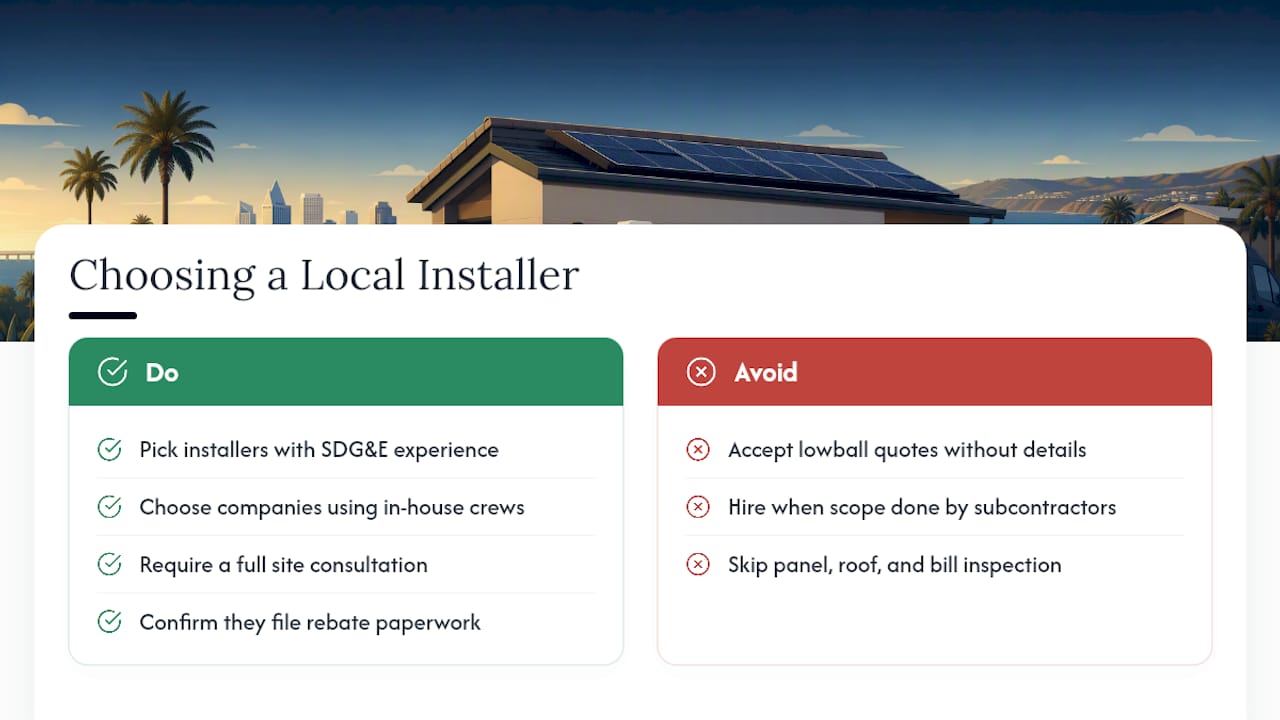
Homeowners get burned less by bad batteries than by vague quotes. Thirty years of installing solar and storage across San Diego County has shown a consistent pattern: the installers who lowball the initial number are usually the ones who “discover” a panel upgrade after the contract is signed.
Some local installers have long experience pulling permits and running interconnections with SDG&E, which matters when NEM 3.0 rewards precise system sizing over guesswork. Using in-house crews means the person scoping your roof is the same crew installing the battery and filing rebate paperwork, rather than subcontractors working off someone else’s site visit. A real consultation should walk your electrical panel, your roof, and your bill history before anyone quotes a number.
— Curtis Williamson
Get a Local, Itemized Enphase Battery Quote
Most Enphase pricing you’ll find online is a national average that ignores what actually drives your final number: your panel, your roof, and whether San Diego Community Power’s rebate applies to your project. Every battery installation should be scoped by in-house crews, so the team that assesses your electrical panel also commissions the system and files your rebate paperwork, rather than subcontractors working off secondhand notes.

That matters most when you’re trying to compare bids apples-to-apples, because a quote without panel-upgrade contingencies built in isn’t a real quote yet. San Diego Solar’s solar battery storage team offers a free consultation that includes a written, itemized estimate covering equipment, labor, permitting, and rebate handling before you commit to anything. If you’re weighing a battery against a full solar-plus-storage system, the solar installation page walks through how NEM 3.0 strategy shapes system sizing. Book a free consultation and get a written timeline before you sign.
Sources
- Solar Battery Savings - San Diego Community Power
- What is the labor & services cost of installing a home solar battery? (AES Renewable knowledge base)
- Storage cost in San Diego County, CA (EnergySage)
This article is general information, not a substitute for advice from a qualified financial advisor. Consult a qualified financial professional about your own circumstances before acting on anything here.