How Solar Installation Permits Protect Homeowners
How Solar Installation Permits Protect Homeowners

Solar installation permits are legally required authorizations that protect homeowners by confirming their solar system meets all safety, structural, and electrical codes before a single panel goes on the roof. Most homeowners treat permits as paperwork. They are actually the primary mechanism that determines whether your system is safe, insurable, and financially valuable. Understanding how solar installation permits protect homeowners is the difference between a system that works for you and one that creates legal and financial problems for years. Residential solar installations require building and electrical permits in nearly all U.S. jurisdictions, with fees ranging from $200 to $1,000 and review timelines of 2–8 weeks.
How do solar installation permits protect homeowners?
Solar permits enforce a three-layer safety model covering structural integrity, electrical code compliance, and grid interconnection security. Each layer addresses a distinct risk that an unpermitted installation leaves completely unmanaged.
The structural layer is the one most homeowners underestimate. A residential 7–10 kW solar array adds 800 to 1,200 pounds of load to your roof framing. That is a significant force on a structure that was designed for rain, wind, and snow, not a permanent equipment installation. The permit process requires a structural review to confirm your roof framing can handle that weight safely.

The electrical layer enforces the National Electrical Code (NEC), which governs how solar wiring, inverters, and disconnect systems must be installed. One of the most critical requirements is NEC 690.12, which mandates rapid shutdown capability on all rooftop solar systems. Rapid shutdown allows firefighters to de-energize panels during a structure fire. Without a permit, this requirement is never verified.
The grid interconnection layer protects you and your neighbors. Utilities require proof of a passed inspection before granting Permission to Operate (PTO). Without PTO, your system cannot legally export power or earn net metering credits. That means a system installed without permits may generate electricity but cannot reduce your bill through grid export.
- Structural review: Confirms roof framing load capacity before installation begins.
- Electrical inspection: Verifies NEC-compliant wiring, inverter placement, and rapid shutdown labeling.
- Utility interconnection approval: Grants PTO so your system can legally connect to the grid.
- Workmanship verification: Inspectors catch installation errors that the homeowner would never see.
Pro Tip: Ask your installer for a copy of the approved permit plan set before installation starts. That document is the binding blueprint for your system. Any deviation from it can cause a failed inspection.
What legal and financial risks do permits prevent?
Skipping permits does not save money. It creates a liability that compounds over time and surfaces at the worst possible moments.
The most immediate risk is fines and forced removal. Installing solar without permits risks fines from $500 to $10,000 or more, depending on the jurisdiction. Some municipalities require complete removal of the unpermitted system at the homeowner’s expense. That cost can exceed the original installation price.
The insurance risk is equally serious. Many homeowner insurance policies deny coverage for fire or structural damage related to unpermitted solar work. In some cases, unpermitted work can void the entire policy. A house fire traced to faulty solar wiring on an unpermitted system could leave you with no coverage at all.
The financial consequences stack up in a specific order:
- Fines issued by the local Authority Having Jurisdiction (AHJ) upon discovery of unpermitted work.
- Insurance claims denied for any damage connected to the unpermitted installation.
- Home sale blocked or delayed because unpermitted systems fail title transfer inspections.
- Net metering lost because utilities will not grant PTO without a passed inspection.
- Federal tax credit jeopardized because the IRS expects installations to comply with local codes.
The home sale issue catches homeowners off guard most often. Real estate transactions require disclosure of unpermitted work. Buyers’ lenders frequently reject financing on homes with open permit violations. What started as a shortcut becomes a title problem that can kill a sale entirely.
Permits also maintain your eligibility for state rebates and utility incentive programs. California’s NEM 3.0 net metering structure, for example, requires a fully permitted and interconnected system. A system that cannot obtain PTO earns nothing from grid export under NEM 3.0, which makes the financial case for permits straightforward.
What does the solar permit process involve?
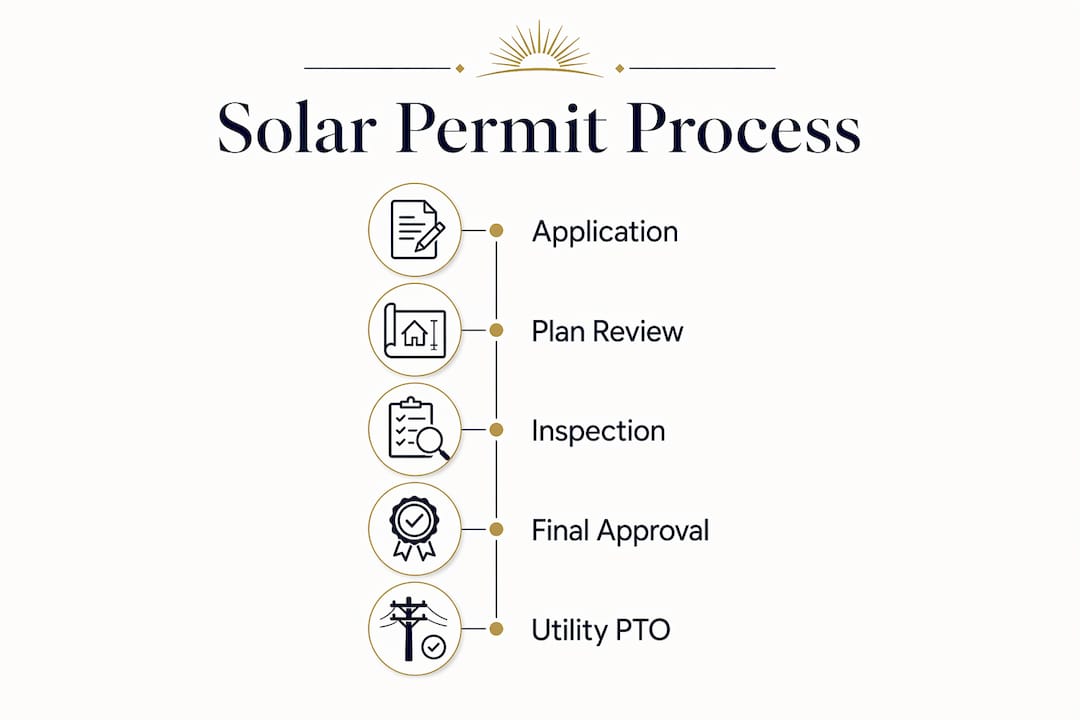
The permitting process follows a defined sequence. Knowing each step helps you set realistic expectations and ask the right questions of your installer.
Every permit application goes to the local Authority Having Jurisdiction, which is typically your city or county building department. The AHJ reviews the submitted plan set, which includes structural drawings, electrical diagrams, and equipment specifications. The permit application serves as the authoritative installation plan, and any deviation from it during installation causes a failed inspection.
Most residential solar projects require two separate permits. The building permit addresses structural concerns: roof loading, mounting hardware, and penetration details. The electrical permit covers all wiring, the inverter, the main panel connection, and rapid shutdown components. Some jurisdictions combine these into a single solar permit, but the underlying reviews are always separate.
After installation, a city or county inspector visits the site to verify the work matches the approved plans. Passing that inspection triggers the utility interconnection process. The utility then issues PTO, which is the final authorization to turn the system on.
- Application submitted to the AHJ with a complete plan set.
- Plan review completed by building and electrical departments.
- Installation performed strictly according to the approved plans.
- Field inspection passed by a city or county inspector.
- Utility interconnection approved and PTO issued.
| Stage | Who handles it | Typical timeline |
|---|---|---|
| Permit application | Installer or homeowner | 1–2 days to submit |
| AHJ plan review | City or county | 2–8 weeks |
| Installation | Licensed solar crew | 1–3 days |
| Field inspection | City or county inspector | 1–2 weeks after install |
| Utility PTO | SDG&E or local utility | 1–4 weeks after inspection |
Pro Tip: Some jurisdictions offer expedited or online permit review for solar projects. San Diego Solar knows which local AHJs have fast-track options and submits applications accordingly, cutting weeks off the typical timeline.
How do HOA rules interact with solar permits?
HOA rules and solar permits operate on separate tracks, but they intersect in ways that directly affect your legal rights as a homeowner.
28 U.S. states have enacted solar access laws that prevent HOAs from banning rooftop solar outright. California is among them. These laws allow HOAs to impose reasonable aesthetic restrictions, such as panel placement or color requirements, but they cannot prohibit solar installation entirely. That protection only applies when your system is properly permitted and installed to code.
Permits enforce technical safety standards that exist independently of HOA rules. An HOA can require that panels face a certain direction, but it cannot override NEC wiring requirements or rapid shutdown mandates. The permit process ensures those non-negotiable safety standards are met regardless of what your HOA says.
- Solar access laws in 28 states block outright HOA bans but allow aesthetic regulation.
- Permit requirements apply regardless of HOA approval status.
- Detailed plan sets submitted to the HOA, referencing state solar access law, strengthen your legal position.
- Unpermitted systems may undermine your ability to invoke solar access law protections in a dispute.
The practical takeaway is this: get your permit and your HOA approval in parallel, not sequentially. Waiting for HOA approval before starting the permit process adds unnecessary time. A licensed solar contractor familiar with local HOA rules can manage both tracks simultaneously.
Key Takeaways
Solar permits are the legal and safety foundation of every residential solar installation. Skipping them creates financial, legal, and safety risks that far outweigh any perceived savings.
| Point | Details |
|---|---|
| Three-layer safety model | Permits enforce structural, electrical, and grid interconnection safety on every installation. |
| Financial risk of skipping permits | Fines from $500 to $10,000+, insurance denial, and blocked home sales are direct consequences. |
| PTO requires a passed inspection | Utilities will not grant Permission to Operate without verified permit compliance. |
| HOA laws need permit backing | Solar access law protections in 28 states apply most reliably to fully permitted systems. |
| Experienced installers reduce delays | Contractors who manage permits cut inspection failures and project timelines significantly. |
Why permits matter more than most homeowners realize
The most common mistake I see homeowners make is treating the permit as the installer’s problem. It is your problem. The permit is issued in your name, attached to your property record, and follows your home through every future sale, refinance, and insurance claim.
I have watched homeowners discover unpermitted solar work during a home sale, sometimes years after installation. The installer is long gone. The homeowner is left negotiating with a buyer’s lender, a title company, and a building department simultaneously. That situation is avoidable, and it is entirely the result of not asking one simple question upfront: “Will you pull the permits and show me the inspection sign-off?”
The permit application as the binding plan is something experienced installers understand deeply. When the plan set matches the installation exactly, inspections pass on the first visit. When they do not match, you get a failed inspection, a correction notice, and a delay that pushes your PTO back by weeks. Experienced installers who handle permits professionally reduce that risk to near zero.
My honest advice: before you sign any solar contract, ask for the installer’s permit history. How many inspections have they failed in the past year? How do they handle AHJ corrections? A company that cannot answer those questions clearly is not ready to manage your permit.
— Curtis Williamson
San Diego Solar handles every permit, from application to PTO
San Diego Solar has managed residential solar permits in San Diego County since 1996, longer than any other installer in the region. The company pulled the first commercial solar permit in the City of San Diego and has navigated every AHJ, every code update, and every utility interconnection process that California has introduced since then.

Every San Diego Solar installation uses 100% in-house crews, which means the team that designs your system is the same team that pulls the permit and installs the panels. There are no subcontractors and no handoffs that create gaps between the approved plan and the finished installation. San Diego Solar handles the building permit, the electrical permit, SDG&E interconnection, and HOA approvals as part of every project. You get a written project timeline before work begins and a fully permitted, inspection-passed system when it ends. Contact San Diego Solar for a free consultation and find out how straightforward the permitting process can be when the right team manages it.
FAQ
Do I need a permit for solar panels on my home?
Yes. Residential solar installations require building and electrical permits in nearly all U.S. jurisdictions. Permit fees typically range from $200 to $1,000, and review timelines run 2–8 weeks depending on the local AHJ.
What happens if solar panels are installed without a permit?
Unpermitted solar installations risk fines from $500 to $10,000 or more, forced removal, insurance claim denial, and loss of net metering eligibility. The system also cannot receive Permission to Operate from the utility.
How long does the solar permit process take?
AHJ plan review typically takes 2–8 weeks. After installation and a passed field inspection, utility PTO adds another 1–4 weeks. Some jurisdictions offer expedited review that can shorten the AHJ stage significantly.
Can my HOA block my solar installation?
In 28 states, including California, solar access laws prevent HOAs from banning rooftop solar outright. HOAs may impose reasonable aesthetic restrictions but cannot prohibit installation entirely, provided the system is properly permitted.
Does a roofing permit apply to solar installations?
Solar installations that involve roof penetrations or structural modifications often require a roofing permit for solar in addition to the standard building and electrical permits. Your installer should identify all required permits before submitting the application.