How to Compare Solar Installer Qualifications in 2026
How to Compare Solar Installer Qualifications in 2026

Comparing solar installer qualifications means verifying licenses, certifications, insurance, warranties, and service history before you sign anything. The ways to compare solar installer qualifications covered here give you a practical checklist built around the criteria that actually predict long-term system performance. Credentials like NABCEP certification, state-issued contractor licenses, and workmanship warranties separate qualified professionals from high-pressure salespeople. Getting this right protects a purchase that will sit on your roof for 25 years.
1. Ways to compare solar installer qualifications: start with licensing
Licensing is the legal floor, not a bonus feature. California requires both a C-46 solar contractor license and a C-10 electrical contractor license for any grid-tied solar installation. That dual requirement exists because solar installation demands proficiency in wiring, inverter configuration, and safety compliance that general contractors simply do not have.
Every state sets its own rules, and requirements vary widely. Verify any license number through your state’s contractor licensing board website before you schedule a site visit. An unlicensed installer cannot legally pull permits, which means your system may never pass inspection or qualify for utility interconnection.

Pro Tip: Search the California Contractors State License Board (CSLB) database directly. Enter the company name and confirm both the C-46 and C-10 licenses show “active” status. A lapsed license is a disqualifying red flag.
2. Check NABCEP certification as the industry benchmark
NABCEP PV Installation Professional certification is the solar industry’s gold standard credential. Fewer than 5,000 professionals nationwide hold an active NABCEP certification as of 2026. That scarcity means a certified installer has cleared a rigorous exam, documented field hours, and committed to ongoing education.
NABCEP certification is voluntary in most states, so its absence does not automatically disqualify an installer. It does, however, raise the bar for what you should expect in return. Ask directly whether the lead technician on your job holds NABCEP credentials, not just the company owner.
Multiple certifications combined with consumer protection memberships provide a stronger trust signal than any single badge alone. An installer holding NABCEP credentials plus manufacturer certifications from Tesla, Enphase, or SunPower has cleared multiple independent quality checks.
3. Verify manufacturer-specific certifications
Manufacturer certifications are not marketing labels. Tesla Certified Installers, Enphase Platinum Installers, and SunPower dealers must complete product-specific training and meet installation volume requirements. These programs give manufacturers a direct stake in the quality of your installation.
A certified Enphase installer, for example, has been trained on microinverter placement, system monitoring setup, and warranty claim procedures specific to Enphase IQ systems. That training matters when something goes wrong five years from now. Ask for proof of current certification status, since these programs require annual renewal.
4. Confirm insurance coverage before work begins
General liability insurance and workers’ compensation coverage are non-negotiable requirements. General liability protects your property if the crew damages your roof or electrical system during installation. Workers’ compensation protects you from liability if a technician is injured on your property.
Ask for a certificate of insurance and call the insurer directly to confirm the policy is active. Policies lapse. A certificate dated six months ago tells you nothing about today’s coverage. Any installer who hesitates to provide this document should be removed from your list immediately.
5. Assess experience, track record, and financial stability
An installer’s history predicts their future behavior more reliably than any sales pitch. Look for companies with at least three years of operation and a documented portfolio of completed local installations. Long-term system health depends heavily on the installer’s financial stability and track record to honor warranties over 20 or more years.
Check Google reviews, Yelp, the Better Business Bureau, and ask for references from jobs completed in your neighborhood. A company with hundreds of local installations will have neighbors you can call. A company that launched two years ago during a solar boom may not survive the next industry correction.
“A 12-point credibility scorecard can help evaluate solar installer reliability. Installers scoring 9 or higher indicate lower risk for business failures during the warranty period. Scores of 5 or below should result in immediate rejection.”
Pro Tip: Ask whether the company uses its own employees or subcontractors. In-house crews mean consistent training, direct accountability, and no handoff of your project to a third party who has never met you.
6. Compare at least three itemized quotes
Obtaining at least three itemized quotes is the minimum standard for a fair solar installer comparison. Local installers often price 10–20% below national chains while delivering faster service and better post-installation support. A single quote gives you no reference point for whether the price is fair or the equipment is appropriate.
An itemized quote breaks out equipment costs, labor, permits, taxes, and financing separately. Low-cost quotes often mask hidden fees or lower-tier equipment. A flat bottom-line number tells you nothing about what you are actually buying.
When reviewing quotes, compare these components side by side:
- Panel brand and wattage: Tier 1 panels from manufacturers like Qcells, REC, or Panasonic carry stronger performance guarantees than off-brand alternatives.
- Inverter type and brand: String inverters, microinverters (Enphase), and power optimizers (SolarEdge) differ significantly in performance and monitoring capability.
- Labor costs: Unusually low labor costs often signal subcontractor use or inexperienced crews.
- Permit and interconnection fees: These should be itemized, not buried in a lump sum.
- Financing terms: Interest rates, dealer fees, and loan terms affect your total cost more than the panel price.
| Quote Component | What to Look For |
|---|---|
| Equipment cost | Named brands with documented tier ratings |
| Labor | In-house crew, not subcontracted |
| Permits and fees | Itemized, not bundled |
| Workmanship warranty | Minimum 10 years, ideally 25 |
| Financing terms | APR, dealer fee, and total cost disclosed |
Pro Tip: San Diego homeowners can use the San Diego solar cost breakdown as a reference point when reviewing quotes from any installer.
7. Evaluate warranty terms carefully
Warranties are where installers reveal how much they trust their own work. Panel warranties typically run 12–25 years for product defects and 25 years for performance guarantees. Inverter warranties range from 10–25 years depending on the manufacturer and model.
The warranty most homeowners overlook is the workmanship warranty. Installer workmanship warranties of at least 10 years, and ideally up to 25, are critical for covering roof penetrations and preventing long-term problems like leaks or structural failures. Many homeowners mistakenly assume panel and inverter warranties cover all issues, but workmanship and roof penetration warranties are often more critical for lasting installation quality.
Ask these questions before signing:
- Does the workmanship warranty cover roof penetrations specifically?
- Who handles warranty claims: the installer or the manufacturer?
- What happens to your warranty if the installer goes out of business?
- Is the workmanship warranty insurance-backed, providing protection beyond manufacturer coverage?
A warranty is only as good as the company standing behind it. An installer with a 25-year workmanship warranty who has been in business for two years is offering a promise they may not be able to keep.
8. Recognize red flags before you commit
High-pressure sales tactics are the clearest signal that an installer prioritizes closing deals over serving customers. “Decide today” offers and door-to-door cold calling are documented red flags in the solar industry. Legitimate installers do not need artificial urgency to earn your business.
Watch for these additional warning signs:
- Refusal to provide a written, itemized quote
- No local references or verifiable completed projects
- Missing or expired NABCEP certification and state licenses
- Large upfront deposit requirements before permits are pulled
- Heavy pressure toward lease or PPA financing without explaining ownership alternatives
- Vague answers about who physically performs the installation
A qualified installer welcomes your questions about installer trustworthiness. They provide documentation without being asked. They give you time to review the contract. Any resistance to transparency is a reason to walk away.
Key takeaways
Comparing solar installer qualifications requires verifying licenses, certifications, insurance, warranties, and financial stability before committing to any installer.
| Point | Details |
|---|---|
| Licensing is mandatory | Confirm active state licenses, including C-46 and C-10 in California, through official databases. |
| NABCEP sets the standard | Fewer than 5,000 professionals hold this credential, making it a meaningful quality signal. |
| Get three itemized quotes | Local installers often price 10–20% below national chains with better service. |
| Workmanship warranty matters most | Require at least 10 years of coverage for roof penetrations and installation defects. |
| Financial stability predicts warranty reliability | An installer must survive 20+ years to honor the warranties they sell you today. |
Why credentials alone won’t protect your investment
I have watched homeowners make the same mistake for years. They find an installer with a clean NABCEP badge and a polished website, skip the deeper due diligence, and end up with a system that underperforms because the crew was subcontracted and the company folded before the five-year mark.
Certifications matter. But they are a starting point, not a finish line. The questions that actually separate good installers from great ones are the ones most homeowners never ask: Who physically installs my system? What happens to my warranty if you close? Can I speak to a customer from a job you completed three years ago in my neighborhood?
Price is the other trap. A quote that comes in 20% below the competition is not a deal. It is a question. What did they cut to get there? Equipment tier, labor quality, and permit handling are the first casualties of a race to the bottom on price.
The solar industry in San Diego has seen multiple boom-and-bust cycles since the mid-1990s. Companies that launched during the last rush are already gone. The installers still standing are the ones who built their business on repeat referrals, not door-to-door urgency. That longevity is the credential that matters most and the one you cannot fake.
— Curtis Williamson
San Diego Solar: 30 years of verified credentials and in-house work
San Diego Solar has operated in San Diego County since 1996, making it the region’s longest-running residential solar installation company. Every installation uses 100% in-house crews with zero subcontractors, which means the same trained team designs, installs, and services your system.
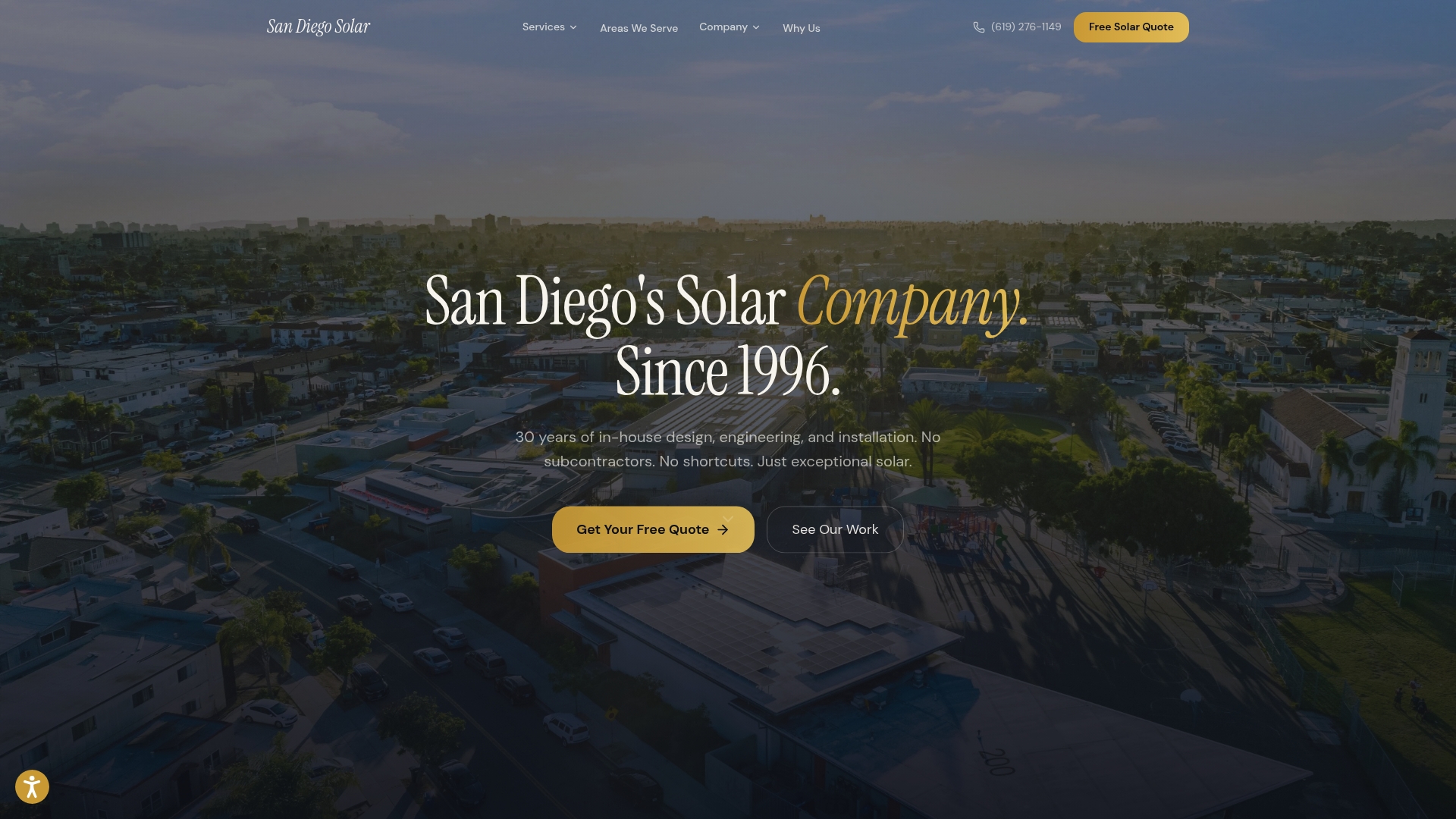
San Diego Solar holds all required California contractor licenses, carries full general liability and workers’ compensation insurance, and backs every installation with manufacturer warranties up to 25 years. The company handles all permitting, SDG&E interconnection, and HOA approvals. For homeowners ready to compare a qualified installer against other quotes, get a free solar quote with full itemization. Or review the full range of residential solar options available across San Diego County.
FAQ
What is NABCEP certification and why does it matter?
NABCEP PV Installation Professional certification is the solar industry’s most recognized credential, held by fewer than 5,000 professionals nationwide. It signals that an installer has passed a rigorous exam, logged documented field hours, and committed to continuing education.
How many quotes should I get before choosing a solar installer?
Get at least three itemized quotes. Local installers often price 10–20% below national chains and typically provide faster post-installation service.
What licenses does a solar installer need in California?
California requires both a C-46 solar contractor license and a C-10 electrical contractor license for grid-tied solar installations. Verify both licenses are active through the CSLB database before hiring.
What workmanship warranty should I require from a solar installer?
Require a minimum 10-year workmanship warranty, with 25 years being the gold standard. This warranty should explicitly cover roof penetrations, which are the most common source of long-term installation problems.
What are the biggest red flags when evaluating a solar installer?
High-pressure “decide today” sales tactics, refusal to provide itemized quotes, missing state licenses, and heavy reliance on subcontractors are the top warning signs. An installer unwilling to answer direct questions about who performs the work should be removed from consideration immediately.