Licensed Solar Contractor Explained for Homeowners
Licensed Solar Contractor Explained for Homeowners

A licensed solar contractor is a professional authorized by a state licensing board to legally install, wire, and maintain solar photovoltaic systems in compliance with electrical codes and local building regulations. Understanding what is licensed solar contractor explained means knowing the difference between a legal credential and a marketing claim. The wrong hire can void your homeowner’s insurance, block utility interconnection, and leave you holding liability for unpermitted work. This guide covers licensing types, state requirements, the licensing versus certification distinction, and exactly how to verify a contractor before you sign anything.
What types of licenses do solar contractors need?
No federal solar contractor license exists; licensing is exclusively a state-level function. About 12 states have dedicated solar-specific license classifications, including California, Florida, Nevada, Arizona, Hawaii, Maryland, Connecticut, Massachusetts, New Jersey, Oregon, and Washington. Every other state requires solar installers to hold either an electrical contractor license or a general contractor license with a licensed electrical subcontractor handling grid connection.
The variation between states is significant. California is one of the most demanding. California requires both C-46 and C-10 licenses for grid-tied solar systems. The C-46 is the Solar Contractor classification; the C-10 is the Electrical Contractor classification. Applicants must document four years of journey-level experience, pass written exams, and carry liability insurance. Surety bonds up to $25,000 may be required, and licenses renew every two years.

Florida uses a Solar Specialty contractor classification under its Construction Industry Licensing Board. Nevada requires a C-2 Electrical license for solar work. Arizona routes solar through its Registrar of Contractors under residential and commercial contractor categories. The practical takeaway: the license type that matters depends entirely on your state, and a contractor licensed in one state cannot legally work in another without separate authorization.
General contractor licenses often require subcontracting electrical work for solar interconnection to a licensed electrical contractor. This matters for homeowners because it affects who carries liability if the grid connection fails or causes damage. Always ask which license covers the electrical work on your system, not just the panel mounting.
| State | License Type Required | Dedicated Solar Classification |
|---|---|---|
| California | C-46 (Solar) + C-10 (Electrical) | Yes |
| Florida | Solar Specialty Contractor | Yes |
| Nevada | C-2 Electrical | No |
| Arizona | Residential/Commercial Contractor | No |
| Texas | Electrical Contractor | No |
Pro Tip: Search your state’s contractor licensing board website by license number, not by company name. License numbers are harder to fake than business names, and the search will show you the exact classifications, expiration date, and any disciplinary history.
Licensing vs. certification: what is the real difference?
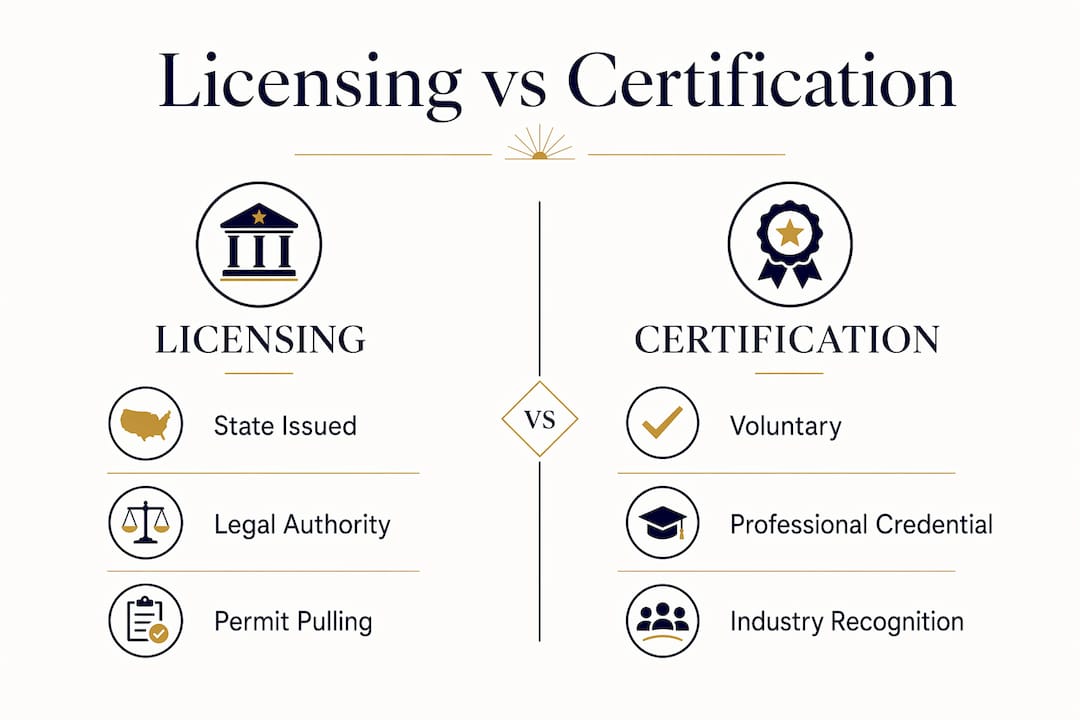
Licensing is a legal authorization required by government to work; certification is a voluntary professional credential indicating advanced training. These two things are not interchangeable, and confusing them is one of the most common mistakes homeowners make when hiring solar installers.
NABCEP, the North American Board of Certified Energy Practitioners, is the most recognized certification body in the solar industry. NABCEP certification signals that a technician has passed rigorous exams and met experience requirements. That matters for quality. It does not matter for legal authority. NABCEP certification is voluntary and does not legally authorize permit pulling except in Utah and Rhode Island, which are the only two states that recognize it as a licensing prerequisite. In every other state, a NABCEP-certified installer without a state contractor license cannot legally pull a permit.
Some rebate programs and utility incentive schemes do require NABCEP certification as a condition of eligibility. That adds market value to the credential. It still does not replace the state license.
Here is what each credential actually covers:
- State license: Legal authority to pull permits, sign off on inspections, and take contractual responsibility for code-compliant work
- NABCEP certification: Voluntary credential demonstrating technical knowledge and field experience in PV installation
- General liability insurance: Financial protection for property damage or injury during installation
- Surety bond: Financial guarantee that the contractor will complete the work as contracted
Pro Tip: When a contractor leads their pitch with “NABCEP-certified” and you have to ask about their state license, that is a red flag. A legitimate contractor will have both and will show you the license number without hesitation.
What does a licensed solar contractor legally do?
A licensed solar contractor is legally authorized to design, install, wire, and commission a complete rooftop solar system, and to pull every permit the project requires. The scope of work includes mounting the racking structure, installing photovoltaic panels, running DC and AC wiring, connecting the inverter, and coordinating utility interconnection with your power company.
The permit-pulling authority is the most critical legal function. Licensed contractors are legally required to pull permits for every project, ensuring compliance with the National Electrical Code. A permit creates an official record that the work was inspected and approved. Without it, your utility may refuse interconnection, your homeowner’s insurance may deny claims related to the system, and you may face fines or forced removal when you sell the home.
Hiring an unlicensed installer creates four specific legal risks for you as the homeowner:
- No permit on record. The installation has no official approval, which creates problems at resale and with your insurer.
- Insurance claim denial. Most homeowner’s insurance policies exclude damage caused by unpermitted work.
- Personal liability. If an unlicensed worker is injured on your property, you may bear financial responsibility.
- Utility interconnection refusal. SDG&E and other utilities require a permit before approving net metering or grid connection.
There is one more structural detail worth knowing. Every contractor license has a “qualifier,” which is the licensed individual whose credentials legally back the company’s permit authority. If the qualifier leaves and no new qualifier is appointed, the company’s license is suspended. A suspended license means the company cannot legally pull permits until a new qualifier is approved. This can stall your project mid-installation with no clear resolution timeline.
How to verify a licensed solar contractor before you hire
Verification is a five-minute task that protects a five-figure investment. Contractor licensing boards advise homeowners to verify license numbers on official state websites, checking for active status and coverage scope. Do not rely on a license number printed on a business card or a website. Look it up yourself.
Here is what to check and what to look for beyond the license itself:
- Active status: Confirm the license is current, not expired or suspended
- Classification match: Verify the license type covers solar and electrical work in your state
- Qualifier name: Note who the qualifier is and confirm they are still with the company
- Disciplinary history: Most state boards publish complaints, citations, and suspensions
- Insurance certificates: Request current general liability and workers’ compensation certificates
- Bond confirmation: Ask for the surety bond amount and carrier
Beyond the license, a license is the minimum legal standard, not a quality guarantee. Two contractors can both hold valid C-46 licenses in California and deliver very different quality of work. The license tells you the contractor is legally allowed to work. It does not tell you whether they use in-house crews or subcontractors, how they handle post-installation service, or whether their previous customers would hire them again.
Check the contractor’s company track record by reviewing completed project portfolios, reading verified reviews on Google and the Better Business Bureau, and asking directly how long the company has operated under its current license. A company that has held the same license for 10 or more years has a verifiable history that a newly licensed company simply cannot offer.
Pro Tip: Ask the contractor to name the qualifier on their license and confirm that person will be involved in your project. If they cannot answer that question clearly, the license may be valid on paper but inactive in practice.
Key takeaways
A licensed solar contractor holds state-issued legal authority to pull permits, install compliant systems, and protect homeowners from insurance and liability risks that unlicensed work creates.
| Point | Details |
|---|---|
| Licensing is state-level | No federal solar license exists; about 12 states have dedicated solar contractor classifications. |
| License and certification differ | NABCEP certification is voluntary; only a state license grants legal permit-pulling authority. |
| Permits protect homeowners | Unpermitted solar work can void insurance, block utility interconnection, and create resale problems. |
| Verify licenses directly | Check your state licensing board’s website for active status, classification, and disciplinary history. |
| License is the floor, not the ceiling | A valid license confirms legal authority; evaluate experience and crew structure separately for quality. |
Why licensing confusion costs homeowners more than they expect
I have watched homeowners make the same mistake for years. They see “NABCEP-certified” in a contractor’s marketing and assume the legal boxes are checked. They are not. Certification and licensing serve completely different functions, and confusing licensing with certification is one of the most predictable ways a solar project goes sideways before the first panel is mounted.
The licensing framework sets a legal floor. It tells you the contractor has met minimum state standards for experience, passed an exam, and carries required insurance. What it does not tell you is whether that contractor will show up with a trained in-house crew or a rotating cast of subcontractors who have never worked together. In-house crews matter for code compliance and warranty continuity in ways that a license number alone cannot capture.
The qualifier issue is the detail most homeowners never think to ask about. A company’s license is only as active as its qualifier’s involvement. If that person leaves and the company delays appointing a replacement, the license goes into suspension. The company may still be marketing itself, still signing contracts, and still showing up to job sites. But it cannot legally pull permits. You would not know unless you checked the state board directly.
My honest recommendation: verify the license yourself on the state board’s website, confirm the qualifier is still active with the company, and then evaluate the contractor’s track record and crew structure as a separate step. Both checks matter. Neither one replaces the other.
— Curtis Williamson
San diego solar: licensed, in-house, and permitted since 1996
San Diego Solar has held its contractor licenses continuously since 1996 and has never used a subcontractor on a single installation. Every system San Diego Solar installs is permitted, inspected, and interconnected through SDG&E by the same in-house crew that designed and built it. San Diego Solar pulled the first commercial solar permit in the City of San Diego and has completed thousands of residential solar installations across every neighborhood in San Diego County.

If you want to see the license, the insurance certificate, and the project timeline before you commit to anything, San Diego Solar provides all of it at no charge during a free consultation. One company, one crew, and 30 years of permitted work behind every system.
FAQ
What is a licensed solar contractor?
A licensed solar contractor is a professional holding a state-issued license that legally authorizes them to install solar energy systems, pull permits, and ensure compliance with the National Electrical Code. Licensing requirements vary by state, with about 12 states offering dedicated solar contractor classifications.
Is NABCEP certification the same as a contractor license?
No. NABCEP certification is voluntary and does not grant permit-pulling authority except in Utah and Rhode Island. A state-issued contractor license is the legal requirement for permitted solar work in every other state.
What happens if i hire an unlicensed solar contractor?
Hiring an unlicensed contractor risks permit denial, insurance claim refusal, personal liability for on-site injuries, and utility interconnection refusal. The homeowner typically bears these consequences, not the contractor.
How do i verify a solar contractor’s license?
Visit your state’s contractor licensing board website and search by the contractor’s license number. Confirm the license is active, the classification covers solar and electrical work, and there are no open disciplinary actions on record.
Does a general contractor license cover solar installation?
Not always. General contractor licenses often require subcontracting electrical work for solar interconnection to a separately licensed electrical contractor. Ask specifically which license covers the grid connection on your system.