Questions to Ask Solar Installer: 2026 Homeowner Guide
Questions to Ask Solar Installer: 2026 Homeowner Guide

Asking the right questions to ask solar installer candidates is the single most effective way to protect your investment, avoid costly surprises, and choose a company you can trust for the next 25 years. Solar is not a commodity purchase. The company you hire will affect your roof, your electric bill, and your home’s resale value for decades. Knowing which inquiries to make before you sign separates homeowners who get exactly what they expected from those who spend years dealing with warranty disputes, underperforming systems, and contractors who have disappeared. This guide gives you the specific questions that matter most, organized by category, so you walk into every consultation prepared.
What are the best questions to ask solar installer candidates?
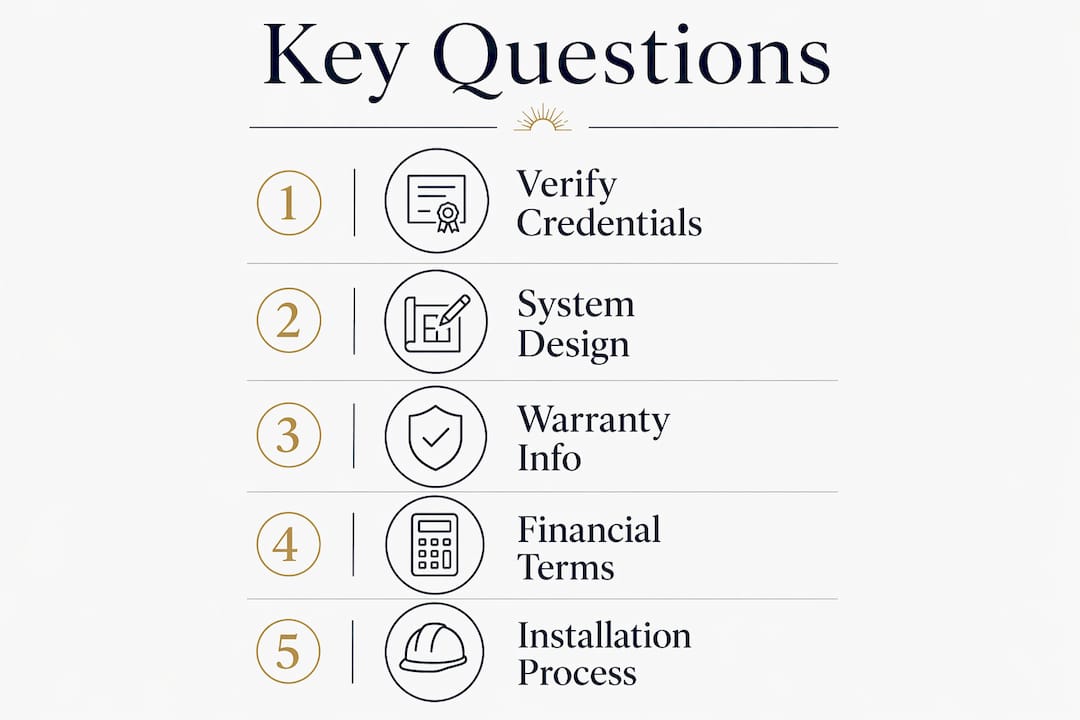
The most important solar installer interview questions fall into four categories: credentials, system design, pricing, and process. Covering all four protects you from the most common failure points in residential solar.
Start with the basics before you discuss panels or pricing:
- How long has your company been in business? At least 10 years in operation is the minimum threshold for long-term support assurance. Solar companies that launched during the last boom cycle and folded leave homeowners with no warranty support.
- Are your installation crews in-house or subcontracted? 1 in 5 cases of poor workmanship trace back to subcontractor use without direct oversight. An in-house crew means the company owns the quality of every penetration, wire run, and mount.
- What is your NABCEP certification number? The North American Board of Certified Energy Practitioners (NABCEP) is the recognized industry credential for photovoltaic installers. Demand the specific NABCEP PV Installation Professional number for the person leading your installation. Generic licensing claims are not sufficient.
- Are you licensed, bonded, and insured in California? Ask for proof, not just a yes.
- Can you provide three local references from systems installed at least two years ago? A two-year-old system has been through at least two billing cycles and one summer peak season. That reference will tell you more than any sales pitch.
- What is your BBB rating and how do you handle unresolved complaints?
Pro Tip: Search the company’s name on the California Contractors State License Board (CSLB) website before your first meeting. A valid, active license takes 30 seconds to verify and eliminates a lot of risk upfront.
Learning how to evaluate a solar company’s track record before you meet with any installer gives you a sharper filter for the answers you receive.
What should you ask about system design and warranties?
System design questions reveal whether an installer is engineering a solution for your home or selling you a standard package. The difference shows up in your electric bill every month for 25 years.
Ask these questions about equipment and design:
- What panel brand and model are you specifying, and why? A credible installer names the manufacturer, explains the efficiency rating, and tells you why that panel fits your roof and usage profile.
- What inverter type are you using: string, microinverter, or power optimizer? String inverters are cost-effective but reduce whole-system output if one panel is shaded. Microinverters from Enphase and power optimizers from SolarEdge allow each panel to perform independently. The right choice depends on your roof’s shade profile.
- What monitoring platform is included, and do I have direct access?
- What are the equipment warranties versus the workmanship warranty? Manufacturer warranties on panels typically run 25 years. Workmanship warranties vary widely. Reputable installers provide written 25-year workmanship warranties, which is the benchmark you should hold every proposal to.
- Do you provide a separate roof penetration warranty? Standard warranties typically do not cover roof damage caused by installation. A written roof penetration warranty for at least 10 years is the protection that keeps a future leak from becoming your expense.
- Do you offer any production guarantees, and how are shortfalls handled?
Here is how the three main inverter types compare:
| Inverter type | Best for | Key trade-off |
|---|---|---|
| String inverter | Simple roofs, no shading | Whole string affected by one shaded panel |
| Microinverter (Enphase) | Complex roofs, partial shade | Higher upfront cost, panel-level monitoring |
| Power optimizer (SolarEdge) | Moderate shade, cost-conscious | Requires central inverter, still panel-level data |
Pro Tip: Ask the installer to show you the shade analysis tool they used to model your roof. If they cannot produce one, their production estimate is a guess, not an engineering calculation.

Installers must clearly explain the assumptions used for shade, roof orientation, and sunlight data when projecting system output. An installer who cannot walk you through those assumptions is a red flag, not a minor concern.
What financial questions should you ask your solar provider?
Pricing transparency separates trustworthy solar contractors from those who rely on confusion to close deals. Ask every question below before you sign anything.
- What is the total installed price, including all equipment, labor, permits, and utility fees? The number on page one of a proposal is rarely the final number without this confirmation.
- What is the cash price versus the financed price? Solar loans often carry dealer fees that inflate the total cost by 20–30% above the cash price. Ask the installer to state the dealer fee as a dollar amount, not a percentage buried in fine print.
- Can you provide an itemized quote? A line-by-line breakdown shows you exactly what you are paying for and makes comparing proposals from different contractors straightforward.
- Are there any origination charges, prepayment penalties, or escalator clauses in the financing?
- How does the 30% federal Investment Tax Credit (ITC) affect my net cost, and does it apply to battery storage? The ITC covers panels, battery storage, and installation costs. An installer who cannot explain this clearly is not current on the incentives that directly affect your payback period.
- How are permitting fees and SDG&E interconnection costs handled?
Contracts should clearly state whether change orders are allowed and under what conditions. Electrical panel upgrades and structural reinforcements are the two most common sources of mid-project cost increases. Clarity on this point before you sign protects you from a bill that grows after the crew is already on your roof.
Pro Tip: Ask for the all-in price in writing before the consultation ends. Any installer who cannot give you a written number within 48 hours is not organized enough to manage your project.
What should you ask about the installation process and ongoing support?
Process questions reveal how organized and experienced a solar contractor actually is. A company that has done this thousands of times can answer every one of these without hesitation.
- What is the full project timeline from contract to system activation? A realistic timeline covers permit submission, permit approval, installation day, city inspection, and SDG&E interconnection approval. Delays in utility grid approval and permitting are common frustrations, and a good installer gives you a specific, written schedule for each step.
- Who handles permitting and utility interconnection? You should never have to call SDG&E yourself. The installer should own this process completely.
- What monitoring tools are included, and how do I access my system’s performance data? Real-time monitoring through platforms like Enphase Enlighten or SolarEdge mySolarEdge lets you catch underperformance before it costs you months of savings.
- What does post-installation support include? Ask specifically whether service calls are covered, how long the response window is, and whether there is a dedicated service team or a general customer service line.
- If I add battery storage, which circuits will be backed up? Homeowners benefit from asking whether battery systems provide full or partial backup and which specific circuits are covered. A Tesla Powerwall or Enphase IQ Battery can back up your whole home or just critical loads. You need to know which before installation day.
- Does your contract allow change orders, and what triggers them?
Pro Tip: Ask the installer to walk you through the interconnection process step by step. If they stumble, that is a sign they outsource this step or rarely manage it themselves. Permitting and interconnection experience matters as much as the hardware they sell.
Understanding whether a solar battery is worth adding to your system is a decision best made before installation, not after, because the wiring and panel design differ depending on your backup goals.
Key takeaways
The best solar installations start with the right questions, asked before any contract is signed.
| Point | Details |
|---|---|
| Verify credentials specifically | Ask for the NABCEP certification number, not just a general license claim. |
| Confirm in-house crews | Subcontracted work is the leading cause of workmanship failures; ask directly. |
| Demand a roof penetration warranty | Standard warranties exclude roof damage; get a separate written warranty for at least 10 years. |
| Get an itemized, all-in price | Dealer fees and change orders are the two biggest sources of surprise costs. |
| Ask for a written project timeline | Permitting and interconnection delays are common; a written schedule holds the installer accountable. |
Why the questions matter more than the panels
I have watched homeowners spend weeks comparing panel brands and almost no time vetting the company installing them. That is the wrong priority. A Tier 1 panel installed by an inexperienced crew with no workmanship warranty is a worse outcome than a mid-tier panel installed by a company with 20 years of local permits and a crew that has been together for a decade.
The questions in this guide are not a formality. They are a filter. An installer who cannot answer them clearly, in writing, and without hesitation is telling you something important about how they will handle your project when something goes wrong. And in solar, something always requires a judgment call: a rafter that is not where the plans showed it, a utility interconnection that takes longer than expected, a monitoring alert six months after installation.
Treat every proposal as a technical document, not a price quote. Installers who cannot justify their production assumptions are guessing at your payback period. That is your money they are guessing with.
The companies worth hiring welcome these questions. They have answered them hundreds of times. They have the references, the certification numbers, the itemized quotes, and the written timelines ready because they have built a business around earning trust, not just closing deals. That is the standard you should hold every solar contractor to.
— Curtis Williamson
Work with a solar installer who has the answers ready
San Diego Solar has been installing residential solar across San Diego County since 1996, and every question in this guide has a clear, documented answer before you sign anything. San Diego Solar uses 100% in-house installation crews with zero subcontractors, backs every installation with manufacturer warranties up to 25 years, and handles all permitting, SDG&E interconnection, and HOA approvals in-house.

Whether you are comparing quotes, adding a Tesla Powerwall or Enphase IQ battery, or starting your research from scratch, San Diego Solar offers free consultations with transparent pricing and a written project timeline before you commit. Serving homeowners from Oceanside to Chula Vista, San Diego Solar is the installer that has outlasted every industry shakeout in California. Schedule your free consultation and get every question answered by a team that has been doing this for 30 years.
FAQ
What credentials should a solar installer have?
A qualified solar installer should hold a valid NABCEP PV Installation Professional certification and a current state contractor’s license. Ask for the specific NABCEP certification number, not just a general claim of being “certified.”
How do I know if a solar quote is complete?
A complete solar quote is itemized and includes all equipment, labor, permitting fees, and utility interconnection costs. Any quote that shows only a system price without line items is missing information that could lead to surprise charges later.
What warranty should I expect from a solar installer?
Reputable installers provide a 25-year workmanship warranty in writing, plus a separate roof penetration warranty for at least 10 years. Standard equipment warranties from manufacturers like Enphase or SolarEdge typically run 25 years on panels and 10–25 years on inverters.
Does battery storage change what I need to ask?
Yes. When adding battery storage such as a Tesla Powerwall or Enphase IQ Battery, ask specifically which circuits will be backed up and whether the system provides full or partial home backup. That answer determines how useful the battery is during an outage.
How long does a residential solar installation take?
The physical installation often takes one day, but the full timeline from contract to system activation typically runs 4–10 weeks. Permitting and SDG&E interconnection approval are the steps that vary most, so ask your installer for a written schedule covering each phase.