15 Questions to Vet Solar Company Experience for Homeowners
15 Questions to Vet Solar Company Experience for Homeowners

Before you sign anything, demand these answers in writing: how long the company has operated, how many residential systems they have completed locally, whether crews are employees or subcontractors, proof of NABCEP certification and state contractor license, a written production estimate with PVWatts assumptions, and full warranty documents that specify who honors the workmanship guarantee if the company closes.
That one sentence is the whole checklist compressed. Every item below unpacks why each question matters and what a trustworthy answer actually sounds like.
San Diego Solar has operated in San Diego County since 1996 with 100% in-house crews and zero subcontractors across thousands of residential installations. That track record is the benchmark worth comparing every other installer against.
Pro Tip: The single best question to reveal whether an installer is serious about long-term service: “If your company closes tomorrow, who honors my workmanship warranty?” A vague answer or a redirect to the manufacturer is a red flag. A third-party insured workmanship warranty is the only answer that actually protects you.
Table of Contents
- 1. How do you verify a solar company’s local experience and track record?
- 2. Who actually installs the system, and what are their qualifications?
- 3. What certifications and licenses does your company hold?
- 4. What does your system design process look like for my specific roof?
- 5. What warranties do you offer, and who backs the workmanship guarantee?
- 6. How do you price your systems, and what is included in the quote?
- 7. Who handles permits, HOA approvals, and utility interconnection?
- 8. How do you verify references, licenses, and online reviews?
- 9. Watch for these red flags during the vetting process
- 10. Why these questions protect your investment long-term
- 11. Ask about staffing levels and project capacity before you commit
- 12. What is your process when something goes wrong during installation?
- 13. How will you communicate with me throughout the project?
- Key Takeaways
- The questions that actually separate good installers from the rest
- San Diego Solar: a vetted local installer with 30 years of proof
- Authority sources to verify installer claims
1. How do you verify a solar company’s local experience and track record?
Start with the basics, but push past the surface. Ask how many residential systems the company has completed, not commercial or utility-scale projects. Ask specifically how many installs they have completed in your county or zip code, because local experience means familiarity with your utility’s interconnection process, your building department’s permit requirements, and common roof types in your neighborhood.
The Department of Energy recommends working with installers who have at least three years of experience. That is a floor, not a goal. A company with a decade or more of continuous local operation has survived market downturns, supply chain disruptions, and the wave of solar company closures that followed California’s NEM 2.0-to-3.0 transition. Longevity increases the likelihood the company will still be around to honor its warranties.
Request at least three local references from installations that have been operating for 12 months or longer. Ask for one project with a roof pitch or shading profile similar to yours. That specificity tells you whether the installer has solved your exact problem before.
Pro Tip: Ask for a recent project in your zip code and request the homeowner’s permission to see the monitoring data. Actual production numbers compared to the original estimate reveal more than any sales pitch.
2. Who actually installs the system, and what are their qualifications?
This question separates companies that own their quality from those who outsource it. Ask directly: “Are the people who will install my system your employees, or do you use subcontractors?” Then ask for the qualifications of the specific crew assigned to your project.

Subcontracting complicates warranty accountability and quality oversight. When something goes wrong, the installer points to the subcontractor and the subcontractor points back. In-house crews mean one chain of responsibility. Ask whether the company has licensed electricians on staff and whether those electricians will be on-site during your installation.
If the installer does use subcontractors, the Department of Energy advises verifying the subcontractors’ credentials separately and asking how the primary installer oversees their work. Get that oversight process in writing.
3. What certifications and licenses does your company hold?
Ask for the company’s state contractor license number and the specific trade it covers. In California, solar installers typically need a C-10 Electrical Contractor license or a C-46 Solar Contractor license. Verify the license directly with the California Contractors State License Board rather than accepting a copy from the company.
NABCEP PV Installation Professional certification is the primary U.S. industry standard. It requires OSHA 10 training, documented field experience, and a comprehensive examination. Ask whether at least one key team member holds NABCEP credentials and verify it in the NABCEP directory at nabcep.org. The FTC’s consumer guidance and the American Solar Energy Society both list NABCEP as the credential worth asking for by name.
Also ask about manufacturer-specific certifications. Installers authorized by panel or inverter manufacturers often receive additional training and may offer extended warranties that non-authorized installers cannot.
Pro Tip: Call the state licensing board directly with the license number the installer provides. Confirm the license is active, covers the right trade, and has no disciplinary history. This takes five minutes and catches false claims that a document copy never would.
4. What does your system design process look like for my specific roof?
A credible installer designs to your home, not from a catalog. Ask for the specific panel brand and model, inverter type (string, microinverter, or power optimizer), racking system, and monitoring platform. Then ask why they chose each component for your roof orientation, pitch, and shading conditions.

Request the production estimate and every assumption behind it: tilt angle, azimuth, shading loss factors, system losses, and the software used to model output. NREL’s PVWatts calculator is the standard independent tool for residential production modeling. If the installer cannot explain how their estimate compares to a PVWatts run for your address, that is a gap worth pressing on.
| Design element | What to ask | What a strong answer includes |
|---|---|---|
| Panel selection | Why this brand and model for my roof? | Efficiency rating, temperature coefficient, warranty length |
| Inverter type | String, micro, or optimizer — and why? | Shading tolerance, monitoring granularity, replacement cost |
| Production estimate | What software and assumptions did you use? | PVWatts or equivalent, shading analysis, degradation rate |
| Battery readiness | How does this design accommodate future storage? | Load panel capacity, inverter compatibility, upgrade path |
| Monitoring | What platform, and how do I access it? | Real-time data, alert thresholds, installer remote access |
Ask specifically whether the design includes a shade analysis and how shading losses were calculated. Experienced installers use tools like Aurora Solar or Solargraf to model shade from trees, chimneys, and neighboring structures across all seasons. A one-size-fits-all package pitch with no shade analysis is a warning sign.
5. What warranties do you offer, and who backs the workmanship guarantee?
There are three warranty types to ask about separately: manufacturer product warranties (typically 10–25 years on panels), manufacturer performance warranties (power output guarantees), and the installer’s workmanship warranty covering the installation itself.
The workmanship warranty is the one most homeowners overlook. Ask for the length, the scope, and specifically: “If your company closes, who honors this warranty?” An insured workmanship warranty backed by a third-party program survives company closure. A self-backed warranty from a company that no longer exists is worthless.
Ask for the actual warranty documents before you sign, not a summary. Confirm the workmanship warranty covers roof penetrations, wiring, and mounting hardware, not just the panels themselves. Ask for a documented escalation path: who do you call, what is the response time commitment, and what happens if production drops below the estimated output?
Strong answers include a workmanship warranty of 10 years or longer, a named third-party insurer or program backing it, and a written service response time commitment.
6. How do you price your systems, and what is included in the quote?
Ask for an itemized, all-in quote that lists equipment cost, labor, permits, utility interconnection fees, inspections, and any monitoring hardware separately. Then ask for the cost-per-watt figure so you can compare proposals on an apples-to-apples basis regardless of system size.
A quote that bundles everything into one number without line items is a red flag. Low-ball quotes that exclude permit fees or interconnection costs look attractive until those charges appear as change orders after you have signed.
Ask which financing options are available: cash purchase, solar loan, lease, or power purchase agreement (PPA). For each option, ask:
- How is the 30% federal Investment Tax Credit (ITC) handled? (Cash and loan buyers claim it; lease and PPA customers typically do not.)
- What happens to the financing if you sell the home?
- Does equipment ownership transfer with a sale, or does the new owner inherit a lease obligation?
- Are there prepayment penalties or early termination fees?
Also request the calculation assumptions behind the savings estimate: projected electricity rate inflation, panel degradation rate (typically around 0.5% per year for quality panels), and whether inverter replacement costs are factored into the long-term payback projection. San Diego homeowners should ask specifically how the design accounts for NEM 3.0 export rates and whether battery storage changes the payback calculation.
7. Who handles permits, HOA approvals, and utility interconnection?
Ask directly: “Do you have in-house engineers who prepare permit drawings, or do you outsource that?” Then ask who files the utility interconnection application and whether they have a dedicated permitting staff member who manages your project through to permission to operate (PTO).
Top-tier installers have dedicated permitting staff and can give you typical local timelines from contract signing to PTO. Ask for that timeline in writing. In San Diego County, the permitting and interconnection process with SDG&E can add weeks to a project. An installer who has done it hundreds of times locally knows the current timeline; one who is new to the area is guessing.
If your home is in an HOA, ask whether the installer will prepare and submit the HOA application package and whether they have handled approvals in your specific association before. Some HOAs have specific aesthetic requirements for panel placement and racking color. An experienced local installer knows those requirements before the application goes in.
8. How do you verify references, licenses, and online reviews?
Do not just call the references an installer provides. Those contacts are pre-selected. Use them, but also run independent checks.
- Verify the license. Call your state contractor licensing board with the license number. Confirm it is active, covers the correct trade, and has no complaints or disciplinary actions.
- Verify insurance. Ask for a certificate of insurance and call the insurer directly to confirm the policy is current. Consumer guidance recommends confirming coverage with the insurer rather than accepting documents from the company alone.
- Check the NABCEP directory. Search nabcep.org for the installer’s name or company to confirm certification status.
- Call references with specific questions. Ask: Did the crew show up on the scheduled date? How did the company communicate when there were delays? Was the site cleaned up after installation? Is the system producing close to what was estimated? Have you needed any service calls, and how did the company respond?
- Read reviews for patterns. A high volume of reviews with a strong average is more reliable than a perfect score with three reviews. Look at how the company responds to negative reviews — dismissive responses are as telling as the complaints themselves.
- Search for complaints. Search the company name plus “complaints” or “BBB” to surface unresolved disputes.
Pro Tip: Ask a reference whether you can see their monitoring app data. Real production numbers from a system similar to yours in a nearby zip code are the most honest production estimate you will find.
9. Watch for these red flags during the vetting process
Some installer behaviors should stop the process immediately.
- Refusal to provide a license number or insurance certificate. Walk away. No legitimate contractor hesitates on this.
- Pressure to sign the same day. High-pressure tactics and “today only” pricing are sales tactics, not business practices.
- A quote with no line items. If the installer cannot break out equipment, labor, permits, and fees separately, get a written correction before proceeding.
- Production estimates significantly higher than a PVWatts check. Inflated estimates are a common red flag. Run your own PVWatts check at pvwatts.nrel.gov and compare.
- Vague answers about who installs the system. If the installer cannot name the crew or confirm employee status, the answer is probably subcontractors.
- No local references. A company that cannot provide three local residential references from the past 12 months has not done enough local work to know your market.
If you suspect fraud, unlicensed work, or unsafe electrical installation, file a complaint with your state contractor licensing board and contact your local building department. Do not allow work to continue on an unpermitted installation.
10. Why these questions protect your investment long-term
The vetting questions above are not bureaucratic box-checking. Each one maps to a real financial or safety risk.
NABCEP certification requires OSHA 10 training, documented field experience, and a comprehensive examination — it is the primary U.S. industry standard for residential solar installers. The Department of Energy lists NABCEP as the gold standard among renewable energy system installers and recommends verifying credentials before hiring.
A company with years of stable local operation is more likely to honor a 25-year manufacturer warranty claim than one that launched during the last solar boom. In-house crews create a single chain of accountability for workmanship. Written production estimates with documented assumptions give you a benchmark to hold the installer to. And an insured workmanship warranty means your roof penetrations are covered even if the company that drilled them is gone.
The FTC’s consumer guidance puts it plainly: compare detailed bids from several companies, confirm all terms match what salespeople told you, and get every warranty and production guarantee in writing before signing.
11. Ask about staffing levels and project capacity before you commit
A company that books more projects than its crew can handle will miss your installation date. Ask directly: “How many projects are currently in your pipeline, and what is your typical lead time from contract to installation?” Then ask how many installation crews the company runs simultaneously.
A small company with two crews and a six-week backlog may still deliver on time. A larger company with 20 active projects and three crews may not. The number that matters is the ratio of projects to crews, not the company’s size. Ask for the specific installation date in writing as part of the contract, not a range.
12. What is your process when something goes wrong during installation?
Every installation hits unexpected conditions: a roof deck that needs reinforcement, a panel layout that has to shift because of a hidden vent, a utility interconnection that takes longer than projected. Ask the installer to describe a recent project where something changed mid-installation and how they handled it.
A strong answer includes a clear communication protocol (who calls you, how quickly, what the options are), a written change-order process before any additional work begins, and a project manager who stays assigned to your job from contract to PTO. Vague answers like “we figure it out” or “it rarely happens” are not reassuring. Unexpected conditions are common enough that any experienced installer has a process for them.
13. How will you communicate with me throughout the project?
Communication failures are the most common complaint in solar installation reviews, and they are entirely preventable. Ask the installer to describe their standard communication process: who is your point of contact after the sale, how often will they update you on permit status and scheduling, and what is the response time commitment for questions or concerns?
Ask specifically: “Will I still be able to reach the person I am talking to now after I sign, or does my project transfer to a different team?” The handoff from sales to installation is where communication most often breaks down. A company with a dedicated project coordinator who manages your job from contract to PTO is worth more than a sales rep who disappears after the deposit clears.
Key Takeaways
Asking the right questions before you hire a solar installer is the single most effective way to protect your investment, your roof, and your long-term warranty coverage.
| Point | Details |
|---|---|
| Demand written documentation | Get an itemized quote, license and insurance certificates, full warranty documents, and a written production estimate with assumptions before signing. |
| Verify credentials independently | Confirm the contractor license with your state board, check NABCEP certification at nabcep.org, and call the insurer directly to verify coverage. |
| Prioritize in-house crews | In-house installation teams create a single chain of warranty accountability; subcontracting complicates responsibility when problems arise. |
| Get three local references | Request contacts from installations operating for 12 months or longer, and ask specific lifecycle questions about communication, cleanup, and production. |
| San Diego Solar | In-house crews, 30 years of local operation, and written project timelines before you commit — the benchmark for vetting any San Diego installer. |
The questions that actually separate good installers from the rest
Most homeowners ask the wrong questions. They ask about price first and credentials last. The installers who give the most polished sales presentations are not always the ones who show up with a licensed electrician, pull the permit correctly, and answer the phone two years later when a monitoring alert fires.
The questions that reveal real experience are the uncomfortable ones: “Who exactly installs my system?” “What happens to my workmanship warranty if you close?” “Can I see the monitoring data from a nearby project?” Experienced installers answer those questions without hesitation because they have nothing to hide. Evasive answers, redirects to marketing materials, or pressure to sign before you have verified anything are the actual red flags.
The solar industry has gone through multiple boom-and-bust cycles. Companies that survived them did so by doing the work correctly the first time and standing behind it afterward. That is what 30 years of continuous local operation actually means.
San Diego Solar: a vetted local installer with 30 years of proof
Thirty years of in-house residential installations in San Diego County is a track record you can verify. San Diego Solar pulled the first commercial solar permit in the City of San Diego and has completed thousands of residential systems with zero subcontractors. Every question in this checklist has a direct answer: licensed, NABCEP-credentialed crew members, insured workmanship, written production estimates, and a project timeline delivered before you sign.
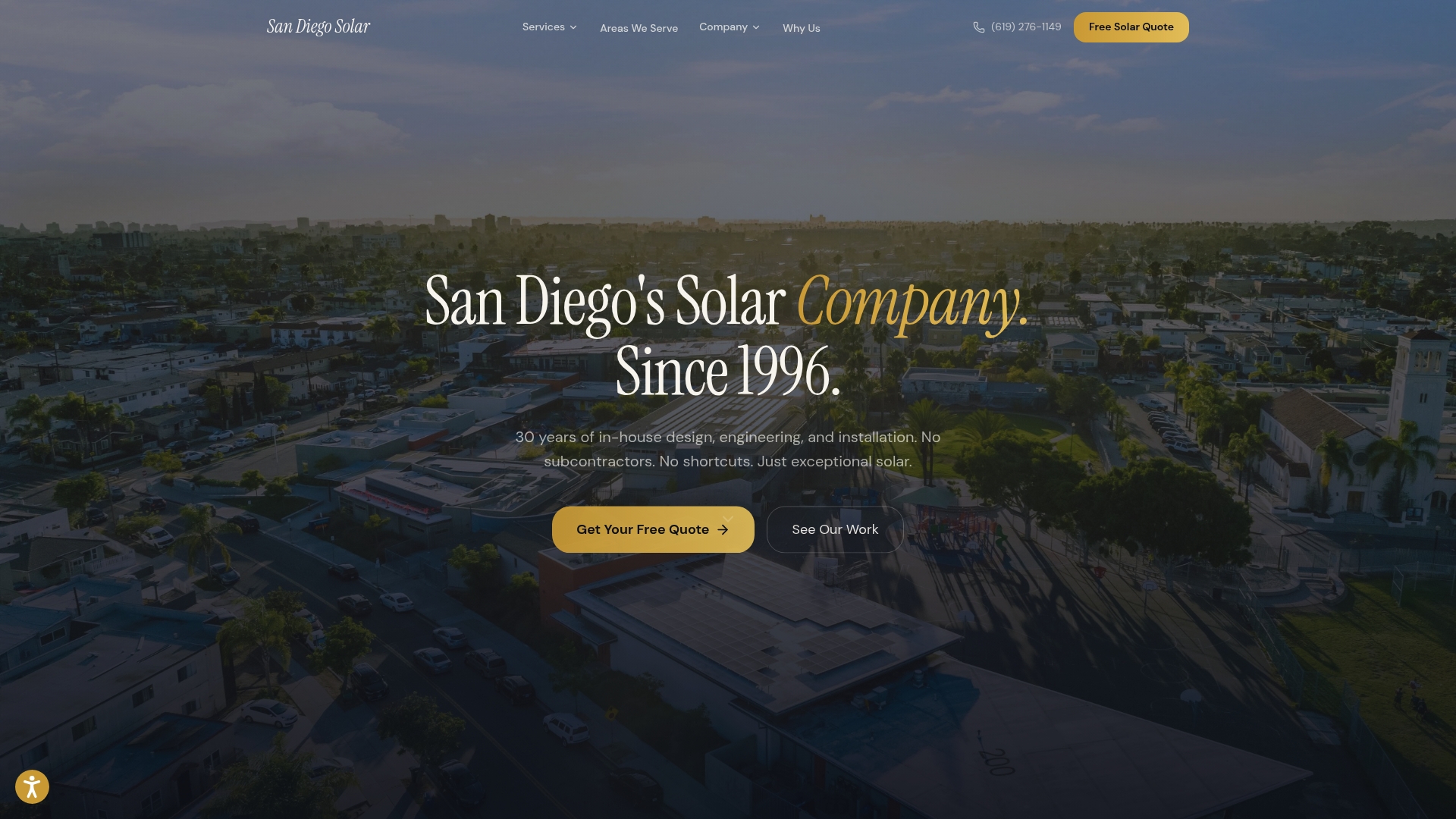
San Diego Solar handles all permitting, SDG&E interconnection, and HOA approvals in-house. The company specializes in NEM 3.0 solar plus battery strategies and installs Tesla Powerwall, Enphase IQ, and Franklin WH storage systems. The 30% federal ITC applies to panels, battery storage, and installation.
Your next three steps:
- Schedule a free consultation and request a written production estimate with PVWatts assumptions.
- Ask for the written project timeline and warranty documents before you commit.
- Verify the license, insurance, and NABCEP credentials using the steps in this guide.
Authority sources to verify installer claims
Use these resources to independently confirm licenses, certifications, and production estimates before hiring any installer.
| Source | What it verifies | URL |
|---|---|---|
| NABCEP directory | PV Installation Professional certification status | nabcep.org |
| NREL PVWatts | Independent production estimate for your address | pvwatts.nrel.gov |
| NASCLA | State contractor licensing guidance and reciprocity | nascla.org |
| FTC Consumer Advice | Solar contract terms, lease/PPA rights, and complaint guidance | consumer.ftc.gov |
| Department of Energy | Installer selection criteria and incentive guidance | energy.gov |
| DSIRE | State and local solar incentive programs | dsireusa.org |
| ASES | 40 questions to ask any solar installer | ases.org |
Screenshot or save the license number and insurance certificate the installer provides, then verify each independently using the sources above. A legitimate installer will not object to that process.