SDG&E Time-of-Use for San Diego Homes: New 10 a.m. to 2 p.m. Window
SDG&E Time-of-Use for San Diego Homes: New 10 a.m. to 2 p.m. Window

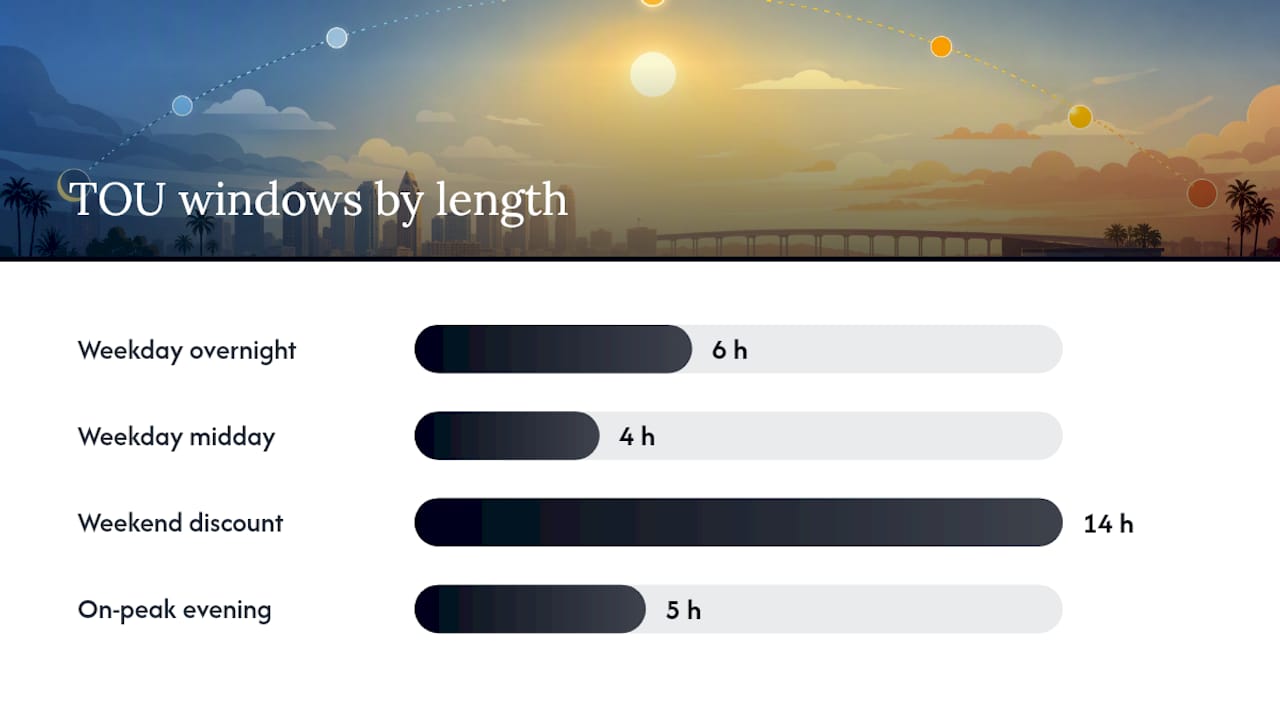
SDG&E’s cheapest electricity is super off-peak power: overnight from midnight to 6 a.m. every day, plus weekdays from 10 a.m. to 2 p.m. year-round as of May 1, 2026. On-peak runs 4 p.m. to 9 p.m. daily and costs the most, so that’s the window to avoid for laundry, dishwashers, and EV charging. Weekends and holidays get an extended super off-peak stretch from midnight to 2 p.m. Set your appliances and EV charger to those windows and you’ll cut real money off your bill without changing a single habit besides the clock.
TL;DR:
- Running household appliances during the expanded super off-peak hours from midnight to 2 p.m. can significantly lower energy costs, especially on weekends and holidays.
- The on-peak period from 4 p.m. to 9 p.m. remains the most expensive time, so avoiding heavy loads during those hours is essential for savings.
- Most households should select their SDG&E TOU plan based on actual usage patterns, running a simulation first to identify the most cost-effective option.
- Solar and battery storage systems can maximize savings by shifting midday generation to the expensive on-peak window, especially under current net metering rules.
- Tiered pricing still applies alongside TOU rates, so managing total consumption and leveraging flexible schedules are both crucial for minimizing bills.
Table of Contents
- What Are SDG&E’s Time-of-Use Periods, Exactly?
- Which SDG&E TOU Plan Fits Your Household?
- What Changed With SDG&E’s 2026 Super Off-Peak Expansion?
- How Do You Check Your SDG&E Plan and Switch If Needed?
- When Should You Run Laundry, Charge an EV, or Avoid Power Use?
- Which San Diego County Installer Understands SDG&E’s TOU Schedule?
- Do TOU Plans Carry Demand Charges or Extra Fees?
- How Do TOU Rates Work With Solar and Net Metering?
- Are There TOU Exceptions for Low-Income or Vulnerable Customers?
- Is a Flat-Rate Plan Ever Better Than Time-of-Use?
- A Local Contractor’s Take on Realistic Savings
- Let San Diego Solar Build Your Schedule Around SDG&E’s Rates
- Where to Verify SDG&E’s Current TOU Rates and Rules
- Sources
- FAQ
What Are SDG&E’s Time-of-Use Periods, Exactly?
On-peak runs from 4 p.m. to 9 p.m. every day of the year, no exceptions for weekends. This is SDG&E’s highest-priced period, and it lines up with exactly when San Diego households turn on ovens, run laundry after work, and plug in cars the moment they get home. That overlap is precisely why it’s priced the way it is.
Off-peak fills most of the remaining hours and varies slightly by plan, generally covering mid-morning through late afternoon and again after 9 p.m. before super off-peak kicks in overnight.
Super off-peak is the cheapest tier, and as of May 1, 2026, it covers:
- Every day, midnight to 6 a.m.
- Weekdays, 10 a.m. to 2 p.m. (new, year-round)
- Weekends and holidays, midnight to 2 p.m.
Season matters for rate levels, not the clock times themselves. Summer runs June 1 through October 31, winter runs November 1 through May 31, and summer on-peak pricing runs noticeably higher because grid demand spikes with air conditioning use across the county.
Which SDG&E TOU Plan Fits Your Household?
Most San Diego County homes land on one of four residential TOU plans, and the right one depends less on your total usage and more on when you actually use power.
- TOU-DR1: The default for many customers, with three distinct pricing periods (on-peak, off-peak, super off-peak). It rewards households that can genuinely shift laundry, dishwashing, and charging into the overnight or new midday window. Because on-peak doesn’t start until 4 p.m., it’s more forgiving for people who work from home or run errands in the early afternoon.
- TOU-DR2: A simpler two-period structure. It can suit customers who find three pricing tiers confusing, but the tradeoff is often a narrower off-peak window in the afternoon, which gives you less flexibility to dodge higher rates before 4 p.m.
- TOU-ELEC: Built for electrified homes, meaning houses that have swapped gas appliances or heating for electric equivalents. It reflects the higher, steadier baseline load those homes carry.
- EV-TOU: Designed around dedicated EV charging periods, aligning naturally with the Pricing Plan Chooser tool SDG&E offers for homeowners deciding between standard TOU and EV-specific pricing.
One thing every plan shares: tiered pricing based on total consumption still applies underneath the time-of-use structure. Homes that stay under the Tier 1 baseline allowance (roughly 130% of a calculated baseline) pay less per kilowatt-hour than usage above that line, regardless of what time it happens. A household that shifts everything into super off-peak but still runs a pool pump and central air nonstop in August can still land in Tier 2 pricing.
What Changed With SDG&E’s 2026 Super Off-Peak Expansion?
Before May 1, 2026, super off-peak’s daytime discount was seasonal and limited mostly to spring months. SDG&E made it permanent and year-round, adding a full weekday window from 10 a.m. to 2 p.m. every month of the year. Local coverage from NBC San Diego framed the change around a practical benefit: it opens up daytime EV charging and midday flexibility that didn’t reliably exist before.
That four-hour weekday window is worth building a routine around. Run the dishwasher after a late breakfast instead of after dinner. If you work from home, start a laundry load at 10 a.m. instead of letting it pile up until evening. Pool and spa pumps, which many San Diego County homes run daily, are a natural fit for that window rather than running on a default afternoon timer. Homeowners with programmable thermostats can also use the midday hours to pre-cool the house before the 4 p.m. on-peak period starts, which reduces how hard your air conditioner has to work during the expensive hours.
Pro Tip: The midday super off-peak window only applies if your plan includes a super off-peak tier at all. Not every legacy or grandfathered rate schedule does, so confirm your specific plan in My Energy Center before rearranging your whole daily routine around it.
How Do You Check Your SDG&E Plan and Switch If Needed?
Figuring out your current rate takes a few minutes, and switching costs nothing if you decide a different plan fits better.
- Pull up a recent bill, paper or PDF, and look under “Electric Service” for the line labeled “Rate.” That tells you which TOU plan you’re already on.
- Log into My Energy Center and go to Billing, then Pricing Plans.
- Run the personalized recommendation tool, which simulates your actual usage history against every available plan.
- Compare the simulated annual cost across plans before switching anything.
- If a different plan comes out ahead, switch directly through My Energy Center. SDG&E doesn’t charge a fee for the change.
Skipping the simulation step is the most common mistake homeowners make. A plan that looks cheaper on paper can cost more for a household with a specific usage pattern, so run the numbers first. If something still doesn’t add up, SDG&E’s customer support can walk through your specific bill.
When Should You Run Laundry, Charge an EV, or Avoid Power Use?
The cheapest time to do laundry in San Diego is overnight between midnight and 6 a.m., or weekdays from 10 a.m. to 2 p.m. under the expanded super off-peak window. Weekends stretch that discount window all the way from midnight to 2 p.m., giving you a longer Saturday or Sunday morning stretch to run multiple loads back to back. The same logic answers the broader question for the cheapest time to do laundry in California generally: super off-peak windows exist on most utility TOU schedules, though the specific hours vary by provider.
EV charging follows the identical logic. If your charger supports scheduling, or your EV’s app lets you delay charging start times, set it to begin at midnight or during the weekday midday window rather than the moment you plug in after work.
What not to use during SDG&E peak hours: avoid running the dishwasher, washer, dryer, oven, and EV charger between 4 p.m. and 9 p.m. daily. That five-hour block carries the highest per-kilowatt-hour price on every standard TOU plan.
- Laundry and dishwashers: shift to overnight or the 10 a.m. to 2 p.m. window.
- EV charging: schedule for midnight start or midday weekday charging.
- Ovens and stovetops: harder to shift, so at minimum avoid pairing them with other heavy loads during on-peak.
SDG&E also runs occasional Reduce Your Use event days, typically triggered by extreme heat or grid strain, when customers who cut usage during a specified window can earn bill credits rather than face extra charges. Ignoring an event day doesn’t automatically penalize you, but it does mean missing out on the credit and running at standard on-peak pricing during an already strained grid period.
Which San Diego County Installer Understands SDG&E’s TOU Schedule?
Finding an installer who actually designs around your utility’s pricing structure, rather than just bolting panels onto a roof, makes a measurable difference in how much a solar or battery system actually saves you under TOU billing.
| Installer | Google Reviews | Services Offered | Best For |
|---|---|---|---|
| san diego solar install | 5★ (49 reviews) | Residential solar panel installation, battery storage, EV charger integration, SDG&E interconnection support | Homeowners seeking full-service solar plus battery installations in San Diego County |
| san diego solar install (5★, 49 reviews) | 5★ (49 reviews) | Residential solar installation and related electrical work | Homeowners comparing multiple local quotes before committing |
Before signing with any installer, confirm three things directly: an active California contractor license, written manufacturer warranties on both panels and any battery equipment, and hands-on experience filing SDG&E interconnection paperwork. That last piece matters more than most homeowners realize. A poorly filed interconnection application can delay your system going live by weeks, during which you’re still paying full retail TOU rates with a system sitting idle on your roof.
Do TOU Plans Carry Demand Charges or Extra Fees?
Standard SDG&E residential TOU plans don’t carry a separate demand charge the way commercial rate schedules often do. Demand charges, which bill based on your single highest moment of power draw in a billing cycle, are largely a business and industrial pricing mechanism, not something applied to typical residential TOU-DR1, TOU-DR2, TOU-ELEC, or EV-TOU accounts.
That doesn’t mean residential TOU billing is fee-free. Every bill still includes fixed delivery charges, applicable public purpose program surcharges, and any wildfire-related cost recovery charges SDG&E is authorized to collect, layered on top of the time-based energy rate itself. These fixed charges apply regardless of when you use power, so shifting your laundry to 2 a.m. won’t touch them.
Tiered pricing is the other cost layer worth watching. Even within a favorable TOU plan, total monthly consumption above the Tier 1 baseline allowance triggers a higher per-kilowatt-hour rate on top of whatever time-of-use period you’re in. A household running heavy air conditioning through a San Diego summer can shift everything into super off-peak hours and still see a jump in the bill simply from crossing into Tier 2 territory on total usage.
The practical takeaway: TOU savings come from timing, but total consumption still sets a floor under what you’ll pay. Homeowners chasing the lowest possible bill need to manage both levers at once, not just the clock.
How Do TOU Rates Work With Solar and Net Metering?
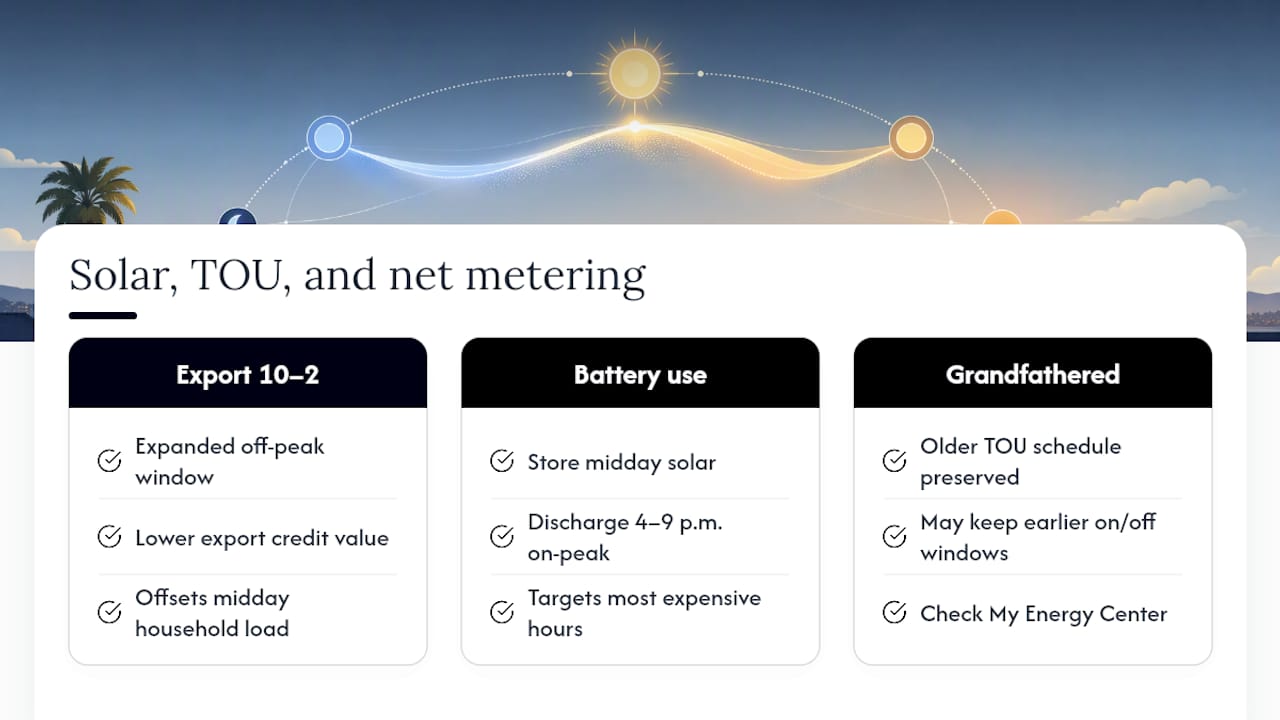
Solar changes the TOU math considerably, because the value of the power you generate depends heavily on when you generate it versus when you use it. A rooftop system produces most of its output during daylight hours, which now overlaps directly with the expanded weekday super off-peak window from 10 a.m. to 2 p.m. That’s useful for offsetting midday household load, but it also means the energy you export to the grid during those same hours is worth less under net metering than energy exported during expensive on-peak hours.
Under current net metering rules (NEM 3.0), the compensation you receive for exported solar power is credited based on the value of energy at the time you send it back to the grid, which makes battery storage far more valuable than it was under older net metering structures. A battery lets you store midday solar production and release it during the 4 p.m. to 9 p.m. on-peak window instead of exporting it for a lower credit, directly targeting the most expensive hours on your bill rather than the cheapest ones.
Some solar customers installed under older rate structures may qualify for TOU period grandfathering, preserving an earlier version of the on-peak and off-peak windows rather than shifting automatically to current definitions. If you installed solar years ago and aren’t sure which schedule applies, that’s worth confirming directly through My Energy Center rather than assuming current TOU hours apply to your account.
Are There TOU Exceptions for Low-Income or Vulnerable Customers?
SDG&E offers rate assistance programs that run alongside, not instead of, standard TOU pricing. The California Alternate Rates for Energy (CARE) program provides a percentage discount on the total bill for qualifying low-income households, and that discount applies on top of whatever TOU plan the household is enrolled in. Medical Baseline is a separate program that raises the baseline allowance for customers who depend on electrically powered medical equipment, which softens the impact of tier pricing rather than changing the time-of-use windows themselves.
Neither program eliminates on-peak pricing or changes when super off-peak hours occur. What they change is the cost sensitivity: a CARE household still pays more running the dryer at 6 p.m. than at 6 a.m., just from a lower overall baseline. For households managing a family member’s medical equipment that has to run continuously regardless of time, Medical Baseline’s expanded allowance matters more than any scheduling trick, since that usage genuinely can’t be shifted to cheaper hours.
Homeowners who think they might qualify for either program should check eligibility directly through SDG&E rather than assuming standard TOU advice applies equally to every household. Scheduling flexibility helps most, but it helps least for households whose biggest loads are medically necessary and constant.
Is a Flat-Rate Plan Ever Better Than Time-of-Use?
For most San Diego County homeowners today, flat-rate plans aren’t the default option anymore. SDG&E has shifted the large majority of residential customers onto TOU pricing structures, and flat-rate availability is limited. Where a flat rate is still an option, it removes the timing variable entirely: you pay the same rate whether you run the dryer at noon or at 7 p.m.
That simplicity has a real cost for anyone who can shift usage. A household that already avoids on-peak hours, whether by habit or by scheduling, will almost always save more under a TOU plan than under an equivalent flat rate, because a meaningful share of their usage lands in the cheapest pricing tier. The math flips for households that genuinely can’t shift load: multiple people working non-flexible daytime schedules, medical equipment running around the clock, or a home occupied and drawing power at consistent levels all day regardless of price.
The honest answer is scenario-dependent rather than universal. If your household has almost no ability to delay laundry, dishwashing, or charging into off-peak hours, a flat structure removes the risk of accidentally running everything during the most expensive window. If you have even modest flexibility, TOU pricing rewards that flexibility directly, and the newly expanded midday super off-peak window makes that flexibility easier to use than it was before May 2026.
A Local Contractor’s Take on Realistic Savings
Battery storage genuinely changes peak exposure by shifting stored midday power into the 4 p.m. to 9 p.m. window, but payback depends on actual usage patterns, not marketing math. The mistakes I see most: switching TOU plans without running a My Energy Center simulation first, and misjudging how tiered pricing stacks on top of time-of-use savings. Run the simulation, then get a local consult before assuming any plan or battery pays for itself.
— Curtis Williamson
Let San Diego Solar Build Your Schedule Around SDG&E’s Rates
Timing your laundry around super off-peak hours only goes so far when your biggest loads, air conditioning, an EV, a pool pump, still land in expensive windows some days. San Diego Solar has spent 30 years designing systems around exactly this problem for San Diego County homeowners, using 100% in-house crews with no subcontractors on every installation.

Our team handles residential solar installation, battery storage systems from Tesla Powerwall, Enphase IQ, and Franklin WH, and EV charger integration, all engineered around your actual SDG&E rate schedule rather than a generic template. They also manage the full SDG&E interconnection process to help minimize delays in system activation. If you’re planning a home improvement project alongside your energy upgrades, One Day Doors & Closets serves San Diego homeowners tackling both at once.
A free consultation is the logical next step: bring a recent SDG&E bill, and we’ll walk through whether a battery, a full solar system, or both actually pencils out against your specific usage pattern. Get a free solar quote and find out what your real numbers look like before you commit to anything.
Where to Verify SDG&E’s Current TOU Rates and Rules
- SDG&E’s Super Off-Peak page has the official current window definitions.
- SDG&E’s residential pricing plans page lists plan comparisons and on-peak hours.
- The TOU-DR tariff PDF contains the full official rate tables.
- NBC San Diego’s coverage summarizes the May 2026 change in plain language.
Sources
- Extended Super Off-Peak Hours | San Diego Gas & Electric
- Residential Pricing Plans - San Diego
- SDG&E adds weekday daytime super off-peak hours year-round – NBC San Diego
FAQ
What Is the Cheapest Time to Do Laundry in San Diego?
The cheapest time is during super off-peak hours: midnight to 6 a.m. every day, or 10 a.m. to 2 p.m. on weekdays under SDG&E’s expanded 2026 schedule. Weekends stretch that discount from midnight to 2 p.m., giving you a longer morning window to run several loads.
What Should You Avoid Using During SDG&E Peak Hours?
Avoid running the dishwasher, washer, dryer, oven, and EV charger between 4 p.m. and 9 p.m. daily, since that’s SDG&E’s highest-priced on-peak window on every standard TOU plan. Shifting even one or two of those loads to overnight or midday hours noticeably reduces your bill.
What Time Is Off-Peak Hours in San Diego?
Off-peak generally covers mid-morning through late afternoon and the hours right after 9 p.m., with exact windows varying slightly by plan. Super off-peak, the cheapest tier, covers midnight to 6 a.m. daily plus weekday 10 a.m. to 2 p.m. and extended weekend hours from midnight to 2 p.m.
What Is the Cheapest Time to Do Laundry in California?
It depends on the utility, since each provider sets its own TOU windows, but the pattern holds statewide: overnight and midday hours are consistently the cheapest across most time-of-use schedules. In San Diego County under SDG&E, that means midnight to 6 a.m. or the weekday 10 a.m. to 2 p.m. super off-peak window.
How Do I Check Which SDG&E Plan I’m On?
Look at a recent bill under “Electric Service” for the line labeled “Rate,” or log into My Energy Center and check Billing, then Pricing Plans. Running the personalized simulation there shows whether a different plan would save you money before you switch.
Can Solar and a Battery Reduce My Exposure to On-Peak Rates?
Yes. A battery stores midday solar production and releases it during the 4 p.m. to 9 p.m. on-peak window instead of exporting it at a lower net metering credit. San Diego Solar designs these systems specifically around SDG&E’s current TOU schedule for homeowners across San Diego County.