5–15 Years: Field Proven Solar Battery Lifespan Advice for Homeowners
5–15 Years: Field Proven Solar Battery Lifespan Advice for Homeowners
Most home solar batteries reach the end of their useful life in 5 to 15 years, and a well-managed lithium iron phosphate (LFP) system running in a mild climate can push past that range. Manufacturer warranties usually guarantee the battery will still hold 60 to 80% of its original capacity at the 10-year mark, which is not the same thing as the battery dying on schedule. Chemistry, depth of discharge, temperature, and how you set up the system all move that number up or down.
TL;DR:
- Most home solar batteries last between 5 to 15 years, with lithium iron phosphate systems potentially exceeding this range in mild climates.
- Battery lifespan depends heavily on chemistry, cycle count, temperature, depth of discharge, and proper installation, with LFP batteries rated for 6,000 to 10,000 cycles.
- Warranties guarantee a capacity retention of about 60 to 70% at 10 years; many batteries continue functioning well beyond that, especially with good maintenance.
- Replacing a battery costs from a couple thousand dollars for small units to over $15,000 for larger systems, with timing influenced by performance decline and capacity needs.
- Refurbished or second-life batteries typically have shorter lifespans and less reliable warranties compared to new units, making them less suitable for systems designed to last 10 to 15 years.
Table of Contents
- What Determines Solar Battery Lifespan by Chemistry?
- What Factors Actually Shorten or Extend Battery Life?
- What Do Solar Battery Warranties Actually Guarantee?
- When Should You Replace Your Solar Battery?
- How Can Homeowners Extend Solar Battery Life?
- What Does Battery Replacement Cost, and How Does It Fit Your Solar ROI?
- Do Refurbished or Second-Life Batteries Last as Long as New Ones?
- What Happens to Solar Batteries at End-Of-Life?
- What Do 30 Years in the Field Teach You About Battery Failures?
- Get a Battery System Sized and Installed to Last
- Sources
What Determines Solar Battery Lifespan by Chemistry?
Battery makers rate their products in cycles, not years, and translating that into a homeowner’s timeline takes a little math. A full cycle means one complete charge and discharge. If your battery cycles once a day, a 6,000-cycle rating theoretically stretches over 16 years, but almost nobody hits the rated number exactly because temperature and depth of discharge chip away at it faster than the spec sheet suggests.
The three chemistries you’ll run into behave very differently:
- LFP (lithium iron phosphate): the dominant chemistry in current residential storage, including most Tesla Powerwall and Enphase IQ units. LFP batteries typically run 6,000 to 10,000 cycles and lose capacity slowly, around 1 to 2% per year, which is why most systems installed today are built around it.
- NMC (nickel manganese cobalt): packs more energy into a smaller footprint but wears out faster, often in the 1,500 to 3,000 cycle range. It shows up more in older installs and some compact all-in-one units.
- Lead-acid: cheap upfront, but cycle life is a fraction of lithium chemistries and it demands frequent maintenance. It’s largely obsolete for new residential solar and shows up mainly in older off-grid retrofits.
Warranty language like “70% capacity at 10 years” is an industry-standard framing, not a marketing gimmick. EnergySage notes that most home battery warranties run about 10 years and guarantee a capacity floor in that 60 to 70% range. That’s the manufacturer’s promise of a minimum. Plenty of batteries keep working well past it, just at reduced output.
What Factors Actually Shorten or Extend Battery Life?
Two aging processes run at the same time inside every lithium battery, and understanding the difference changes how you think about maintenance.
Cycle aging comes from charging and discharging. Every cycle causes microscopic wear on the electrodes. Calendar aging happens regardless of use, driven mostly by time and temperature, and it’s often the dominant factor in grid-tied residential systems that don’t cycle particularly hard. A battery sitting mostly idle in a hot garage can degrade faster than one cycling daily in a cool, shaded utility room.
Depth of discharge (DoD) is the single biggest lever homeowners actually control. The relationship isn’t linear: draining a battery to 20% remaining capacity stresses it disproportionately more than stopping at 50%. LFP chemistry tolerates deeper cycling, often 80 to 90% DoD, while NMC ages more gracefully when kept closer to a 60 to 80% range.
Temperature is where the math gets dramatic. Battery degradation follows Arrhenius kinetics, meaning every 10°C rise in operating temperature roughly doubles the degradation rate. A battery living in an unventilated garage in July is aging on a completely different clock than one in a climate-controlled space.
Every 10°C hotter roughly doubles a lithium battery’s rate of capacity loss — which is why installation location matters as much as the battery model you buy.
C-rate (how fast you charge or discharge relative to capacity) and average state of charge also factor in. Batteries that sit at a high state of charge for long stretches, or get hit with frequent fast discharges for time-of-use arbitrage, tend to fade faster than ones cycling through a moderate range.
Pro Tip: Ask your installer to show you the battery’s operating temperature range in the spec sheet, then check where the unit will actually be mounted. A garage that hits 100°F in summer is a very different environment than an interior wall.
What Do Solar Battery Warranties Actually Guarantee?
A battery warranty is a performance guarantee, not a lifespan promise. Reading the fine print carefully saves homeowners from a lot of confusion down the road.
Most residential warranties combine three limits at once:
- Time limit: typically 10 years, occasionally longer for premium units.
- Throughput or cycle limit: a cap on total energy moved through the battery over its life, expressed in cycles or megawatt-hours.
- Capacity retention floor: the guarantee that the battery still holds a stated percentage, commonly 60 to 70%, of its original capacity by the end of the term.
None of those numbers mean the battery shuts off the day the warranty expires. It means the manufacturer has committed to a minimum performance floor before that date, and many batteries keep delivering useful backup power well beyond it, just with less runway.
To keep that warranty valid and enforceable, hang onto the commissioning report your installer generates at activation, keep firmware updated when the manufacturer pushes releases, and register the system if the manufacturer requires it. Skipping registration is a common, entirely avoidable reason homeowners lose coverage they actually paid for.
When Should You Replace Your Solar Battery?
A few observable signs tell you a battery is heading toward replacement before it fails outright.
- Evening runtime drops sharply. If the battery used to cover a full evening and now taps out two hours early, state of health (SoH) has likely slipped well below its original rating.
- Monitoring software shows SoH near the warranty floor. Most inverter and battery apps display a live capacity percentage. Once it approaches that 60 to 70% guarantee line, start budgeting for replacement.
- Repeated fault codes or unusual charge behavior appear, such as the battery refusing to reach full charge or discharging faster than the load should require.
As a rule of thumb, replacement makes sense once usable capacity no longer covers your actual backup needs, or once SoH drops below roughly 70 to 75%, depending on how much autonomy you require during an outage. Mixing an aging battery module with a brand-new one is rarely a good fix. Battery management systems generally balance packs by their weakest cell, so pairing old and new modules drags the new one down to the old one’s performance ceiling. In most cases, adding a fresh, appropriately sized module or replacing the whole unit beats trying to patch an aging system.
Pro Tip: If you’re on the fence, pull your battery’s cycle count from the monitoring app and compare it against the manufacturer’s rated cycle life. That single number is a better predictor of remaining life than age alone.
How Can Homeowners Extend Solar Battery Life?
The choices made at installation and in daily settings do more to extend service life than anything a homeowner does after the fact.
- Set DoD limits to match the chemistry. LFP systems can be run at 80 to 90% DoD without much penalty; NMC systems age more gracefully closer to 60 to 80%.
- Prioritize install location. Interior walls, garages with airflow, or shaded exterior spots beat sealed metal enclosures baking in direct sun. If your utility area runs hot, look at passive measures like thermal reduction tinting for nearby windows or enclosures to cut ambient heat gain.
- Avoid aggressive time-of-use arbitrage settings that force a full deep cycle every single day just to shave a few cents off peak-rate electricity. That constant deep cycling accelerates wear faster than the savings usually justify.
- Keep firmware current. Manufacturers routinely release updates that refine charge algorithms and thermal management.
- Consider oversizing. A battery sized slightly above your daily needs cycles less deeply on average, which stretches calendar life. Getting the sizing right from day one also avoids the false economy of undersizing just to save a few hundred dollars upfront.
A quick maintenance rhythm: check the monitoring app monthly for SoH trends, confirm firmware is current every quarter, and have a professional inspect connections and ventilation annually.
What Does Battery Replacement Cost, and How Does It Fit Your Solar ROI?
Replacement costs vary widely by capacity and chemistry, but a rough installed range for a residential unit typically runs from the low thousands for a smaller LFP unit to well over $15,000 for a larger, whole-home backup system. The battery itself is only part of the bill.
- Inverter compatibility matters. Some older hybrid inverters need a firmware update or a hardware swap to talk to a newer battery chemistry, adding labor cost.
- Permitting and interconnection paperwork for a replacement is often lighter than for a first install, but it’s rarely zero.
- Recycling or disposal fees for the old unit can apply depending on chemistry and local regulations.
Financing options for replacements are usually narrower than for a first install. The federal tax credit generally applies to a new battery purchase, but rules around standalone replacement of an existing system can differ. Solar panels commonly last 25 to 30 years, well beyond a battery’s typical 5 to 15 year service life, so most homeowners should plan on at least one battery replacement during their system’s lifetime. Battery prices have also been trending down, so timing replacement a year or two later sometimes pays off if your current unit still meets your needs. Weigh that against how battery costs affect your overall solar payback before deciding.
Do Refurbished or Second-Life Batteries Last as Long as New Ones?
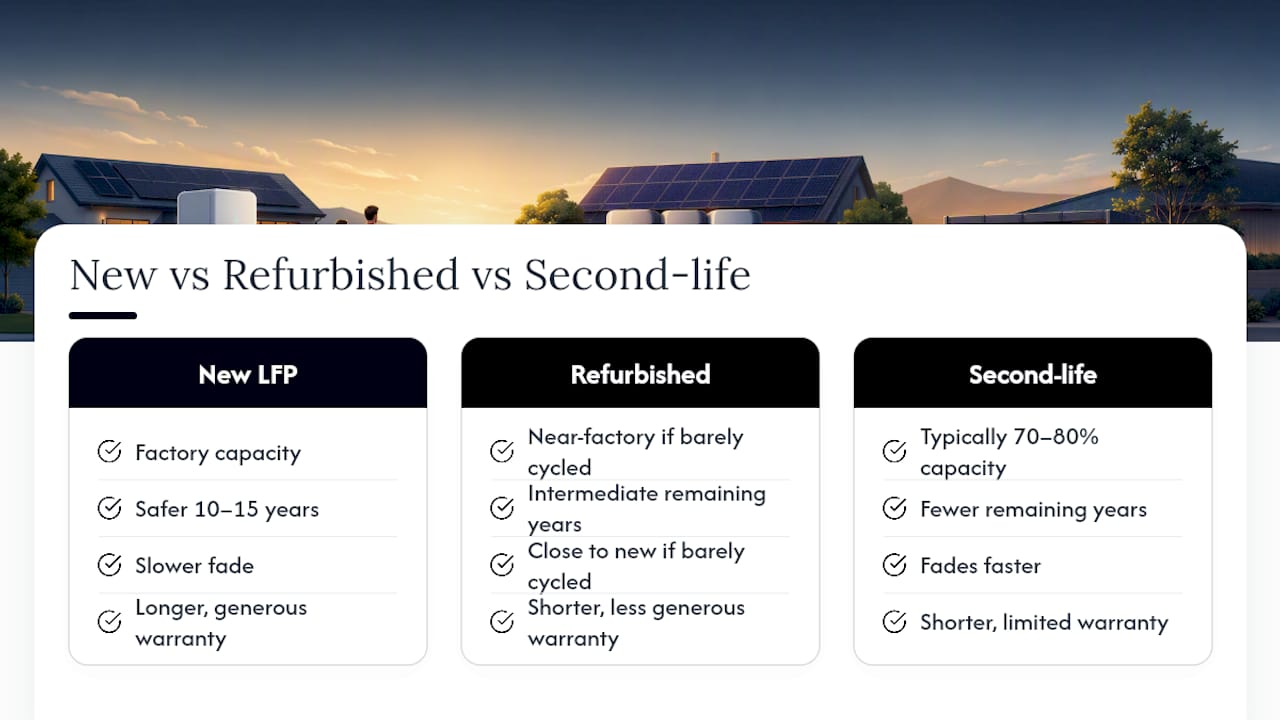
A refurbished or second-life battery is a different product from a new one, and the lifespan gap is real, not marketing spin. Second-life batteries are typically cells pulled from electric vehicles or commercial storage after they’ve already dropped below their original capacity, often already down to 70 to 80% of factory spec before they’re even repurposed for home use.
That head start means a second-life unit generally delivers fewer remaining years of service than a comparable new LFP battery, even when the sticker price looks appealing. The remaining capacity fades faster too, since the battery is starting further along its own degradation curve, closer to the point where internal resistance climbs and performance drops off more steeply.
Refurbished units, meaning new or lightly used cells repackaged after a return or minor defect, sit somewhere in between. If the cells themselves were barely cycled, performance can be close to new. The catch is that warranty terms on refurbished and second-life units are typically shorter and less generous than on a new battery, and finding a company willing to service them years down the line can be harder.
For most homeowners planning a system meant to last 10 to 15 years, a new LFP battery from an established manufacturer remains the safer bet. Second-life storage has a place in the market, particularly for budget-conscious buyers accepting a shorter runway, but it’s not an apples-to-apples swap for a new unit.
What Happens to Solar Batteries at End-Of-Life?
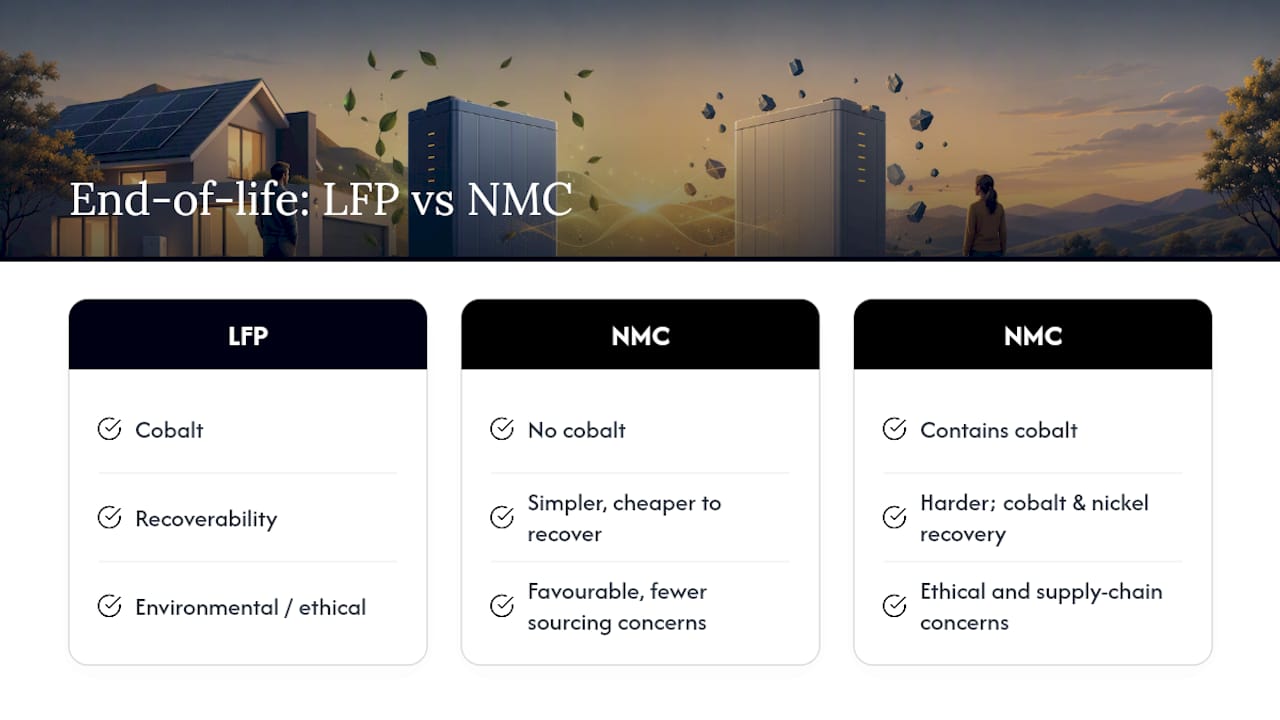
A retired lithium battery doesn’t just go to a landfill, and increasingly, regulations make sure it doesn’t. Lithium-ion batteries contain recoverable materials, including lithium, cobalt, nickel, and copper, that recyclers can extract and feed back into new battery production.
The process generally involves discharging the unit safely, disassembling the enclosure, and processing the cells through either mechanical shredding or hydrometallurgical recovery to separate out the valuable metals. Most manufacturers and installers now have established take-back or recycling partnerships rather than leaving disposal entirely to the homeowner, since improperly disposed lithium cells pose fire and environmental risks.
LFP batteries carry an added environmental upside at end-of-life. They contain no cobalt, which is both a supply-chain and an ethical sourcing concern in battery manufacturing, and their materials are generally simpler and cheaper to recover than NMC cells packed with cobalt and nickel.
For homeowners, the practical takeaway is simple: when it’s time to replace a battery, ask your installer how the old unit will be recycled rather than assuming it’s your problem to solve. A responsible installer should already have that answer ready.
What Do 30 Years in the Field Teach You About Battery Failures?
Most premature battery failures we see aren’t manufacturing defects. They’re installation and commissioning mistakes: a unit mounted in a sealed enclosure with no airflow, a system left on default settings that cycle it too aggressively, or commissioning paperwork that never got filed, which quietly voids warranty coverage nobody realizes is gone until it’s needed.
The fix isn’t complicated, but it does require discipline most installers skip. Every battery we commission gets a documented state-of-health baseline, a firmware log, and proof of warranty registration handed to the homeowner, not buried in a filing cabinet. That paperwork is boring until the day a battery underperforms and you need to prove it happened inside the warranty window.
If your installer can’t produce a commissioning report and a SoH baseline on request, that’s worth asking about before you sign anything. The battery is only half the equation. The installation decisions around it determine whether it hits 8 years or 18.
— Curtis Williamson
Get a Battery System Sized and Installed to Last
There are installers who provide battery sizing and commissioning tailored to each home rather than relying on generic install checklists. Some companies design, engineer, install, and service complete battery systems, including popular models like Tesla Powerwall, Enphase IQ, and Franklin WH, using in-house crews for placement, ventilation, and firmware setup to ensure continuity throughout the warranty period.

Many installations include commissioning documentation and warranty registration to protect coverage if capacity declines prematurely. Experienced companies strive to build systems designed to meet their rated lifespan rather than just pass inspection. If you’re weighing a new battery or planning a replacement, start with a free consultation on battery storage options and get a sizing recommendation built around your actual usage, not a one-size-fits-all default.
Sources
The technical claims in this article draw on EnergySage’s overview of solar battery warranties for capacity-retention standards, NREL/OSTI’s battery degradation modeling for temperature and use-case sensitivity, SurgePV’s chemistry-specific degradation data for LFP versus NMC cycle life and the Arrhenius thermal effect, and PV Magazine’s reporting on typical residential replacement timing.
- How long do solar batteries last? | EnergySage
- Battery Degradation Modeling for Solar 2026: LFP, NMC & Predictions | SurgePV