4–9 Panels Can Power a Home EV: Solar EV Charging for Homeowners
4–9 Panels Can Power a Home EV: Solar EV Charging for Homeowners

Yes. Most homeowners can offset some or all of their EV charging with a residential solar system, and for most of them the right setup is a grid-tied solar array sized to annual driving needs, paired with battery storage or smart charging only when the numbers call for it. Off-grid systems exist but rarely make sense for a typical house. The rest comes down to sizing the array correctly and timing the charge.
TL;DR:
- Most homeowners should size their solar array to their annual driving needs, not just peak usage, and add a battery only if necessary for overnight charging or backup.
- Grid-tied systems are the most practical and cost-effective for residential EV charging, exporting surplus energy to the utility and avoiding costly batteries unless conditions justify it.
- Proper sizing relies on estimating daily energy needs based on vehicle efficiency and mileage, then scaling the array accordingly, usually with 4 to 9 panels.
- Smart charging and scheduling can significantly reduce the required solar capacity, often by a third or more, by aligning charging times with peak solar production.
- The most overlooked factor is charging timing; a modest array combined with disciplined scheduling can outperform larger systems that are charged irregularly or at night.
Table of Contents
- How Solar for EV Charging Actually Works
- What Hardware You Actually Need
- How Do You Size a Solar System for EV Charging?
- Does Smart Charging Really Make a Difference?
- What Does It Cost, and What Incentives Apply?
- What Permits and Code Rules Apply to Solar EV Charging?
- How Do You Prepare for Installation and Vet an Installer?
- Who’s Behind This Guide
- The Overlooked Part of This Whole Equation
- Ready to Design Your Own Solar EV Charging System?
- Sources
How Solar for EV Charging Actually Works
Electricity from your roof doesn’t go straight into your car. It flows through an inverter, into your home’s service panel, and from there either into your EV charger, into a battery, or back onto the grid if you’re producing more than you’re using. That last part, called net export, is what lets grid-tied systems work without a battery at all: the utility acts as your buffer, absorbing extra midday production and returning power when your car is plugged in at 9 p.m.
That’s the core distinction across the three architectures homeowners actually consider.
- Grid-tied: The array feeds your home and exports surplus to the utility. No battery. Simplest, cheapest, and by far the most common configuration for solar EV charging.
- Hybrid (grid-tied plus battery): Adds storage so solar generated at noon can charge your car at midnight, and gives you backup power during an outage.
- Off-grid: No utility connection at all. Requires a battery bank large enough to cover your worst production days, which usually means significant oversizing and cost. It’s a niche fit, mostly for rural properties without utility access, not something most homeowners with an SDG&E meter need to consider.
A global review of EV-PV integration found that pairing EV charging with solar production can cut mobility-related CO2 emissions by roughly 42% to 91%, with the wider end of that range showing up when charging is actively timed to match solar output rather than left to run whenever the car happens to be plugged in.
Grid-tied dominates residential installs for a practical reason: it’s the architecture utilities, code officials, and equipment manufacturers are built around. Permitting is more standardized, inverter options are broader, and you’re not paying for battery capacity you may not need. A research review on solar PV and EV charging infrastructure points to grid-tied systems sized for annual energy needs, with storage added specifically when the vehicle isn’t home during peak solar hours, as the most practical residential approach. That single design principle, size for the year and add a battery only if your schedule demands it, solves most of the decision-making before you even get a quote.
What Hardware You Actually Need
Four components determine whether your solar EV charging setup performs the way you expect: the charger, the inverter, the panels, and, if your schedule calls for it, a battery.
- EV charger level. Level 1 (standard 120V outlet) adds roughly 3 to 5 miles of range per hour, too slow to usefully absorb solar production. Level 2 (240V) delivers 20 to 40 miles per hour and is the practical match for a home solar array. DC fast charging isn’t realistic at a house. It draws more power than most residential services and solar arrays can supply. One technical guide on solar-powered EV charging stations notes that Level 2 is the workable option for nearly every homeowner, with DCFC requiring utility-scale upgrades that make no financial sense for a single household.
- Inverter. This is what converts DC power from your panels into the AC power your home and charger use. Check for UL 1741 listing, which confirms the inverter can safely interconnect with the grid, and ask whether it supports smart-charging communication protocols if you plan to schedule charging around production.
- Battery (optional). Skip it if you charge midday and your commute is short. Add it if you charge overnight, want backup during an outage, or your utility’s export compensation makes storing power more valuable than selling it back.
- Panels, roof, and metering. Your roof’s orientation, shading, and remaining usable area cap how much array you can install, and your utility’s interconnection process determines how exports are metered and credited.
Pro Tip: Get your inverter’s smart-charging compatibility confirmed before you sign a contract, not after. Retrofitting communication features between an inverter and a charger installed a year apart is far more expensive than specifying it up front.
DC-coupled architectures, where the battery sits directly on the DC side of the system, tend to reduce conversion losses and allow a higher panel-to-inverter ratio without clipping. AC-coupled setups are the more practical retrofit when you already have an inverter and don’t want to replace it. A design guide for solar and EV charging integration recommends sizing the EV load first, then the solar array around it, precisely because charger demand tends to be the largest new load added to an existing home’s electrical system.
How Do You Size a Solar System for EV Charging?
Sizing isn’t guesswork. It follows a formula you can run in about five minutes with your car’s efficiency rating and your average daily mileage.
- Estimate daily energy need. Divide your daily miles by your vehicle’s efficiency in miles per kWh. A Tesla Model 3 rated around 4 miles/kWh driving 30 miles a day needs about 7.5 kWh daily.
- Convert to required array size. Divide daily kWh by your region’s average peak sun hours (commonly 5 to 6 hours in sunbelt regions), then divide again by a system efficiency factor of roughly 0.8 to account for inverter losses, wiring, and panel derating.
- Translate kW into panel count. Divide the required array kW by your chosen panel’s wattage, typically 400 to 450 watts per panel for current residential panels.
AAA’s consumer guidance on EV solar charging points to sizing energy need from miles driven and vehicle efficiency as the simplest and most accurate homeowner method, and that same guidance estimates roughly 7 to 12 panels can cover typical EV charging needs depending on the vehicle and driving habits.
Example A: The 30-mile commuter. At 4 mi/kWh, that’s 7.5 kWh/day. Divide by 5.5 peak sun hours and 0.8 efficiency, and you land at roughly 1.7 kW of added array, or about 4 panels at 400 watts each. That’s a small addition to an existing system, and most homeowners with a mid-sized array already have the headroom without expanding their roof footprint.
Example B: The 60-mile driver charging in the evening. Double the mileage roughly doubles the daily energy need to about 15 kWh, pushing the array requirement to roughly 3.4 kW, or 8 to 9 panels. But because this driver charges after work, well outside peak solar hours, none of that midday production reaches the car directly unless it’s stored. This is the scenario where a battery stops being a luxury and starts being the piece that actually makes the math work: without one, the solar production either exports to the grid at whatever your utility credits, or the charging session simply draws grid power instead of solar.
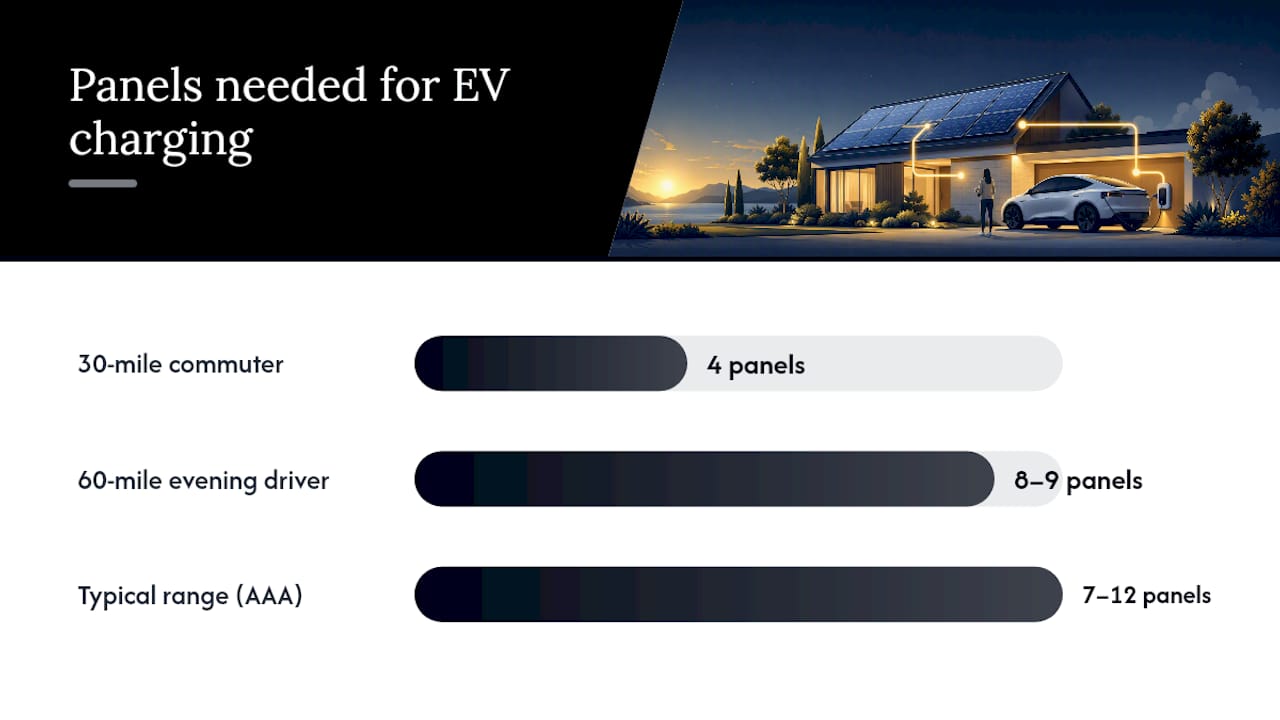
Seasonal swings matter here too. A system sized to your summer production will underperform in December, so the right target is annual offset, not a guarantee that every charging session runs on real-time sunshine. SolarX Energy’s sizing guidance for future EV loads walks through the same daily-kWh-to-array-size logic and is worth a look if you want to run the numbers yourself before a consultation.
Does Smart Charging Really Make a Difference?
It makes a bigger difference than most homeowners expect. Charging on a fixed schedule that ignores what your panels are actually producing wastes a meaningful share of your system’s potential.
- Charger scheduling lets you set your Level 2 unit to start charging at 11 a.m. instead of 7 p.m., catching peak solar output instead of missing it entirely.
- Smart-inverter control can throttle or ramp charging based on real-time production, avoiding the situation where your car pulls from the grid while your panels are exporting excess power at the same moment.
- Automatic Load Management Systems (ALMS) matter most in homes with multiple high-draw circuits or more than one EV charger, balancing demand so nothing trips a breaker or forces a service upgrade.
The IEA PVPS 2026 executive summary found that aligning charging schedules with solar output through smart charging strategies can reduce required PV capacity by a third or more compared with unmanaged, plug-and-charge sizing. That’s a meaningful gap. It means two homeowners with identical driving habits could need noticeably different array sizes based purely on whether their charging is scheduled or left random.
Time-of-use rates change the calculation further. If your utility charges a premium during evening peak hours, charging midday on solar production isn’t just greener, it’s the cheaper option outright, even before accounting for exports. Overnight charging on off-peak grid rates can still beat evening solar in some rate structures, so it’s worth checking your actual tariff rather than assuming solar always wins.
Pro Tip: If your car is rarely home before 6 p.m., don’t oversize your solar array chasing a “charge on sunshine” ideal. Size the array for annual offset, add a modest battery if the math supports it, and let smart scheduling handle the rest.
Vehicle-to-grid and vehicle-to-home technology, where your EV’s battery can push power back into your house or the grid, is real but still early. A handful of vehicles and chargers support it today, and it’s worth watching, but it isn’t yet a mainstream planning assumption for most homeowners designing a system this year.
What Does It Cost, and What Incentives Apply?
The array increment needed to meaningfully offset EV charging, roughly 4 to 9 panels in the examples above, is a modest addition on top of a typical home solar system, though exact installed cost depends heavily on your equipment choices, roof complexity, and regional labor rates.
- The 30% federal solar tax credit applies to solar panels, battery storage, and installation labor, and it’s current policy as of 2026. Confirm eligibility details at the time of purchase since credit terms can shift.
- Annual savings come from the grid kWh you avoid buying at retail rates. A homeowner offsetting 7.5 kWh/day of EV charging at a typical residential rate saves a predictable, calculable amount every year, and that number scales directly with both electricity prices and driving distance.
- Batteries change the payback math. They add upfront cost but increase the share of solar-sourced charging for anyone who charges outside peak sun hours, and they add outage backup value that’s hard to price into a simple payback calculation.
- Public and workplace charging are worth factoring in if you drive high mileage. Offsetting a portion of your charging away from home changes how much home array you actually need.
The MDPI global review on EV-PV coupling frames the economic case plainly: charging costs drop when sessions are synchronized with solar production, and that synchronization is where the real savings live, not just in owning panels. San Diego Solar’s prepaid lease program is one route homeowners here use to reduce upfront cost while still qualifying for the federal credit on the full system.
What Permits and Code Rules Apply to Solar EV Charging?
The National Electrical Code treats EV charging as a continuous load under Article 625, which affects how your electrician sizes the circuit and conductors feeding your charger. In practice, this means your permit package needs to account for that load classification alongside your solar interconnection, not as two separate afterthoughts bolted together.
- A single-line diagram is the document your Authority Having Jurisdiction (AHJ) will scrutinize most closely. It needs to show solar disconnects, inverter labeling, and the EV charger connection reconciled on one coherent drawing.
- Equipment should carry the relevant UL listings, UL 1741 for inverters and appropriate listings for EVSE equipment, since AHJs generally reject submittals citing unlisted hardware.
- ALMS can, in many residential retrofits, help avoid a costly electrical service upgrade by managing simultaneous demand from multiple loads rather than requiring the panel to support the theoretical maximum draw of everything running at once. Whether that applies to your specific home depends on your existing service size and your AHJ’s interpretation, so treat it as a question for your installer, not a guarantee.
- Final inspection and Permission to Operate (PTO) from your utility are the last steps before your system is live, and incomplete documentation is the single most common cause of delay.
A Solar Permit Solutions breakdown of real-world permitting friction found that incomplete single-line diagrams, ones that fail to reconcile the solar and EVSE connections on the same drawing, are a recurring cause of rejected submittals. A PE-stamped plan set tends to prevent the back-and-forth that otherwise adds weeks to a timeline.
Pro Tip: Ask your installer directly whether they’ve secured EV-charging permits with your specific city or county before. Some jurisdictions have quirks around combined solar-plus-EV submittals that a generalist electrician who’s never filed one will learn on your project’s timeline, not before it.
San Diego Solar’s guide on how solar permits protect homeowners covers what a complete, code-compliant package should include if you want to see the documentation standard before you’re staring at a contract.
How Do You Prepare for Installation and Vet an Installer?
Before you get quotes, walk your own site with a checklist. Note your roof’s age, orientation, and any shading from trees or neighboring structures. Check your electrical panel’s current capacity and whether it has room for a new circuit. Decide where the EV charger will physically mount relative to where your car parks, since driveway layout affects conduit runs and labor cost. Track your actual charging habits, when you plug in and how often, for a couple of weeks if you don’t already know them; that data is what a legitimate installer will ask for before recommending a system size.
When quotes come in, they should include specific deliverables, not just a price:
- A single-line diagram showing the full solar-to-EVSE interconnection, not a generic solar-only drawing.
- Complete equipment specifications, brand, model, and warranty terms for panels, inverter, and charger.
- A written project timeline covering permitting, installation, and inspection milestones.
- Clear disclosure of whether the crew doing the work is in-house or subcontracted.
Ask pointed questions during the sales process: How many EV-integrated systems has this installer permitted with your specific AHJ? What’s their NEM 3.0 strategy for maximizing self-consumption rather than relying on exports? Do they perform their own structural roof analysis, or outsource it? Who’s actually pulling the electrical permit? What’s their change-order policy if the site reveals a complication mid-install? San Diego Solar’s list of 15 questions to vet a solar company’s experience covers this ground if you want the full interview script.
Red flags are consistent across the industry: no PE-stamped plans, subcontracted crews with no accountability chain, no written timeline, or warranty language that’s vague about what’s actually covered. Any one of these should make you ask harder questions before signing. San Diego Solar’s own take on what makes a solar installer trustworthy walks through the same red-flag list from the other side of the table.
Who’s Behind This Guide
This guide was written by Curtis Williamson for San Diego Solar, a company that’s been designing and installing residential solar systems in San Diego County since 1996.
San Diego Solar pulled the first commercial solar permit issued in the City of San Diego, at the OB People’s Food Co-Op, and has completed thousands of installations since. That continuity matters for EV charging integration specifically: a system installed today needs to interconnect cleanly with permitting standards, utility interconnection rules, and equipment that will still be supported a decade from now.
The company’s engineering team designs every system around the homeowner’s actual roof, usage, and goals rather than a standardized template, and handles permitting, SDG&E interconnection, and HOA approval directly.
The Overlooked Part of This Whole Equation
Most advice on solar EV charging focuses on the wrong number. Homeowners fixate on panel count, when the variable that actually determines whether solar meaningfully powers their car is when they charge, not how many panels sit on the roof.
I’d argue the conventional advice undersells smart charging and oversells battery capacity. A modest array with disciplined midday scheduling will often outperform a bigger array charging blind at 9 p.m. That’s not intuitive, and it’s not what most sales conversations lead with, because a bigger system is an easier sell than a smarter one.
If you take one thing from this guide, prioritize sizing for your annual driving pattern first, then decide on a battery based on your actual schedule, not on a worst-case fear of the grid going down. Get the permitting and code side handled by people who’ve filed EV-integrated permits before. That’s where DIY research runs out of runway, and where experience actually earns its cost.
— Curtis Williamson
Ready to Design Your Own Solar EV Charging System?
San Diego Solar is the installer to call when you want a system engineered around your actual driving habits, not a generic panel count pulled from an online calculator. Where most quotes hand you a spreadsheet and leave the permitting, interconnection, and code compliance for you to sort out, San Diego Solar’s in-house engineering team designs the solar array, battery, and EV charger integration as one coherent system, then handles the entire permit package, SDG&E interconnection, and HOA approval directly, with zero subcontractors touching your roof or panel in 30 years of doing this work.

If you’re weighing a moderate commuter setup against a battery-backed system for evening charging, a free consultation is the fastest way to get real numbers instead of rough estimates. San Diego Solar’s prepaid lease program can lower upfront costs by 30% to 40% while the system still qualifies for the full federal tax credit. Start with a solar installation consultation and get a written project timeline before you commit to anything.
Sources
- Benefits of Coupling Electric Vehicle Charging with Photovoltaic Electricity Production: A Global Overview
- IEA-PVPS: PV charging stations executive summary (2026)
- Charging your EV with solar panels — AAA (2025)
- Integration of Solar PV Panels in Electric Vehicle Charging Infrastructure: Benefits, Challenges, and Environmental Implications