CPUC Alternatives for San Diego Solar Homeowners
CPUC Alternatives for San Diego Solar Homeowners

For San Diego homeowners going solar in 2026, the most useful resources beyond www.cpuc.ca.gov are: SDG&E’s interconnection and rate pages, the California Energy Commission (CEC), DSIRE (Database of State Incentives for Renewables & Efficiency), CALSSA (California Solar & Storage Association), the Contractors State License Board (CSLB), and your local city or county building permit portal. Each one covers a gap the CPUC site doesn’t fill directly.
Here’s where each fits:
- SDG&E rate and interconnection pages — confirm your rate plan (EV-TOU-5 for solar + EV households), check interconnection timelines, and verify activation status
- CEC — statewide building standards, appliance efficiency rules, and solar policy context
- DSIRE — the first stop for current state, local, and utility incentives including SGIP battery rebates
- CALSSA — industry association for vetted California solar contractors and market guidance
- CSLB — verify any installer’s license (C-46, C-10, or B classification) and search complaint history before signing anything
- City of San Diego / County PDS permit portals — pull permit status, submit SolarAPP+ applications, and schedule inspections
- San Diego Solar — local installer handling permitting, SDG&E interconnection, and NEM 3.0 battery-first system design since 1996
One item the CPUC site does own outright: the Solar Consumer Protection Guide (version 4), which every California homeowner must receive and sign before a residential solar contract is finalized. That document is non-negotiable regardless of which other resources you use.
Table of Contents
- 1. Where each alternative resource actually helps you
- 2. What the CPUC Solar Consumer Protection Guide (v4) actually requires
- 3. How NEM 3.0 changes the math for SDG&E customers
- 4. How to vet a solar installer using these resources
- 5. Red flags and what to do when something goes wrong
- 6. San Diego–specific steps from contract to activation
- Key Takeaways
- What the current San Diego market actually looks like
- San Diego Solar: in-house engineering, battery-first systems, and 30 years of local installs
- Useful sources and where to go next
1. Where each alternative resource actually helps you
These California utility commission options and energy regulator alternatives each serve a specific job. Knowing which to open first saves real time.

| Resource | Primary Use Case | When to Use It |
|---|---|---|
| SDG&E Interconnection Portal | Interconnection application, PTO status, rate plan selection | Before signing a contract; after install |
| California Energy Commission (CEC) | Statewide solar standards, Title 24 code references | When reviewing system specs or code questions |
| DSIRE | State + federal + utility incentives, SGIP eligibility | Early in the quoting process |
| CALSSA | Contractor directory, industry standards | When shortlisting installers |
| CSLB | License verification, complaint filing | Before signing; if problems arise |
| City of San Diego / County PDS | SolarAPP+ permit submission, inspection scheduling | During permitting phase |
| CPUC Solar Guide (v4) | Required pre-contract disclosure | Must be signed before any contract |
Pro Tip: Check DSIRE before your first installer meeting. Knowing your SGIP eligibility and any active local rebates can change how you evaluate battery sizing proposals — and it takes about ten minutes.
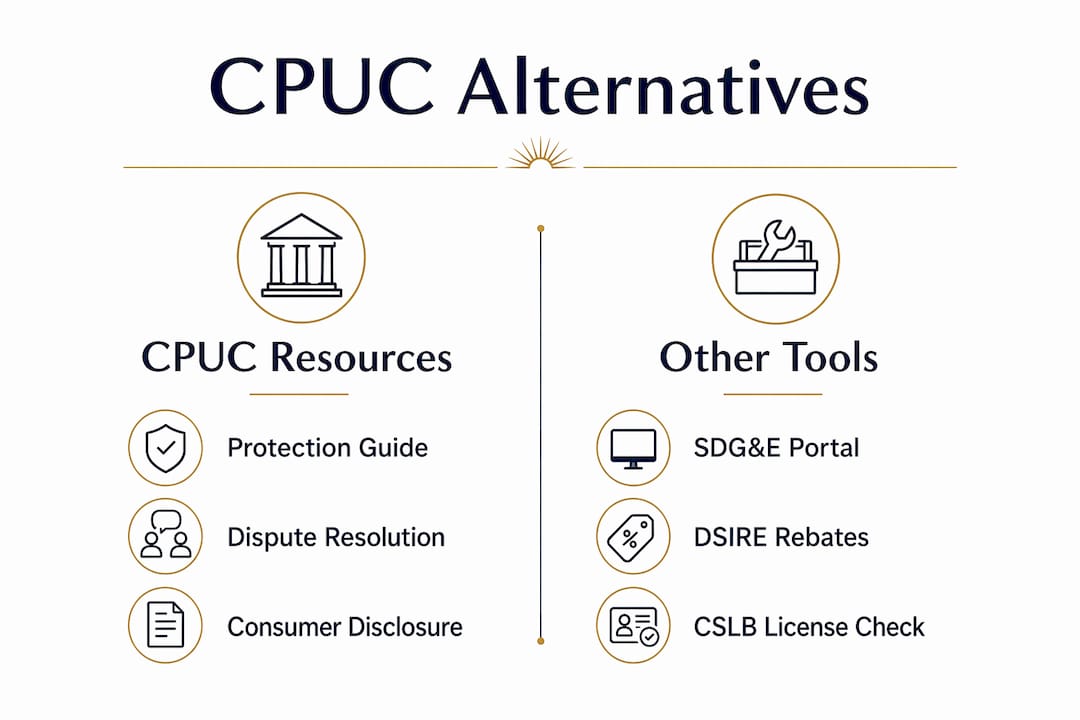
The CPUC site is the authority for the required consumer disclosure and for regulated utility disputes. The alternatives above handle everything operational: permits, incentives, licensing, and interconnection timelines. You’ll use both, but for different reasons.
2. What the CPUC Solar Consumer Protection Guide (v4) actually requires
The CPUC Solar Consumer Protection Guide is a government-mandated disclosure, not optional reading. SDG&E customers must sign it before their installer can proceed with interconnection.
What the guide covers:
- Your right to receive bids from at least three solar providers
- How to verify a CSLB license number (C-46, C-10, or B classification) at cslb.ca.gov
- Required contract documents: Solar Energy System Disclosure Document, the contract itself, and financing paperwork
- Cancellation rights and dispute resolution pointers
- A link to the CPUC’s Public List of Non-Compliant Solar Providers
| Action | Why It Matters |
|---|---|
| Request your signed copy | You need it for warranty claims and dispute resolution |
| Read the disclosure document | It lists system size, production estimates, and financing terms |
| Check the non-compliant provider list | Filters out flagged contractors before you commit |
| Retain all three contract documents | Required if you ever file a CSLB or CPUC complaint |
Keep a physical and digital copy. If an installer rushes past the guide or discourages you from reading it, that alone is a reason to walk away.
3. How NEM 3.0 changes the math for SDG&E customers
Under the Net Billing Tariff that replaced NEM 2.0 in April 2023, exported solar energy earns roughly $0.05–$0.08/kWh via the CPUC Avoided Cost Calculator. SDG&E retail rates regularly exceed $0.40/kWh, with peak TOU rates topping $0.55–$0.60/kWh.
That gap is the whole story. Every kilowatt-hour you export earns a fraction of what you’d have paid to import it an hour later. The practical consequence: panels alone are a weaker investment than they were under NEM 2.0. Batteries change that equation by shifting daytime production into the evening peak window.
Payback comparison (San Diego, 2026 SDG&E rates): Solar + battery storage: approximately 7–9 years Solar-only: approximately 12–15 years
Homeowners with EVs can push that further. Pairing solar, a battery, and smart EV charging on an EV-TOU-5 rate plan can significantly reduce payback times for many homeowners in San Diego.
SGIP battery rebates can also reduce out-of-pocket costs materially. Standard-tier rebates provide financial incentives per kWh installed; equity-tier rebates offer substantially higher incentives for income-qualified households. Check DSIRE or ask your installer to run SGIP eligibility before you finalize battery sizing.
Pro Tip: Adding more panels without storage under NEM 3.0 mostly increases low-value exports. The real ROI levers are battery kWh capacity and energy-management software that shifts daytime production to cover evening use. Learn more about NEM 3.0 self-consumption strategy before your first proposal.
4. How to vet a solar installer using these resources
A solid installer checklist pulls from several of the alternatives above, not just the CPUC guide.
- Request the signed CPUC Solar Consumer Protection Guide (v4) before any contract discussion.
- Verify the CSLB license at cslb.ca.gov — confirm C-46, C-10, or B classification is active and complaint-free.
- Confirm proof of insurance — general liability and workers’ compensation, current certificates.
- Ask about crew structure — in-house crews vs. subcontractors affects accountability and warranty continuity.
- Review the engineering package — written one-line diagrams, shading analysis, and production modeling.
- Confirm permit handling — SolarAPP+ submission for qualifying systems under 15 kW in the City of San Diego; county PDS for unincorporated areas.
- Check manufacturer warranties — panels and batteries should carry warranties up to 25 years; verify the installer will still be around to honor them.
- Ask for NEM 3.0 modeling — the proposal should show self-consumption rate, battery dispatch schedule, and rate-plan recommendation (EV-TOU-5 if you have or plan an EV).
- Confirm SGIP eligibility check — a good installer runs this before finalizing battery sizing.
- Get a written project timeline — from permit submission through SDG&E activation.
Pro Tip: Ask specifically whether the installer uses battery storage options sized to your evening load, not just a default 10 kWh unit. Undersized batteries leave peak-rate exposure on the table.
Understanding battery backup ROI before your first proposal helps you ask sharper questions about sizing and dispatch settings.
5. Red flags and what to do when something goes wrong
Watch for these warning signs:
- Pressure to sign before you’ve read the CPUC guide
- Vague scope of work with no itemized contract
- No permit pulled or permit “handled later”
- Unexplained subcontractors with no license verification
- Unusually low bids with no engineering documentation
- Warranties that reference a third party you can’t verify
“The cheapest bid is not necessarily the best option for you. A very low bid may indicate that a solar provider is trying to cut corners.” — CPUC Solar Consumer Protection Guide (v4)
If problems arise, here’s who handles what:
- CSLB — licensing violations, contractor fraud, workmanship disputes
- Local building department — permit failures, inspection holds, unpermitted work
- SDG&E — interconnection delays, activation issues, billing disputes on the utility side
- CPUC — regulated utility complaints (SDG&E billing, tariff application errors)
Document every communication in writing. A paper trail is what makes a CSLB complaint actionable.
6. San Diego–specific steps from contract to activation
Here’s the realistic local timeline once you’ve signed a contract with a vetted installer.
| Step | Who Handles It | Typical Duration |
|---|---|---|
| SolarAPP+ permit (standard systems under 15 kW) | Installer + City of San Diego | 1–3 business days |
| Manual plan check (complex systems, county PDS) | Installer + jurisdiction AHJ | 7–15 business days |
| Installation | Installer crew | 1–2 days |
| Local inspection | City/county inspector | 3–7 business days |
| SDG&E technical review | SDG&E | 10 business days |
| SDG&E activation (PTO) | SDG&E | 5–10 business days post-inspection |
| Total (no delays) | ~8–10 weeks |
Permit fees vary by jurisdiction. The City of San Diego uses SolarAPP+ for qualifying residential systems, which dramatically compresses the approval window. Unincorporated county areas go through the County PDS and typically run longer.
Pro Tip: Choose an installer who manages both the permit submission and the SDG&E interconnection application in-house. Handoffs between separate permit expediters and installers are where timelines slip.
Key Takeaways
For San Diego homeowners, the most effective approach is to use CPUC’s required disclosure as a baseline, then layer in the operational alternatives — DSIRE, CSLB, SDG&E, and local permit portals — to cover every step from incentives to activation.
| Point | Details |
|---|---|
| CPUC guide is mandatory | Sign version 4 before any contract; keep your copy for warranty and dispute use. |
| Battery-first economics | NEM 3.0 export rates (~$0.05–$0.08/kWh) make storage the primary ROI lever in San Diego. |
| Verify CSLB license first | Confirm C-46, C-10, or B classification is active at cslb.ca.gov before signing. |
| Check DSIRE early | SGIP rebates vary by tier and can change battery sizing and payback math. |
| San Diego Solar | Handles in-house engineering, permitting, SDG&E interconnection, and NEM 3.0 battery-first design across San Diego County. |
What the current San Diego market actually looks like
The CPUC guide, DSIRE, and CSLB are all useful tools. But the homeowners who get the best outcomes in San Diego right now are the ones who treat battery sizing as the central design decision, not an add-on. Under NEM 3.0, a solar system without storage is essentially a daytime appliance that exports cheap energy and then buys it back at peak rates after 4 PM. The math on that is hard to make work in 7 years.
What I see consistently is that the projects with the shortest payback periods are the ones where the installer modeled the homeowner’s actual evening load, sized the battery to cover it, and put them on the right TOU rate. That’s not a complicated insight, but a surprising number of proposals still skip it. The other variable that matters more than most homeowners expect is whether the installer will still be around in year 10 to service the system. Manufacturer warranties up to 25 years are only as good as the company backing the installation.
San Diego Solar: in-house engineering, battery-first systems, and 30 years of local installs
San Diego Solar has handled residential solar in San Diego County since 1996, with 100% in-house crews and zero subcontractors across every project. Every system is custom-engineered for your roof, your SDG&E rate plan, and your evening load profile — with NEM 3.0 battery-first design built into every proposal from the start.
A free consultation includes a full rate analysis, NEM 3.0 production modeling, SGIP eligibility check, and a written permit and interconnection timeline before you commit to anything. San Diego Solar manages SolarAPP+ submissions, SDG&E interconnection, and HOA approvals in-house, so nothing falls through the cracks between steps.
Get a free solar estimate from San Diego’s longest-running residential installer — one company, one crew, backed by manufacturer warranties up to 25 years.
Useful sources and where to go next
Official disclosures and regulatory resources:
- CPUC Solar Consumer Protection Guide (v4) — required pre-contract disclosure; read before signing anything
- CPUC Net Billing Tariff page — NEM 3.0 rules, Avoided Cost Calculator, and tariff comparisons
- SDG&E Solar page (sdge.com/solar) — rate plan options, interconnection application portal, SGIP rebate information
- California Energy Commission (energy.ca.gov) — Title 24 building standards, statewide solar policy
- DSIRE (dsireusa.org) — check current state, local, and utility incentives including SGIP tiers
- CALSSA (calssa.org) — California Solar & Storage Association; contractor directory and industry standards
- CSLB (cslb.ca.gov) — verify installer license (C-46, C-10, or B), search complaints, call 800-321-2752
- City of San Diego Development Services — SolarAPP+ permit portal for residential systems under 15 kW
- San Diego County PDS — permit applications for unincorporated county areas
Match each resource to your task:
- Incentives and rebates → DSIRE first, then SDG&E’s SGIP page
- License check before signing → CSLB
- Interconnection timeline and rate plan → SDG&E solar portal
- Permit submission → City of San Diego (SolarAPP+) or County PDS
- Required pre-contract disclosure → CPUC Solar Consumer Protection Guide (v4)
- Contractor complaint → CSLB; utility billing dispute → CPUC
Save your signed CPUC guide alongside your contract. Confirm your SDG&E rate plan selection with your installer before activation — switching rate plans after the fact is possible but adds delay.