Rock & Torch-Down Roof Replacement
Permanent Roof Replacement for
Rock & Torch-Down Roofs
Old tar-and-gravel or torch-down roof in San Diego? Here are the permanent options that actually last — and why to handle the roof before your solar goes on.
The short answer
Yes — you can replace an old rock (tar-and-gravel) or torch-down roof with a permanent, single-ply membrane like TPO or PVC. In the right conditions a new membrane goes over one sound existing layer; if there are already two layers, trapped moisture, or loose gravel, a tear-off is required. Planning solar? Re-roof first — it’s far cheaper than removing panels later.
Why Homeowners Choose One Licensed Team
One Licensed Company
We’re a licensed roofer and solar installer (CSLB #970079, C-39 / C-10 / C-46) — no juggling two contractors who blame each other.
Roof + Solar, One Warranty
Your new roof and solar array are covered under a single combined warranty, so nothing falls through the cracks between trades.
In-House Crews Only
Every roof and every panel is installed by our own crews — never subcontractors — so quality and accountability stay under one roof.
Re-Roof Once, Solar Once
We size your new membrane to match your solar array’s 25–30 year life, so panels never have to come off for a roof job you could have done first.
Permanent Flat-Roof Options
Old rock and torch-down roofs fail the same way in San Diego’s climate: ponding water, UV breakdown, blistering, and gravel or granule loss let moisture into the layers below. The permanent fix is a modern low-slope system. Here are the real options, what they cost, and how each one works with solar.
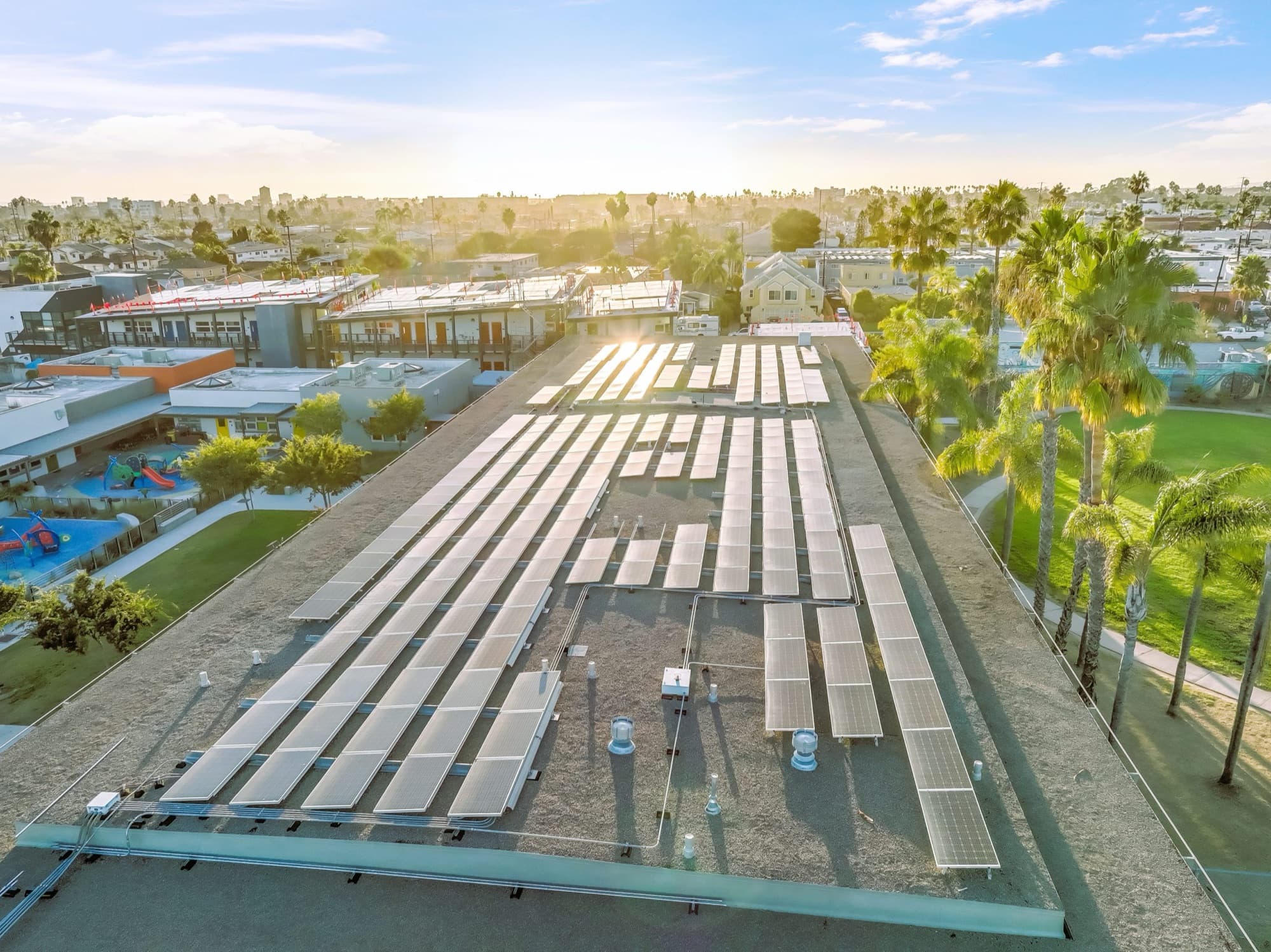
TPO single-ply membrane
A heat-welded white membrane, the most popular flat-roof choice today. Seams are welded rather than glued, so there are no adhesive joints to fail.
Solar fit: Excellent. Its bright white surface is a natural cool roof that reflects heat, and panels mount with low-penetration or ballasted racking that keeps the membrane watertight.
Bottom line: Best all-around value for a San Diego home going solar — long life, cool-roof energy savings, and a clean surface to mount on.
PVC single-ply membrane
A premium welded membrane, chemically similar to TPO but tougher against grease, chemicals, and long-term weathering. Old PVC also re-welds to new PVC years later, making future repairs easier.
Solar fit: Excellent — the same cool-roof and mounting advantages as TPO, with the longest membrane life to match or outlast your panels.
Bottom line: A step up from TPO when you want maximum lifespan and durability, especially near the coast.
Modified bitumen (new SBS)
A modern asphalt-based membrane in reinforced rolls — the current, engineered version of the old torch-down roof, far more durable than what it replaces.
Solar fit: Good, but it’s a darker, heat-absorbing surface unless a reflective cap sheet or coating is used, so it’s less cool-roof than TPO or PVC.
Bottom line: The budget-friendly, walkable option — a solid choice when cost matters more than squeezing out every energy-savings dollar.
Tear-off & replace
Full removal of the old roof down to the deck, then a brand-new membrane. Required by code when the roof already has two layers, is water-soaked, or is deteriorated — and the practical choice for most old rock/gravel roofs, where loose gravel must come off anyway.
Solar fit: The best possible starting point — a clean deck and fresh membrane give panels the longest worry-free life.
Bottom line: The most thorough, longest-lasting path, and often the only code-compliant one for aged rock or torch-down roofs.
Recover / overlay
Installing a new membrane (usually over a cover board) on top of a single, sound, dry existing layer — no full tear-off. This is the TPO-over-your-existing-roof approach, and it’s legitimate when conditions allow.
Solar fit: Good, provided the base below is genuinely sound — solar racking will rely on it.
Bottom line: Faster and cheaper, but only if there’s just one existing layer, no trapped moisture, and code permits it. We confirm with an inspection first.
| Option | Typical lifespan | Rough installed cost* | Best for |
|---|---|---|---|
| TPO membrane | 15–30 yrs (commonly 20–25) | ~$7–$12 / sq ft | Cool-roof savings + solar; best all-around value |
| PVC membrane | 20–30+ yrs | ~$8–$14 / sq ft | Longest membrane life; coastal / chemical resistance |
| Modified bitumen (new) | 15–25 yrs | ~$4.50–$8 / sq ft | Budget builds; walkable, familiar system |
| Tear-off & replace | Matches new membrane | Membrane + ~$1–$3 / sq ft removal | 2+ existing layers, moisture, or gravel/rock roofs |
| Recover / overlay | Matches new membrane | Saves ~$1–$2 / sq ft vs tear-off | One sound, dry layer where code permits |
*Planning ranges from 2025–2026 national installed-cost data; San Diego coastal labor tends toward the higher end. A typical single-story ~1,500 sq ft low-slope roof lands roughly $7,000–$12,000 (modified bitumen), $10,000–$18,000 (TPO), or $12,000–$21,000 (PVC). Your exact price depends on roof size, condition, and access — we quote after an inspection.
Not sure whether your roof needs a tear-off or can be recovered?
We’ll inspect your rock or torch-down roof, tell you honestly what it needs, and quote the permanent options — no pressure.
Why Re-Roof Before Solar
The industry rule is simple: if your roof doesn’t have at least 10–15 years of life left, replace it before the panels go on. A rock or torch-down roof that’s already 20+ years old almost never clears that bar. Put panels on a roof that’s near the end, and you’ll be paying to take them back off long before they’ve paid for themselves.
Here’s the math homeowners miss. Removing and reinstalling an existing solar array to re-roof underneath costs roughly $200–$300 per panel — about $2,800–$4,800 for a typical 15-panel system, with most homeowners paying around $3,800. That’s pure avoidable cost: money spent moving panels, not improving your home. Re-roof first and you pay for the roof once and the solar once.
Solar panels are built to produce for 25–30 years. A quality TPO or PVC membrane is engineered to last just as long. When we install both, we match them on purpose — one roof, one array, one lifespan — so your panels never have to come off for a roof repair you could have handled up front. Doing it in the wrong order is the single most expensive mistake in residential solar.
How Our Roof-to-Solar Process Works
Free Roof & Solar Assessment
We inspect your existing rock or torch-down roof, check how many layers are on it, probe for trapped moisture, and evaluate the deck — then tell you honestly whether you need a tear-off or can recover.
Material Recommendation
Based on what we find, your budget, and your solar plans, we recommend the right system (TPO, PVC, or modified bitumen) and explain the trade-offs in plain terms — no upselling.
Permits & Code
We pull the San Diego permit when one is required and make sure the job meets California code, including Title 24 cool-roof rules that apply to any reroof covering 50% or more of the roof.
Roof Installation
Our in-house crew removes or preps the old roof and installs your new welded membrane — flashings, drains, and penetrations done right, built as a clean, watertight base for panels.
Solar-Ready (or Full Solar)
We hand you a roof engineered to carry solar, or install the array ourselves in the same project — all under one combined roof-and-solar warranty, from one licensed company.
What Do San Diego Customers Say?
“Brad and Dirk are the kind of pros that make San Diego a great place. Friendly, know their craft well, not flashy. Went so well I worked with them to expand the original system later on.”
Brian K.
Google review · 2026
“Reasonable price. Dirk and his team are true professionals who know their business well. I look forward to working with them again.”
Kalman Zsamboky
Google review · 2025
“They have free coffee and anything you need to do solar or other electrical products at unbeatable prices.”
Sean G.
Google review · 2025
Rock & Torch-Down Roof FAQs
Often yes, if the torch-down is a single, sound, dry layer — a new membrane can be installed over a cover board without a full tear-off. But if there are already two layers, trapped moisture, or blistering and deterioration, California residential code requires a complete tear-off first. We confirm which applies with an inspection before quoting.
Almost always, yes. Rock (tar-and-gravel) roofs that are 20+ years old rarely have the 10–15 years of remaining life solar needs. Replacing first avoids paying roughly $2,800–$4,800 later to pull the panels off and reset them for a re-roof. It is cheaper to do the roof once, then mount solar on a fresh surface.
A well-installed TPO roof lasts about 15–30 years, commonly 20–25. San Diego’s marine layer, salt air, and year-round UV are hard on flat roofs, but TPO’s welded seams and reflective surface hold up well — and pairing installation with proper drainage prevents the ponding water that kills older systems.
It depends on what is already up there. An overlay (recover) is allowed over one sound, dry layer. A tear-off is required when the roof has two or more existing layers, is water-soaked, or has deteriorated below a usable base — that is California code, not a sales pitch. Most aged gravel roofs need at least the loose rock removed regardless.
For a typical 1,500 sq ft low-slope roof, expect roughly $7,000–$12,000 for modified bitumen, $10,000–$18,000 for TPO, or $12,000–$21,000 for PVC. Coastal labor runs higher, and price depends on roof size, condition, layers, and access. We give a firm number after inspecting — these are planning ranges, not a quote.
Usually yes for a full replacement. San Diego doesn’t require a permit for a simple like-for-like covering renewal that doesn’t touch the roof structure, but a permit is required when framing, decking, or structural elements are altered — and Title 24 cool-roof rules apply when you replace 50% or more of the roof. We handle the permitting.
Both are excellent under solar — welded, long-lasting, and bright white for cool-roof energy savings. TPO is the better value and the most popular choice; PVC costs a bit more but lasts longer and resists chemicals and coastal weathering. Either gives panels a clean, watertight base with low-penetration or ballasted mounting.
Because the roof and the panels are one system. When a licensed roofer and solar installer (that’s us — CSLB #970079, C-39/C-10/C-46) does both, you get one crew, one combined warranty, and no finger-pointing if there’s ever an issue. Split the work between two contractors and a leak becomes an argument.
Ready to Go Solar?
Get Your Free Custom Quote.
Save 30–40% with our prepaid lease program. These programs won't last forever.